Schrödinger's Cat and Gravity-Induced Decoherence

scitechdaily physics quantum-mechanics general-relativity gravity

Riepilogo

Immagine Copertina Mappa Mentale
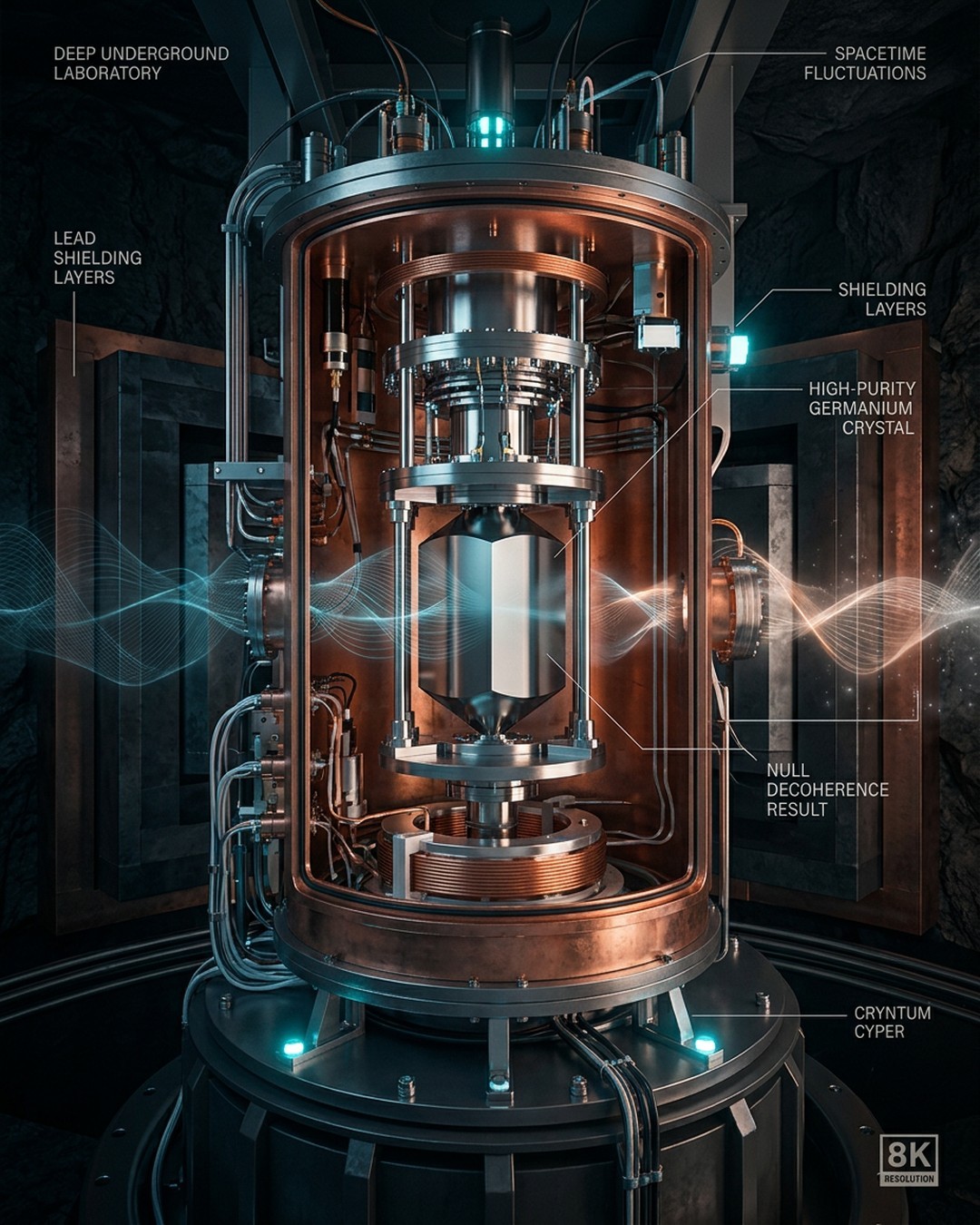
Immagine Copertina Generata da AI

Scientists have recently ruled out a 60-year-old physics theory proposed by Frigyes Károlyházy, which suggested that constant fluctuations in spacetime cause quantum decoherence and destroy quantum superpositions in macroscopic objects. Researchers from the VIP Collaboration at INFN-LNF conducted an underground experiment at the INFN Gran Sasso National Laboratory using a high-purity germanium crystal over a 62-day measurement period. The primary objective of the experiment was to detect faint electromagnetic radiation that electrically charged particles would theoretically emit if Károlyházy's gravity-induced decoherence model were accurate. After accounting for background radiation, the researchers found no trace of the predicted signal, thereby excluding this specific model and establishing rigorous new constraints on gravity-induced decoherence theories. While this specific hypothesis was disproven, the finding does not completely eliminate the possibility that gravity plays a role in quantum decoherence. The results narrow the search parameters for a unified theory connecting general relativity with quantum mechanics, demonstrating that precision physics experiments can now test once-speculative theoretical concepts. The study's conclusions advance the field of fundamental physics by pushing the boundaries of what can be tested experimentally, bringing researchers closer to understanding the interplay between gravity and quantum mechanics. Future sensitivity improvements in similar precision instruments will likely continue to test remaining theories involving spacetime uncertainty and minimum length scales.

Punti Chiave

01

🔹 Experimental Test of Károlyházy Model

【📌 Key Finding】Researchers ruled out a 60-year-old theory by Hungarian physicist Frigyes Károlyházy proposing that spacetime fluctuations cause quantum decoherence 【⭐ Data Support】The experiment analyzed data collected over a 62-day measurement period using a high-purity germanium crystal enclosed in copper and lead shielding.

02

🔸 Underground Laboratory Environment

【📌 Key Finding】The experiment took place at the INFN Gran Sasso National Laboratory (INFN-LNGS) 【🔸 Impact Factors】Located beneath 1.4 kilometers (0.87 miles) of rock, the facility provides exceptional natural shielding from cosmic radiation to detect extremely rare physical phenomena.

03

⭐ Missing Radiation Signature

【📌 Key Finding】The Károlyházy model predicted that spacetime fluctuations would cause electrically charged particles to undergo tiny random accelerations, producing weak electromagnetic radiation 【⭐ Data Support】After accounting for background radiation, researchers found no matching signal in the data, thereby excluding the tested model.

04

📊 Implications for Quantum Gravity

【📌 Key Finding】The null result places new constraints on gravitational explanations for quantum decoherence 【⭐ Data Support】Although this specific model is excluded, other gravitational mechanisms remain possible, narrowing the search space for reconciling quantum mechanics with Einstein's general theory of relativity.

05

💡 Advancing Precision Physics

【📌 Key Finding】Modern precision experiments are reaching sensitivity levels capable of testing theoretical concepts previously considered untestable 【⭐ Data Support】Led by researchers such as Catalina Curceanu and Kristian Piscicchia, these advancements test physical consequences of spacetime uncertainty and minimum length scales.

Vuoi creare la tua mappa mentale?

Accedi a Neumap AI e inizia a creare le tue mappe mentali!

Inizia Ora