Brain-Computer Interface (BCI) Learning via Neural Manifolds

Neuroscience Brain-Computer-Interface YaleUniversity Technology NatureNeuroscience CognitiveScience

Riepilogo

Immagine Copertina Mappa Mentale
Immagine Copertina Generata da AI

Yale University researchers have developed a groundbreaking brain-computer interface (BCI) that enables users to control video games using only their thoughts. Published in Nature Neuroscience on June 9, 2026, the study demonstrates that BCI training is significantly more effective when the system aligns with the brain's natural neural pathways, known as neural manifolds, rather than forcing the brain to adapt to arbitrary patterns. The research team, led by Erica Busch, Smita Krishnaswamy, and Nick Turk-Browne, utilized real-time fMRI technology to map individual neural structures. By creating personalized control systems that match these natural manifolds, participants achieved mastery in under an hour. This approach overcomes previous BCI limitations where many users failed to learn control even after multiple lengthy training sessions. The study highlights that the brain's internal geometry acts as both a constraint and an opportunity for learning. When BCI feedback is tailored to these existing neural structures, the brain reorganizes its activity to support the interface, leading to rapid skill acquisition. This discovery suggests that interventions designed around natural brain organization are more accessible and effective. These findings offer transformative potential for medical and therapeutic applications, including motor impairment rehabilitation and treatments for mental health conditions like depression and anxiety. By aligning therapeutic interventions with the brain's inherent structure, future technologies could enhance cognitive performance and provide more reliable communication tools for individuals with disabilities.

Punti Chiave

01

🔹 Breakthrough in BCI Learning Efficiency

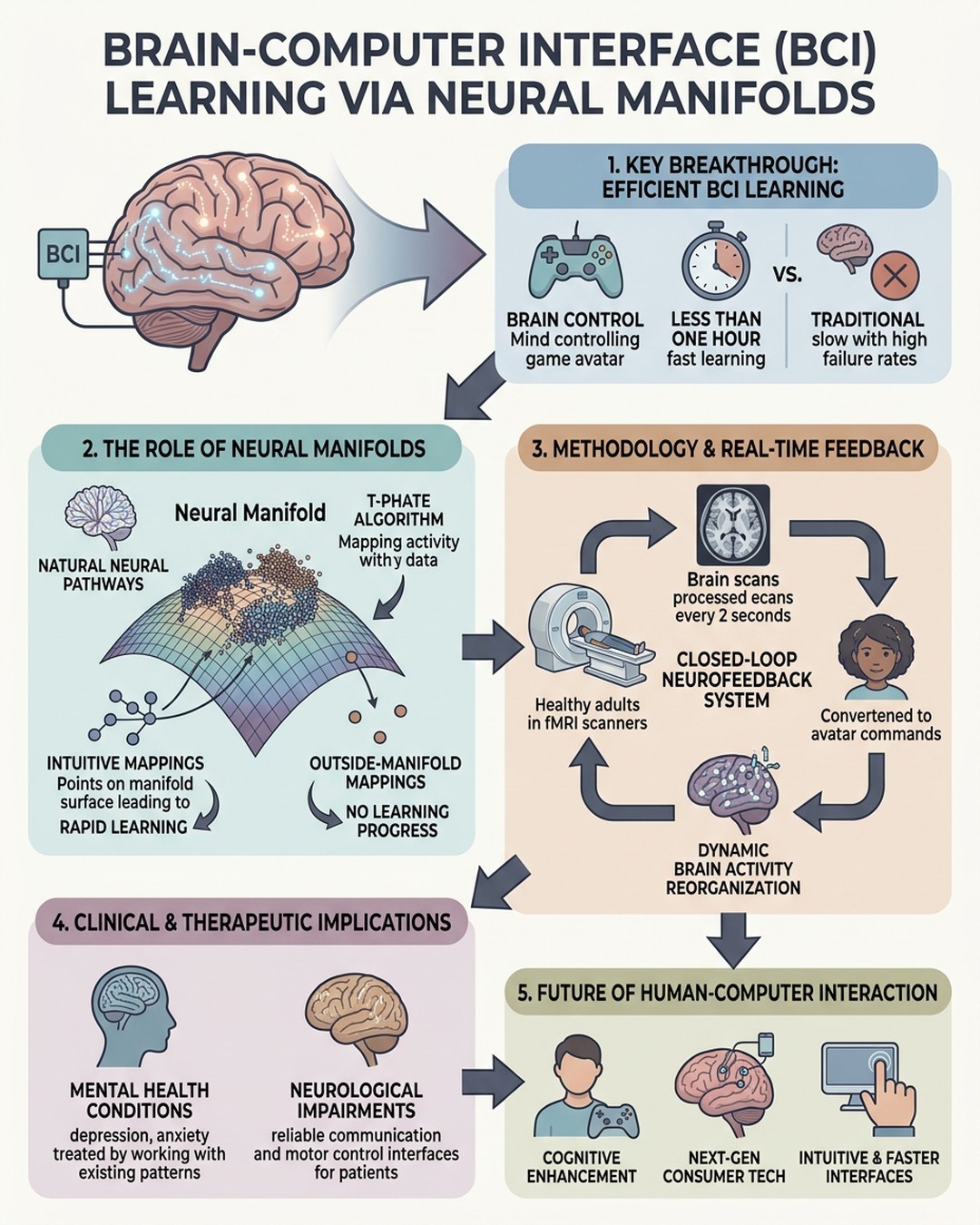
Yale researchers developed a BCI system that allows users to control video games via thought alone. By aligning the interface with the brain's natural neural manifold (the underlying structure of neural activity), participants learned to control the system in less than one hour, a significant improvement over traditional methods that often required multiple sessions with high failure rates.

02

🔸 The Role of Neural Manifolds

The study identifies the neural manifold as the key to BCI success. Researchers used an algorithm called T-PHATE to map individual brain activity patterns. Systems designed to follow these 'intuitive mappings' allowed for rapid learning, whereas 'outside-manifold' mappings—patterns not naturally generated by the brain—resulted in no learning progress during the study period.

03

⭐ Methodology and Real-Time Feedback

The experiment involved healthy adults in four fMRI sessions. The team built a closed-loop system that processed brain scans every two seconds, converting neural activity into avatar movement commands. This real-time neurofeedback loop allowed the brain to reorganize its activity dynamically to better match the BCI's demands.

04

📊 Clinical and Therapeutic Implications

The findings suggest that mental health conditions like depression and anxiety could be treated more effectively by working with existing neural patterns rather than attempting to force complete restructuring. Furthermore, this technology promises more reliable communication and motor control interfaces for patients with neurological impairments.

05

💡 Future of Human-Computer Interaction

Beyond medical use, the research opens doors for cognitive enhancement and next-generation consumer technology. By understanding the brain's natural geometry, developers can create interfaces that are more intuitive, faster to learn, and more accessible, potentially making traditional game controllers optional in the future.

Vuoi creare la tua mappa mentale?

Accedi a Neumap AI e inizia a creare le tue mappe mentali!

Inizia Ora