Antiviral Immune Evolution in Sea Anemones

Immunology EvolutionaryBiology MarineBiology Genetics Virology HebrewUniversity

Riepilogo

Immagine Copertina Mappa Mentale
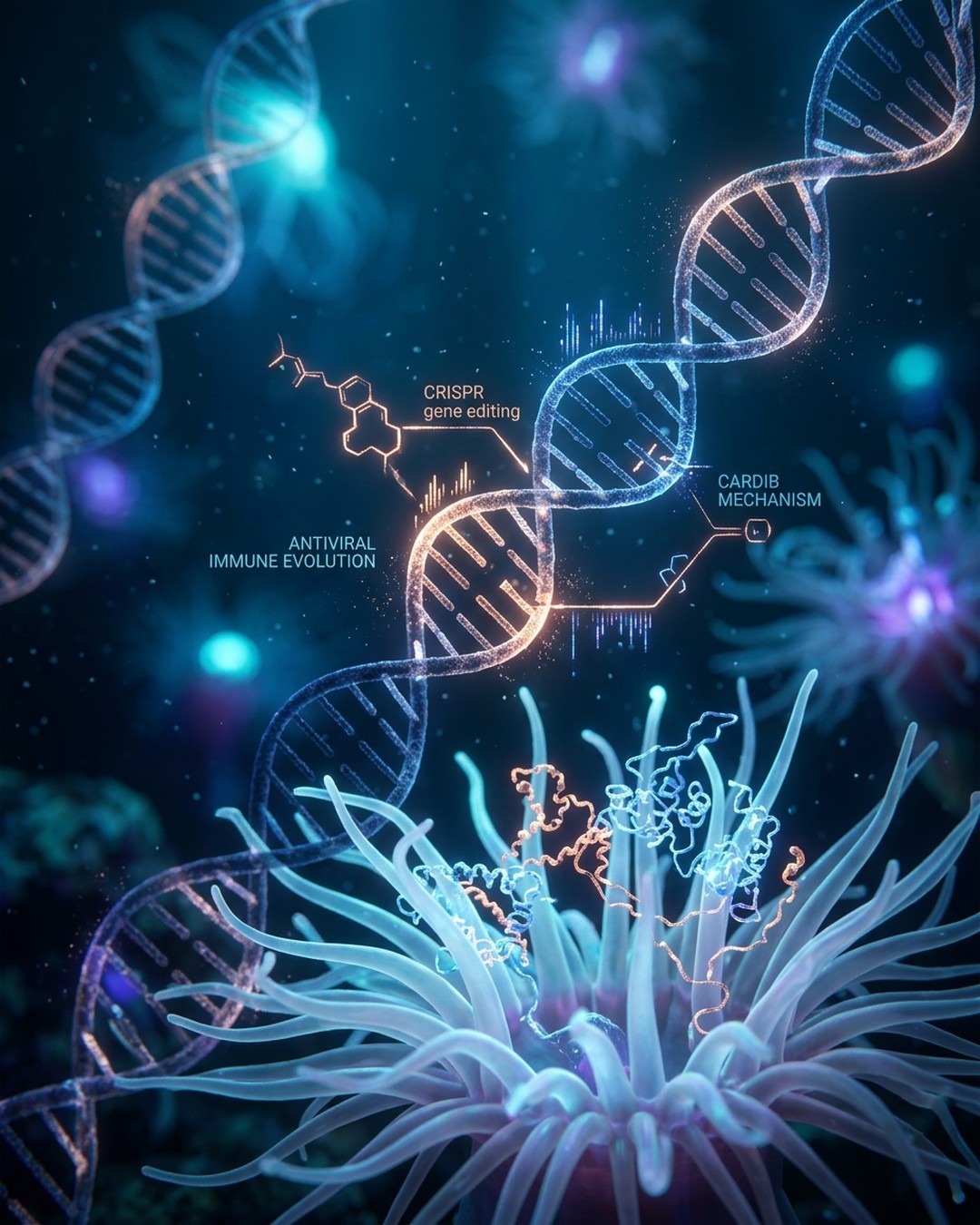
Immagine Copertina Generata da AI

Researchers from the Hebrew University of Jerusalem have discovered a unique antiviral defense mechanism in the sea anemone Nematostella vectensis, an ancient organism that diverged from the human lineage over 600 million years ago. The study, published on July 19, 2026, reveals that these animals utilize a protein called CARDIB (CARD Inhibitor Binding protein) to regulate their immune response. While CARDIB structurally resembles the human MAVS protein, it functions in the exact opposite manner by suppressing rather than activating antiviral defenses. The authors demonstrate that this suppression is not a sign of weakness but a critical component of the sea anemone's survival strategy. By employing CRISPR gene editing to remove CARDIB, scientists observed that the animals became significantly more susceptible to viral infections, proving that this inhibitory brake is essential for mounting an effective immune response. This finding challenges the assumption that antiviral immunity follows a universal evolutionary path across all animal species. The research highlights that evolution has developed diverse molecular solutions to combat viral threats. By comparing the immune pathways of ancient marine life with those of vertebrates, the study underscores the importance of looking beyond traditional laboratory models to understand the full spectrum of biological innovation. This discovery provides new insights into the early history of animal immunity and the complex ways organisms adapt to environmental pathogens. For the scientific community, this work emphasizes the value of studying non-traditional model organisms to uncover hidden evolutionary mechanisms. The findings suggest that future biomedical research could benefit from exploring these alternative pathways, potentially revealing new strategies for managing viral infections in other species, including humans.

Punti Chiave

01

🔹 Discovery of the CARDIB Protein

【📌 Key Finding】Researchers identified a protein named CARDIB (CARD Inhibitor Binding protein) in the sea anemone Nematostella vectensis. 【⭐ Data Support】Although CARDIB shares structural similarities with the human MAVS protein, which activates immune defenses, CARDIB functions as an inhibitor that suppresses immune activity.

02

🔸 Counterintuitive Immune Function

【📌 Key Finding】The study revealed that CARDIB acts as a necessary brake on the immune system. 【🔸 Impact Factors】When the gene for CARDIB was removed using CRISPR, the sea anemones lost their ability to resist viral infections, demonstrating that this inhibitory mechanism is essential for an effective antiviral response.

03

⭐ Evolutionary Divergence

【📌 Key Finding】The lineage of sea anemones split from the human lineage over 600 million years ago. 【⚖️ Comparison】Humans and sea anemones have developed fundamentally different molecular pathways to recognize and combat viruses, proving that evolution has invented multiple strategies for immune defense.

04

📊 Natural Environment Validation

【📌 Key Finding】The research was validated in outdoor marine mesocosms in South Carolina. 【⭐ Data Support】Genetically modified sea anemones lacking CARDIB carried substantially higher viral loads than normal animals when exposed to natural estuarine water, confirming the laboratory findings are relevant to real-world survival.

05

💡 Significance for Biomedical Research

【📌 Key Finding】The study highlights the limitations of relying solely on traditional models like mice or humans. 【💡 Application】By studying ancient animals, scientists can uncover evolutionary innovations that remain hidden in familiar species, providing a broader understanding of how life solves persistent biological challenges.

Vuoi creare la tua mappa mentale?

Accedi a Neumap AI e inizia a creare le tue mappe mentali!

Inizia Ora