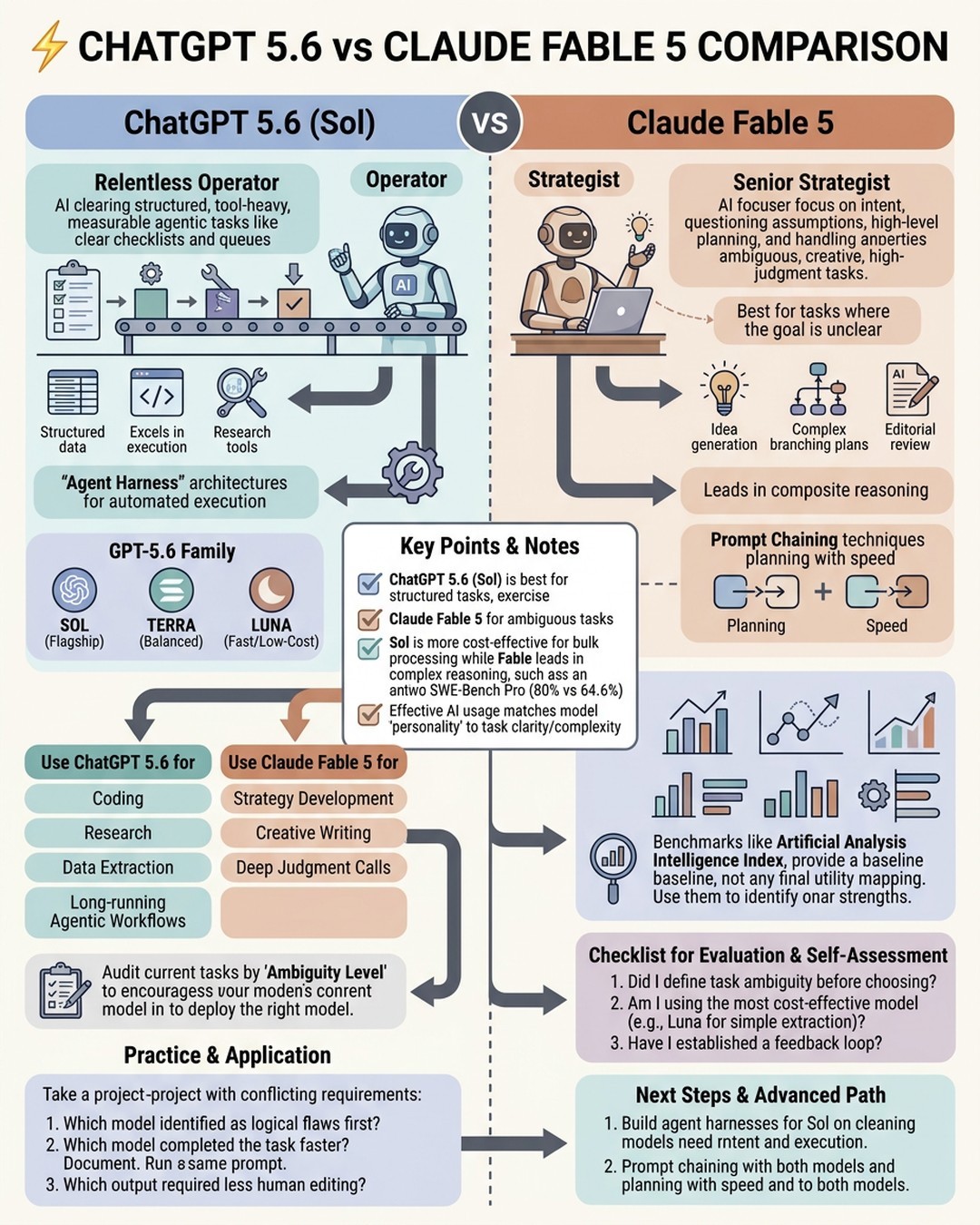
⚡ ChatGPT 5.6 vs Claude Fable 5 Comparison

AI-Models LLM-Comparison Workflow-Optimization Agentic-AI Productivity

要約

マインドマップカバー画像
AI生成カバー画像

【Recommended for: 🌿Basic】 Learning Overview: This unit analyzes the comparative performance of ChatGPT 5.6 (Sol) and Claude Fable 5. It highlights the distinction between 'operator' models (Sol) and 'strategic' models (Fable), providing a framework for selecting the right AI for specific professional tasks. Learning Objectives: After completing this unit, learners will be able to: 1. Distinguish between agentic execution and strategic reasoning in AI models. 2. Map specific work tasks to the appropriate model architecture. 3. Implement a multi-model workflow to optimize cost and quality. Learning Path: Start by understanding the core behavioral differences, then analyze the benchmark data, and finally apply the 'operator vs. strategist' framework to your daily tasks. Practice Suggestions: Conduct a side-by-side test using a complex, ambiguous project. Observe which model requires more human intervention versus which model proactively identifies flaws in your assumptions.

キーポイント

01

📝 Key Notes (Essential Takeaways)

【📌 Key Point 1】ChatGPT 5.6 (Sol) excels as a 'relentless operator' for structured, tool-heavy, and measurable agentic tasks. 【📌 Key Point 2】Claude Fable 5 functions as a 'senior strategist' better suited for ambiguous, creative, or high-judgment tasks. 【📌 Key Point 3】Sol is more cost-effective for bulk processing, while Fable leads in complex reasoning benchmarks like SWE-Bench Pro (80% vs 64.6%). 【📌 Key Point 4】GPT-5.6 is a family: Sol (flagship), Terra (balanced), and Luna (fast/low-cost). 【📌 Key Point 5】Effective AI usage requires matching the model's 'personality' to the task's clarity and complexity.

02

🔵 Bloom Level 1: Understanding Model Archetypes

【Concept】The distinction between 'Operator' and 'Strategist' AI. 【Operator (Sol)】Focuses on execution, tool usage, and clearing queues. Best for tasks with clear checklists. 【Strategist (Fable)】Focuses on intent, questioning assumptions, and high-level planning. Best for tasks where the goal is unclear.

03

🟡 Bloom Level 3: Applying Model Selection

【Strategy】Use Sol for: Coding, research, data extraction, and long-running agentic workflows. Use Fable for: Strategy development, creative writing, and tasks requiring deep judgment calls. 【Activity】Audit your current week's tasks: categorize them by 'Ambiguity Level' to decide which model to deploy.

04

🔴 Bloom Level 5: Evaluating Performance Metrics

【Analysis】Benchmarks (like Artificial Analysis Intelligence Index) provide a baseline, but they don't map to daily workflows. Sol leads in agentic/coding benchmarks, while Fable leads in composite reasoning. Use benchmarks to identify strengths, not as a final verdict on utility.

05

[Practice & Application]

【Exercise】Take an unfinished project with conflicting requirements. Run the same prompt through both models. Document: 1. Which model identified the logical flaw first? 2. Which model completed the task faster? 3. Which output required less human editing?

06

[Evaluation & Self-Assessment]

【Checklist】1. Did I define the task's ambiguity level before choosing a model? 2. Am I using the most cost-effective model (e.g., Luna for simple extraction)? 3. Have I established a feedback loop to refine my model selection based on actual output quality?

07

[Extension & Advanced Path]

【Next Steps】Explore 'Agent Harness' architectures to automate Sol's execution. Study prompt chaining techniques to combine Fable's strategic planning with Sol's execution speed.

自分のマインドマップを作成したいですか?

Neumap AIにログインして、あなた専用のマインドマップの作成を始めましょう!

今すぐ始める