Ancient Denisovan Fossil Discovery in Bianfu Cave

scitechdaily anthropology denisovans fossils evolution

要約

マインドマップカバー画像
AI生成カバー画像

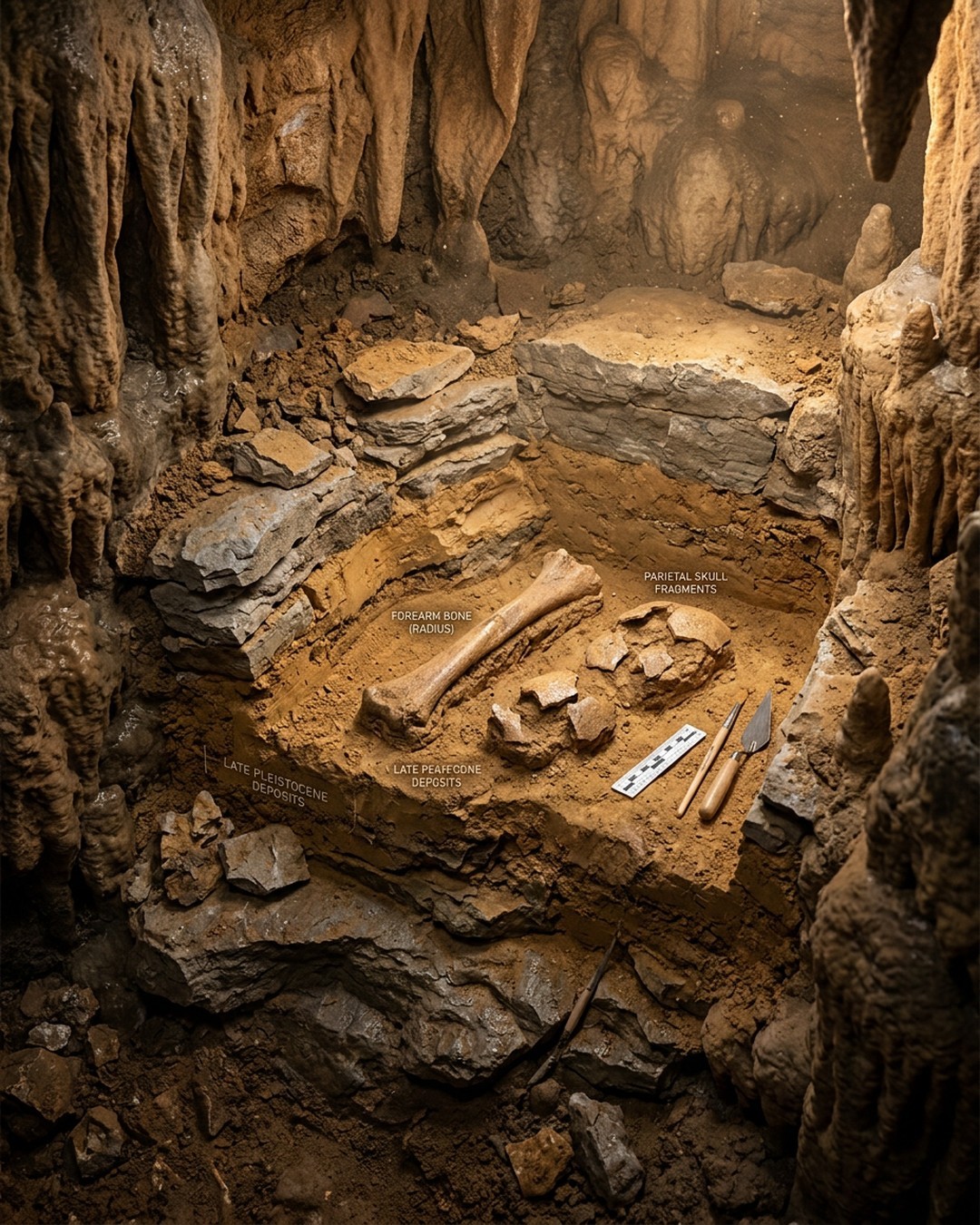
Scientists have discovered five Denisovan remains, including the first confirmed Denisovan radius bone, dating back 150,000 years in Bianfu Cave, Yunnan Province, China. Led by Professor Qiaomei Fu of the Chinese Academy of Sciences, the research combined morphological pre-screening and Zooarchaeology by Mass Spectrometry to analyze over 60,000 bone fragments. The newly identified forearm bone exhibits a combination of Neanderthal-like and modern human-like traits, indicating unique mechanical demands and behavioral adaptations. Protein analysis confirmed the Denisovan identity with 100 percent posterior probability, establishing Bianfu Cave as the richest known source of Denisovan fossils outside of Denisova Cave. The findings provide critical physical evidence for the sparse fossil record below the skull for Denisovans, helping researchers understand their geographic distribution and environmental adaptation in southwest China during Marine Isotope Stage 6. These discoveries offer vital insights into human evolution and demonstrate a highly efficient methodology for screening Paleolithic sites, paving the way for future paleoanthropological breakthroughs.

キーポイント

01

🔹 Discovery of Denisovan Remains in Bianfu Cave

Researchers identified five Denisovan fossils from Bianfu Cave in Yunnan Province, China, dating to the late Middle Pleistocene between 167,000 and 134,000 years ago. The finds include the first confirmed Denisovan radius forearm bone, two parietal skull fragments, and two teeth, making this cave the richest source of Denisovan fossils outside Denisova Cave.

02

🔸 Unique Morphological Characteristics of the Radius

Cataloged as BFD771, the radius bone combines features from multiple human lineages. Its large elbow-end dimensions and radial tuberosity orientation resemble Neanderthals, while its overall external shape and shaft cross-section geometry resemble modern humans, pointing to distinct behavioral adaptations.

03

⭐ Innovative Screening Methodology Using ZooMS

To overcome the high cost and inefficiency of screening over 60,000 bone fragments, researchers developed a morphological pre-screening combined with Zooarchaeology by Mass Spectrometry strategy. This method successfully isolated 22 potential hominin remains, confirming five specific Denisovan specimens.

04

📊 Protein Analysis and Evolutionary Clustering

Ancient protein extraction recovered 6 to 16 proteins per specimen. All five fossils carried the Denisovan-specific protein variant COL1A2 R996K and clustered with Denisova 3 with 100 percent posterior probability in evolutionary trees, while tooth enamel analysis identified both teeth as male.

05

💡 Environmental Adaptations During Glacial Periods

Dated to the Marine Isotope Stage 6 glacial period, the fossils suggest that the warm climate and abundant food resources of the Yunnan-Guizhou Plateau provided a highly favorable habitat for Denisovans, expanding our understanding of their geographic range and survival strategies in Asia.

自分のマインドマップを作成したいですか?

Neumap AIにログインして、あなた専用のマインドマップの作成を始めましょう!

今すぐ始める