Hidden Deep Beneath Mars, Scientists Find Evidence of a Vast Magmatic System

scitechdaily mars geology planetary-science seismology university-of-oxford

要約

マインドマップカバー画像
AI生成カバー画像

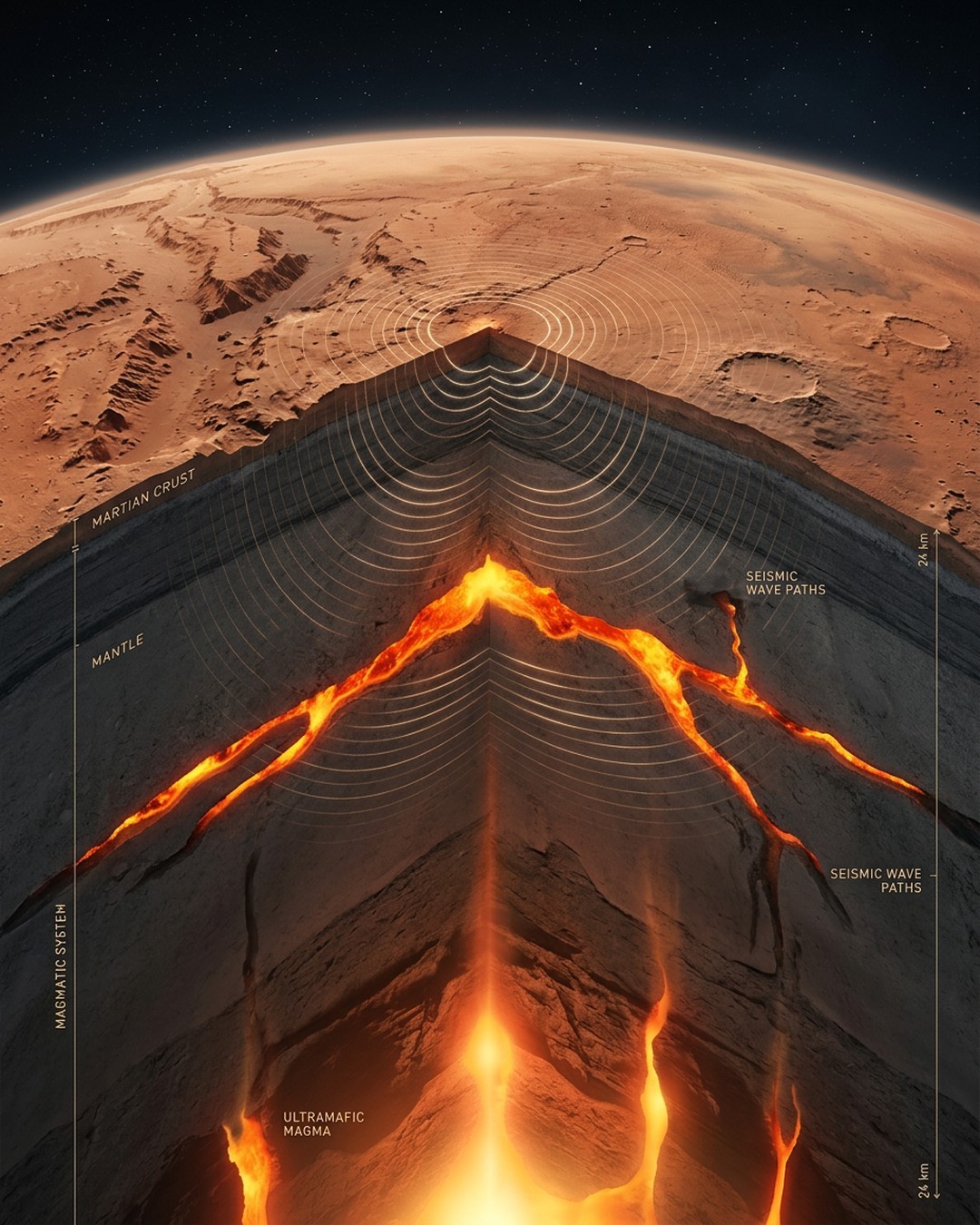
Researchers from the University of Oxford published a groundbreaking study in Nature Astronomy on August 29, 2026, revealing seismic evidence of a vast, interconnected magmatic system hidden deep beneath the surface of Mars. Using data collected by NASA's InSight mission, the team investigated an unexplained boundary located approximately 24 kilometers below the Martian crust. Through rigorous thermodynamic modeling and statistical methods comparing seismic observations with hundreds of possible rock compositions, scientists determined that the deeper layer consists of ultramafic rocks rich in iron and magnesium, while the upper layer contains mafic rocks with higher silica proportions. This discovery demonstrates that Mars could sustain large, long-lived internal melting and recycling processes without the plate tectonics previously thought mandatory for such geological complexity. The identification of this transcrustal magmatism suggests that Mars possessed enormous connected magmatic systems stretching hundreds or thousands of kilometers across its northern hemisphere. This geological recycling mechanism parallels processes associated with continent formation and volatile element movement on Earth, traditionally linked to planetary habitability. These findings challenge the long-held assumption that Earth is unique in developing complex crustal systems and indicate that the geological conditions necessary for habitability may emerge on a wider variety of rocky planets than previously believed, regardless of size or apparent lack of tectonic activity.

キーポイント

01

🔹 Discovery of Vast Magmatic System on Mars

【📌 Key Finding】University of Oxford researchers published a study in Nature Astronomy on August 29, 2026, revealing seismic evidence of a vast, interconnected magmatic system hidden deep beneath the Martian surface. 【🔸 Impact Factors】The findings challenge the traditional assumption that Mars has a simple volcanic history and show that the planet could build a complex crust without moving tectonic plates. ⭐ Data Support】Researchers analyzed seismic waves recorded by NASA's InSight mission, focusing on an unexplained boundary located approximately 24 kilometers below the Martian crust.

02

🔸 Seismic Analysis and Rock Composition Findings

【📌 Key Finding】By employing thermodynamic modeling and statistical methods, the research team compared seismic observations with hundreds of potential rock compositions to map the subsurface structure. 【🔸 Impact Factors】The analysis revealed that rocks below the 24-kilometer boundary are ultramafic, meaning they are rich in iron and magnesium but low in silica. ⭐ Data Support】Above the boundary, observations are better explained by mafic rocks containing higher proportions of silica, indicating that dense crystals remained near the base while lighter melts moved upward.

03

⭐ Mechanism of Transcrustal Magmatism Without Plate Tectonics

【📌 Key Finding】The buried layer may stretch horizontally for hundreds or thousands of kilometers across the northern hemisphere of Mars, pointing to massive connected magmatic systems. 【🔸 Impact Factors】This process, known as transcrustal magmatism, was previously thought to be exclusive to Earth and dependent on plate tectonics. ⭐ Data Support】Internal recycling allowed molten rock to evolve and reprocess itself throughout the entire crust, creating geological complexity similar to Earth's volcanic arcs.

04

📊 Implications for Planetary Habitability and Astrobiology

【📌 Key Finding】Geological recycling is closely tied to the development of atmospheres, oceans, and environments capable of supporting life by regulating climate and volatile elements. 【🔸 Impact Factors】Because Mars achieved this complexity without plate tectonics, rocky planets previously dismissed due to size or lack of tectonic activity may still foster habitable conditions. ⭐ Data Support】Lead author Dr Tobermory Mackay-Champion and co-author Professor Jon Wade emphasize that rocky worlds beyond our solar system may commonly develop such complex systems.

05

💡 Contribution of NASA's InSight Mission Data

【📌 Key Finding】The research directly builds upon groundbreaking observational data gathered by NASA's InSight mission, which deployed the first seismometer on Mars in 2018. 【🔸 Impact Factors】InSight recorded seismic waves generated by meteoroid impacts and marsquakes, providing scientists with an unprecedented view of the interior structure of the Red Planet. ⭐ Data Support】The collaboration between Oxford's Departments of Earth Sciences and Statistics successfully decoded these seismic signatures to redefine our understanding of Martian geology.

自分のマインドマップを作成したいですか?

Neumap AIにログインして、あなた専用のマインドマップの作成を始めましょう!

今すぐ始める