Piezoelectric Properties of Ultrathin Diamond Membranes

Science MaterialsScience Nanotechnology Piezoelectricity UniversityOfHongKong

要約

マインドマップカバー画像
AI生成カバー画像

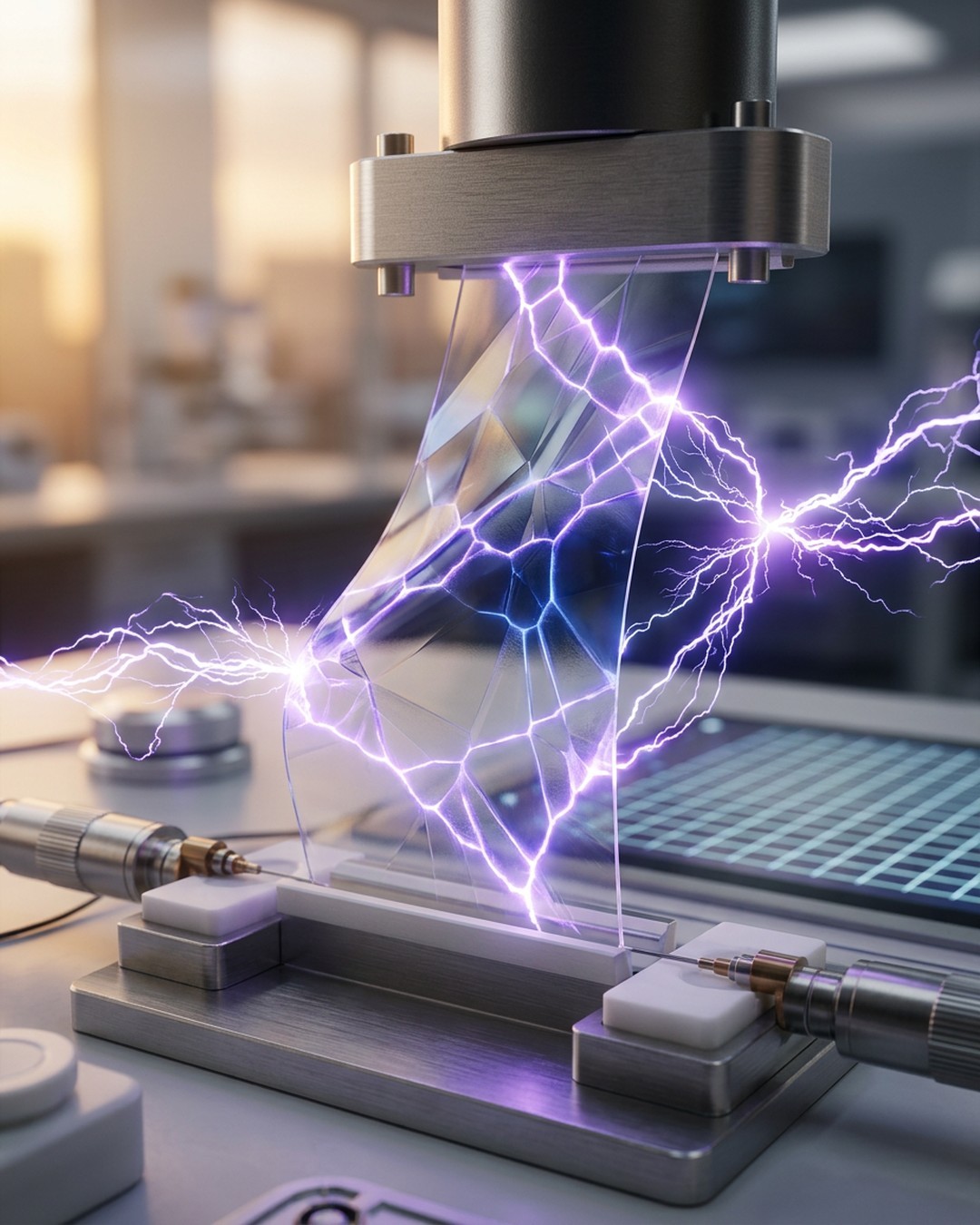
Researchers at the University of Hong Kong have overturned a century-old scientific consensus by demonstrating that diamond, when processed into an ultrathin membrane, exhibits piezoelectric properties. This discovery challenges the long-standing assumption that diamond is fundamentally non-piezoelectric, revealing that mechanical deformation in these thin structures can generate stable electrical voltage. The research team, led by Professor Zhiqin Chu and Professor Yuan Lin, utilized an innovative edge-exfoliation method to create flexible polycrystalline diamond membranes. By subjecting these membranes to controlled mechanical strain, they observed consistent electrical output, confirming that the effect is intrinsic to the material's structure rather than environmental interference. The underlying mechanism for this phenomenon is attributed to asymmetrical grain boundaries within the polycrystalline diamond. As the membrane bends, charge accumulates at these interfaces, creating a voltage difference between the surfaces. This breakthrough shifts the perception of diamond from a purely structural, non-conductive platform to a potential active component in electronic systems. This finding holds significant practical value for the development of next-generation microelectromechanical systems (MEMS). Due to diamond's biocompatibility and chemical stability, these piezoelectric membranes are ideal for future implantable medical devices, self-powered sensors, and miniature energy harvesting systems that operate without external power sources.

キーポイント

01

🔹 Discovery of Piezoelectric Diamond

【📌 Key Finding】Researchers have proven that ultrathin diamond membranes can generate electricity when bent, overturning a century-old belief that diamond is non-piezoelectric. 【⭐ Data Support】The study, published on March 18, 2026, in Science Advances, confirms that stable voltage signals are produced under mechanical strain.

02

🔸 Mechanism of Electrical Generation

【📌 Key Finding】The piezoelectric effect is primarily driven by asymmetrical grain boundaries within the polycrystalline diamond structure. 【🔸 Impact Factors】As the membrane undergoes bending, electrical charges accumulate at the interfaces where individual diamond crystals meet, creating a measurable voltage difference between the top and bottom surfaces.

03

⭐ Methodology and Validation

【📌 Key Finding】The team employed an edge-exfoliation technique to create flexible, ultrathin membranes. 【⭐ Data Support】To rule out environmental interference or triboelectric artifacts, the researchers performed repeated, controlled bending tests, ensuring the observed electrical output was a genuine, reproducible piezoelectric response.

04

📊 Potential Applications

【📌 Key Finding】The biocompatibility and chemical stability of diamond make this discovery highly applicable to advanced technology. 【⭐ Data Support】Potential uses include self-powered implantable medical devices, miniature deformation sensors, and energy harvesting systems that function independently of external power supplies.

05

💡 Research Leadership

【📌 Key Finding】The interdisciplinary study was conducted by the University of Hong Kong (HKU). 【🔸 Impact Factors】The project was led by Professor Zhiqin Chu (Department of Electrical and Computer Engineering) and Professor Yuan Lin (Department of Mechanical Engineering), marking a significant shift in materials science research.

自分のマインドマップを作成したいですか?

Neumap AIにログインして、あなた専用のマインドマップの作成を始めましょう!

今すぐ始める