Nanoreactor Mimics Living Cells For Artificial Photosynthesis

scitechdaily nanotechnology chemistry photosynthesis renewable-energy

要約

マインドマップカバー画像
AI生成カバー画像

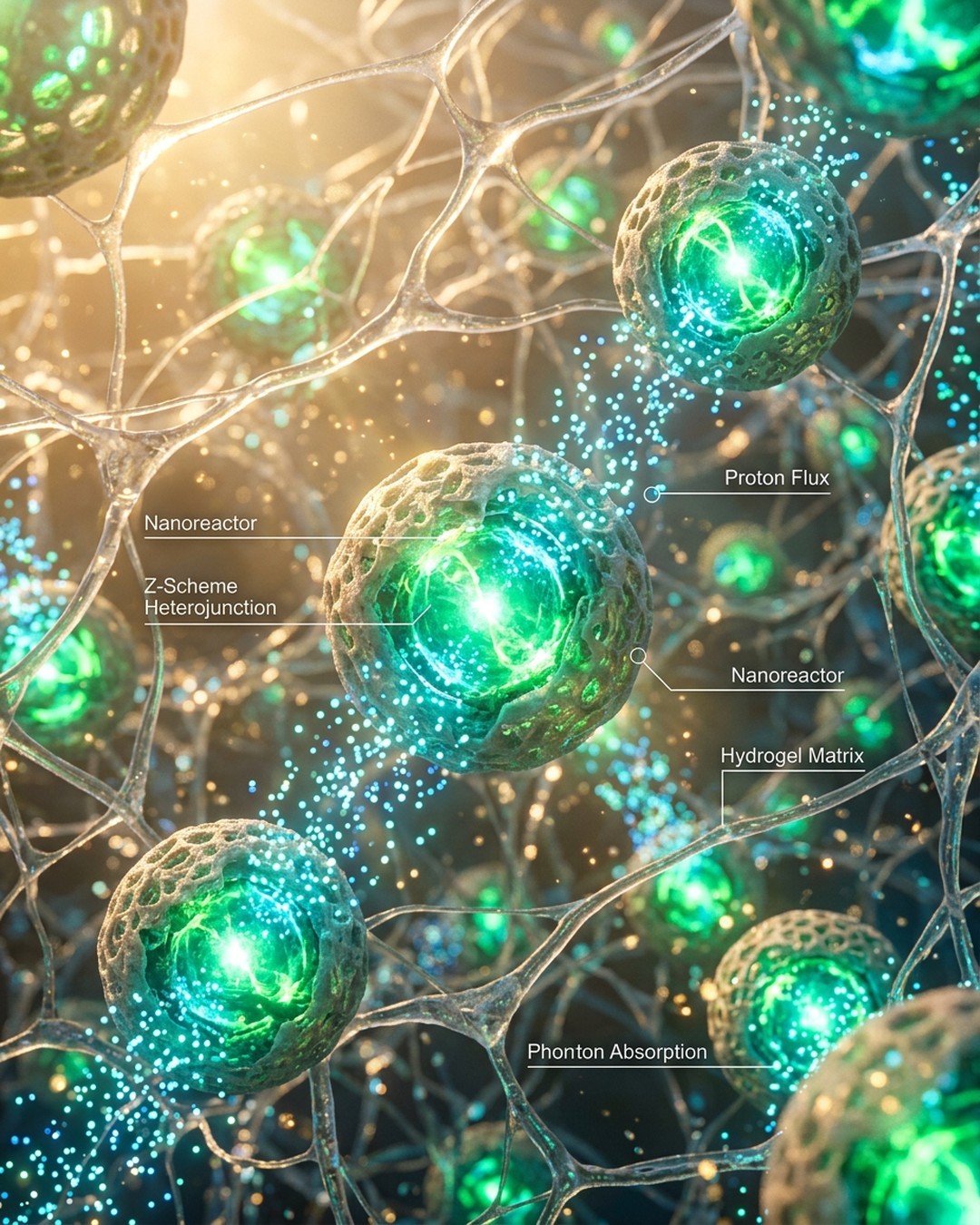
Researchers from the Dalian Institute of Chemical Physics and Inner Mongolia University published a study in the Journal of the American Chemical Society detailing a biomimetic CdS@polydopamine nanoreactor that mimics living cells to supercharge artificial photosynthesis on July 28, 2026. The study's primary objective is to replicate the multilevel compartmentalization and reaction control found in biological systems using synthetic nanocell engineering to accelerate proton-coupled electron transfer and balance oxygen reduction with water oxidation. The nanoreactor features a dynamic catechol/o-benzoquinone redox pair within a polydopamine shell acting as a proton relay, alongside a porous outer shell surrounding a nanoscale cavity that supports reactant enrichment, mass diffusion, and photon trapping based on a Z-scheme heterojunction. Under visible-light illumination in aqueous solution, the system achieved a hydrogen peroxide photosynthesis rate of 3.24 mmol gcat.-1 h-1 and a 1.2 percent solar-to-chemical conversion efficiency, while encapsulation in a sodium alginate hydrogel enabled stable, recyclable synthesis under natural sunlight.

キーポイント

01

🔹 Core Research Findings and Performance Data

【📌 Key Finding】Led by Can Li from the Dalian Institute of Chemical Physics (DICP) and Jian Liu from Inner Mongolia University, published on July 8, 2026, in the Journal of the American Chemical Society, researchers developed a CdS@polydopamine nanoreactor. 【⭐ Data Support】Under visible-light illumination in an aqueous solution, the nanoreactor achieved a hydrogen peroxide photosynthesis rate of 3.24 mmol gcat.-1 h-1 and a solar-to-chemical conversion efficiency of 1.2 percent.

02

🔸 Biomimetic Proton Relay Mechanism

【📌 Key Mechanism】The nanoreactor utilizes a dynamic catechol/o-benzoquinone redox pair embedded within its polydopamine shell. 【🔸 Impact Factors】Instead of actively pumping protons, this redox pair functions as a relay that repeatedly accepts and donates protons, significantly accelerating proton-coupled electron transfer (PCET) and balancing the reaction speeds of oxygen reduction and water oxidation.

03

⭐ Compartmentalized Nanoreactor Structure

【📌 Structural Elements】The synthetic nanoreactor mimics living cell organization through a hollow nanoscale structure featuring a porous outer shell surrounding a central cavity. 【⭐ Functional Benefits】This confined architectural design actively supports reactant enrichment, mass diffusion, photon trapping, and establishes a photocatalytic mechanism based on a Z-scheme heterojunction.

04

📊 Hydrogel Encapsulation and Solar Stability

【📌 Practical Application】Researchers enclosed the CdS@polydopamine photocatalyst within an environmentally benign sodium alginate hydrogel. 【🔸 Outcomes】This encapsulation technique created solid, easily recyclable photocatalysts that successfully maintained stable hydrogen peroxide synthesis performance when exposed directly to natural sunlight.

05

💡 Broader Scientific Implications and Future Outlook

【📌 Strategic Significance】According to Prof. Can Li, this study introduces a novel strategy for engineering biomimetic nanoreactors that closely replicate sophisticated living cell functions. 【🎯 Application Scope】The breakthrough creates advanced opportunities across artificial photosynthesis, renewable energy catalysis, and synthetic chemistry applications.

自分のマインドマップを作成したいですか?

Neumap AIにログインして、あなた専用のマインドマップの作成を始めましょう!

今すぐ始める