Science Debunks Common Belief About Pets and Stress

Psychology MentalHealth PetOwnership StressManagement ScientificResearch

要約

マインドマップカバー画像
AI生成カバー画像

A study published on June 27, 2026, in Frontiers in Psychology challenges the widely held belief that interacting with pets acts as a stress-buffering mechanism. While pet companionship is generally associated with improved mood and positive emotions, researchers found that active interaction during stressful moments does not protect owners from negative emotional impacts. The authors, led by Dr. Mayke Janssens and Dr. Sanne Peeters of The Open University, analyzed nearly 8,000 real-life reports from pet owners. The data indicates that while pets contribute to overall well-being, they do not function as immediate stress-relief tools during acute episodes of tension. The research highlights a nuanced reality where the emotional benefits of pets likely stem from companionship and social connection rather than physiological stress reduction. Notably, for cat owners, higher levels of interaction during stress were sometimes linked to intensified negative emotions, suggesting that the nature of the pet-owner bond varies by species and individual preference. Users should recognize that while pets enhance daily happiness, they are not a substitute for active stress management strategies. The findings suggest that the presence of a pet provides comfort, but owners should not rely on intensive interaction as a primary method to mitigate acute stress responses.

キーポイント

01

🔹 Research Overview and Methodology

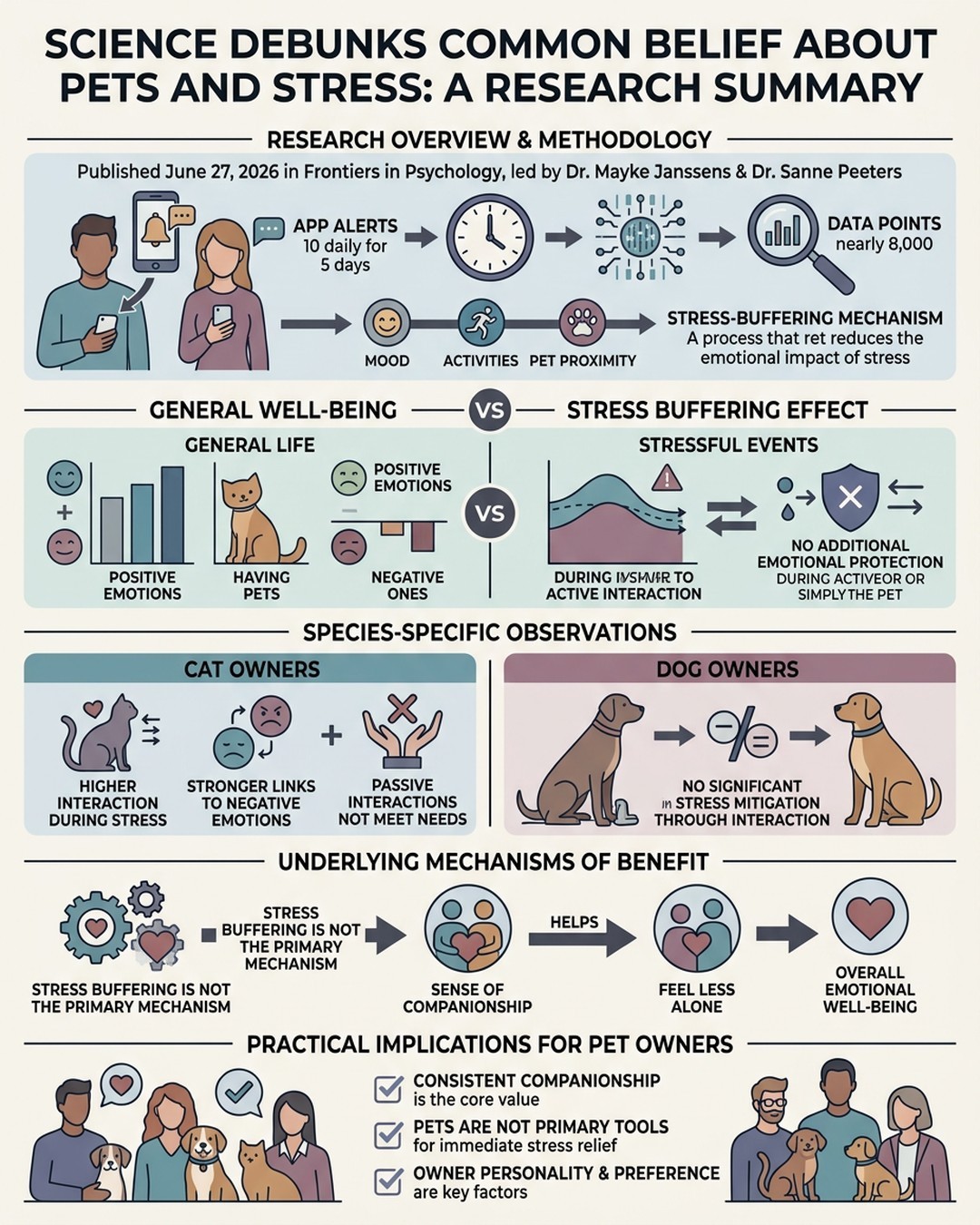
Published on June 27, 2026, in Frontiers in Psychology, the study involved tracking pet owners over five days. Participants received 10 daily app alerts, resulting in nearly 8,000 data points regarding their mood, activities, and proximity to pets. The research aimed to determine if pet interaction serves as a stress-buffering mechanism (a process that reduces the emotional impact of stress).

02

🔸 Key Finding: Stress Buffering vs. General Well-being

The study concludes that while interacting with pets is linked to more positive emotions and fewer negative ones in daily life, it does not act as a buffer during stressful events. Interacting more intensively with a pet during a stressful moment provided no additional emotional protection compared to simply having the animal present.

03

⭐ Species-Specific Observations

The research identified differences between cat and dog owners. For cat owners, higher levels of interaction during stress were associated with stronger links to negative emotions, possibly because cat interactions are more passive and may not meet the owner's need for active support. Dog owners showed no significant difference in stress mitigation through interaction.

04

📊 Underlying Mechanisms of Benefit

Since stress buffering is not the primary mechanism, researchers suggest that the emotional benefits of pet ownership likely stem from a sense of companionship and social connection. Pets help owners feel less alone, which contributes to overall emotional well-being rather than providing a specific 'stress-relief' function during acute crises.

05

💡 Practical Implications for Pet Owners

The findings suggest that pet owners should not view their animals as a primary tool for immediate stress relief. Instead, the value of the human-animal bond lies in consistent companionship. The study emphasizes that owner personality and preference are key factors in the quality of the bond, rather than one species being inherently 'better' for stress management.

自分のマインドマップを作成したいですか?

Neumap AIにログインして、あなた専用のマインドマップの作成を始めましょう!

今すぐ始める