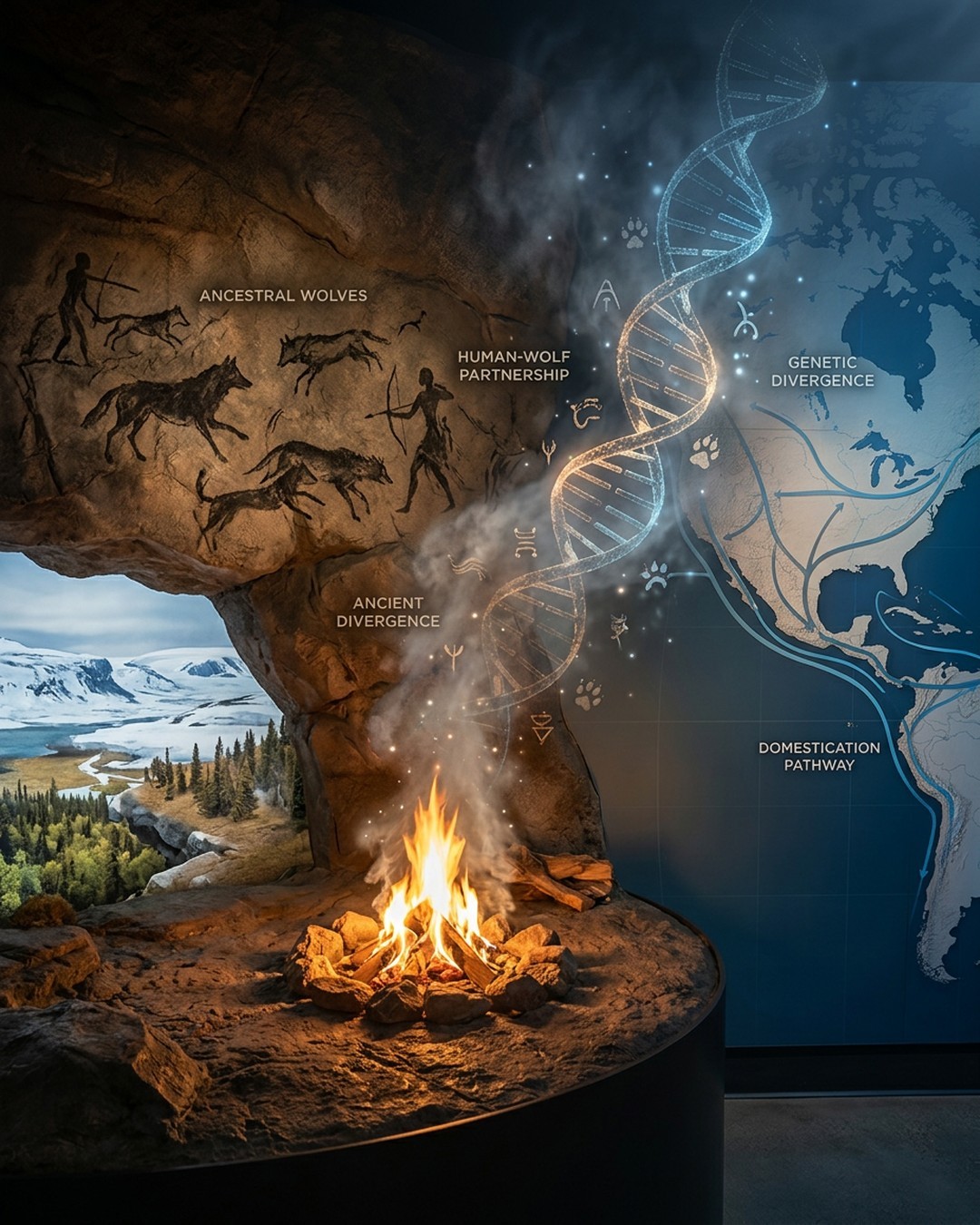
The Complex Evolutionary History of How Wolves Became Dogs

scitechdaily anthropology domestication dogs taylor-francis-group

要約

マインドマップカバー画像
AI生成カバー画像

Published on September 16, 2026, the article explores the complex co-evolutionary history of wolves and humans, challenging the conventional view that dog domestication was a straightforward taming process. Archaeological and genetic evidence indicates that humans and wolves engaged as relatively equal partners over a span of 15,000 years, shaped significantly by environmental adaptation, cultural traditions, and biological factors. The author, drawing insights from archaeologist Professor Peter Mitchell and his book First Dogs: Hunter-Gatherers and their Canine Companions from Prehistory to the Present, emphasizes that dog domestication was a long, drawn-out process rather than a single threshold event. Different human societies and environments drove dogs to develop specialized traits, ranging from Arctic sled-pulling physiques to rainforest hunting agility. The research reveals that regional pressures such as high-altitude hypoxia on the Tibetan Plateau and vector-borne diseases in sub-Saharan Africa dictated where canine populations could survive and thrive. Furthermore, human cultural needs, including ceremonial wool production and spiritual traditions, played a critical role in shaping morphological and behavioral diversity among ancient canine lineages. For practical application, readers and researchers gain a deeper understanding of human-animal interdependency and the evolutionary resilience of domestic species. This comprehensive historical perspective encourages modern conservationists and anthropologists to appreciate how ecological pressures and human partnerships continuously sculpt mammalian genetics and behavior.

キーポイント

01

🔹 Equal Partnership Evolution

Archaeological findings indicate that dog domestication spanning 15,000 years was not a simple taming process by humans, but rather an equal partnership where hunter-gatherer communities and wolves interacted closely long before intensive management of animals began.

02

🔸 Environmental Adaptations Worldwide

As dogs spread across diverse environments, they underwent parallel evolution with humans; Arctic dogs developed heavy skeletal frames and vertebrae stress patterns for pulling loads, while tropical rainforest dogs remained small and agile for tracking prey.

03

⭐ High-Altitude and Regional Genetics

On the Tibetan Plateau, dogs acquired genetic adaptations to survive oxygen-poor high-altitude air similar to human populations, whereas disease barriers such as trypanosomiasis and ehrlichiosis limited canine expansion into sub-Saharan Africa.

04

📊 Cultural Breeding and Ceremonial Roles

Beyond survival needs, human cultural practices drove specific breeding programs, such as Indigenous communities on the Northwest Coast of North America breeding small woolly dogs specifically for hair to weave into ceremonial blankets.

05

💡 Ongoing Joint Evolutionary History

Modern genetic research demonstrates that many ancient dog lineages were replaced during colonial expansion, but the ongoing, complex entwinement between humans and dogs continues to shape their mutual biology and behavior.

自分のマインドマップを作成したいですか?

Neumap AIにログインして、あなた専用のマインドマップの作成を始めましょう!

今すぐ始める