🧠 Evolution of Bumblebee Intelligence

SciTechDaily Bumblebees Cognition Neuroscience Entomology Insect Evolution Biology

要約

マインドマップカバー画像
AI生成カバー画像

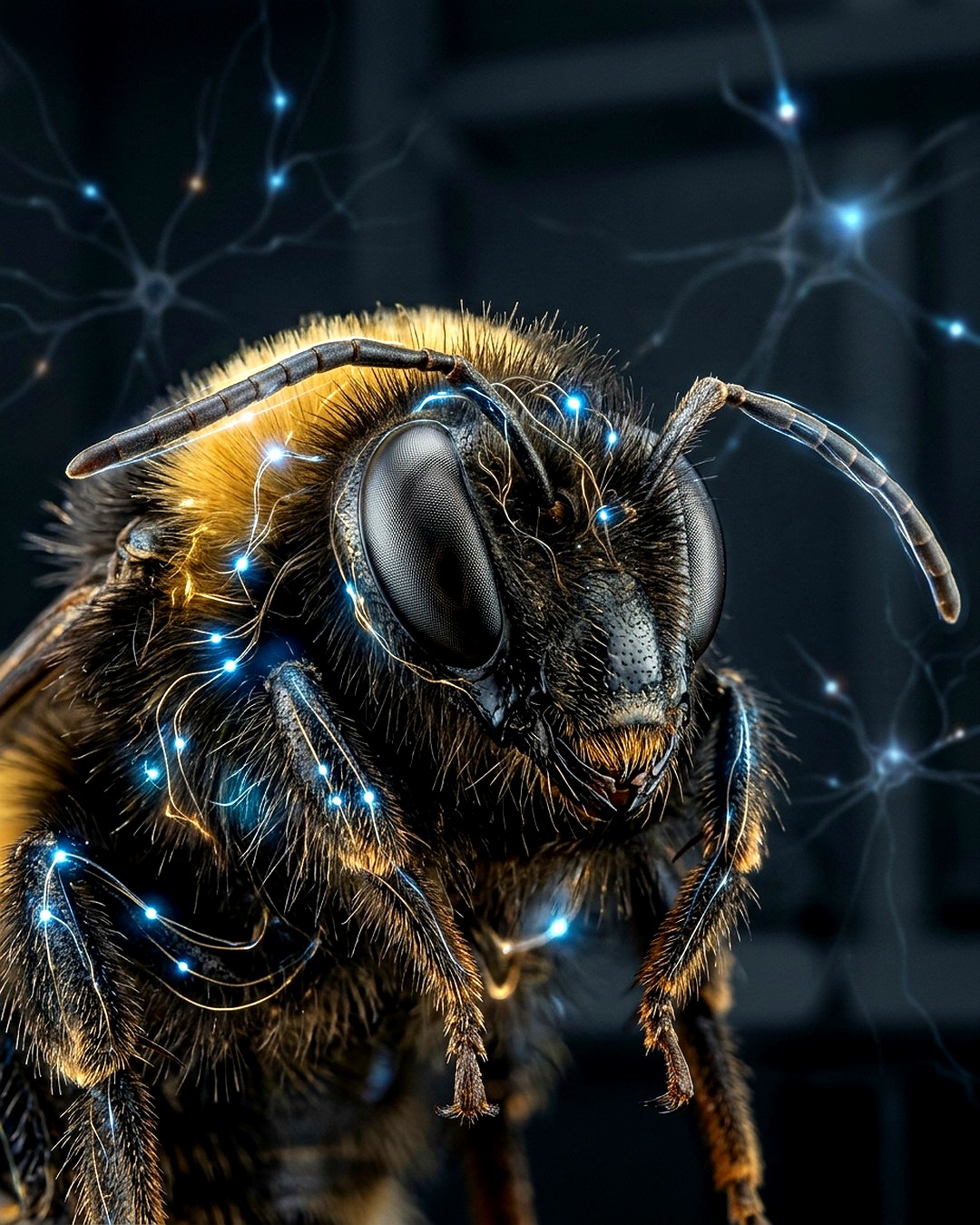
Bumblebees (Bombus) possess advanced cognitive abilities despite having fewer than a million neurons, challenging the assumption that sophisticated intelligence requires a large brain. Researchers Lars Chittka and Stanley Heinze published a Perspective in Science on November 19, 2026, examining how complex thinking emerges from ancient neural circuits rather than entirely new neural algorithms. Experiments show that bumblebees can solve unfamiliar problems like rolling a ball to a target, learn two-step puzzle boxes by observing nestmates, and transmit emotion-like states such as optimism without direct contact. These insights suggest that higher cognitive processes may be more widespread across species than previously thought, offering a blueprint for studying intelligence across both invertebrates and vertebrates. The authors argue that advanced mental capabilities do not depend on massive brain sizes, pointing instead to evolutionary modifications within ancient brain structures. They propose that insects utilize existing neural foundations, such as expanded memory and navigation circuits, to weigh multiple goals and plan complex actions. This perspective reframes intelligence as a modular trait that can be achieved through diverse evolutionary pathways across the animal kingdom. By comparing complete wiring diagrams like the fruit fly connectome with ongoing bee brain mappings, scientists hope to uncover universal design principles of cognition. The stance emphasizes that nature employs both shared and distinct neural solutions to build sophisticated minds. Bumblebees demonstrate sophisticated behaviors, including mentally representing invisible targets during ball-moving experiments and acquiring complex foraging skills socially rather than independently. Their brains feature mushroom bodies containing approximately 50 times as many specialized Kenyon cells as those of fruit flies, which likely provides a significantly greater memory capacity. Furthermore, bees exposed to unexpected rewards displayed optimism-like biases when interpreting ambiguous stimuli, a state that was visually transmitted to neighboring nestmates through a transparent barrier. Ongoing research efforts are mapping complete connectomes across multiple bee species to identify specific neural network differences that enable advanced cognition. These comparative approaches reveal that different insect lineages can evolve parallel cognitive traits through distinct neural mechanisms. Recognizing that high-level intelligence can operate on compact neural substrates opens new avenues for artificial intelligence, robotics, and comparative neuroscience. Engineers and researchers can study how tiny biological networks achieve efficient spatial navigation, problem-solving, and social learning to design decentralized autonomous systems. The findings encourage broader investigations into how simple organisms process complex information, potentially inspiring novel computing architectures inspired by insect connectomics. Readers can apply this knowledge by appreciating the deep evolutionary roots of cognition and supporting interdisciplinary studies linking biology with cognitive science. Ultimately, understanding how bees achieve remarkable feats with minimal hardware demonstrates that functional intelligence is fundamentally about efficient network organization rather than sheer scale.

キーポイント

01

🐝 Remarkable Intelligence in Tiny Insect Brains

Bumblebees demonstrate sophisticated cognitive abilities despite possessing fewer than a million neurons, challenging long-standing assumptions that intelligence requires a large brain. In laboratory experiments published in research referenced by the study, bees successfully learned to move a ball and climb onto it to reach hidden nectar sources. They could even guide the ball toward targets that were no longer visible, indicating an ability to mentally represent goals and solve unfamiliar problems. Additional research published in Nature showed that bumblebees could learn to open a complex two-step puzzle box by watching trained nestmates perform the task. These findings prove that tiny biological systems can support advanced problem-solving and social learning mechanisms.

02

🧠 Ancient Neural Circuits and Mushroom Bodies

The remarkable cognitive abilities of bees may stem from evolutionary modifications to ancient neural circuits rather than entirely new neural algorithms. A primary structure involved is the mushroom body, which handles learning and memory in insect brains. Bumblebees possess approximately 50 times as many specialized neurons known as Kenyon cells compared to fruit flies, directly expanding their memory capacity. Additional neural circuits dedicated to navigation and decision-making allow bees to weigh multiple options and plan future actions effectively. This structural efficiency suggests that higher cognitive processes might be far more widespread across the animal kingdom than previously recognized.

03

⚡ Transmission of Emotion-Like States

Bumblebees appear capable of transmitting emotion-like states to their nestmates without physical contact or chemical communication. After receiving an unexpected reward during behavioral tests, individual bees displayed an optimism-like bias when interpreting ambiguous stimuli. Other bees placed behind a transparent barrier developed a similar behavioral bias simply by observing the rewarded bees. This visual communication of affective states highlights unexpected social and emotional complexity in social insects. Such mechanisms demonstrate that rudimentary emotional contagion can occur across transparent boundaries in invertebrate colonies.

04

🔬 Connectomics and Comparative Brain Mapping

Scientists have already mapped a complete wiring diagram, or connectome, of the fruit fly brain, and similar mapping efforts are currently underway for several bee species. Comparing these intricate neural networks across different insect species can reveal the exact evolutionary changes that enable sophisticated cognition. The authors suggest that, much like the divergence between birds and mammals, different neural solutions likely evolved to produce similar cognitive traits in diverse insects. These comparative insights help researchers isolate both shared and distinct principles that govern cognitive abilities across both vertebrates and invertebrates. The published Perspective paper by Lars Chittka and Stanley Heinze appeared in Science on November 19, 2026.

05

🌱 Broad Implications for Evolutionary Intelligence

The study of bumblebee cognition provides critical clues regarding how intelligence evolved across diverse biological lineages. By demonstrating that complex behavior does not necessitate massive brain structures, the research redefines our understanding of cognitive evolution. Scientists can use these insights to explore whether general principles of neural organization apply across disparate animal phyla. Furthermore, understanding insect connectomes may inspire innovative approaches in artificial intelligence and efficient computing architectures. These discoveries reinforce the value of invertebrate models in solving fundamental questions about the nature of mind and thought.

自分のマインドマップを作成したいですか?

Neumap AIにログインして、あなた専用のマインドマップの作成を始めましょう!

今すぐ始める