Dark Stars Gravitational-Wave Signal

scitechdaily astronomy gravitational-waves black-holes dark-matter pulsar-timing-arrays

要約

マインドマップカバー画像
AI生成カバー画像

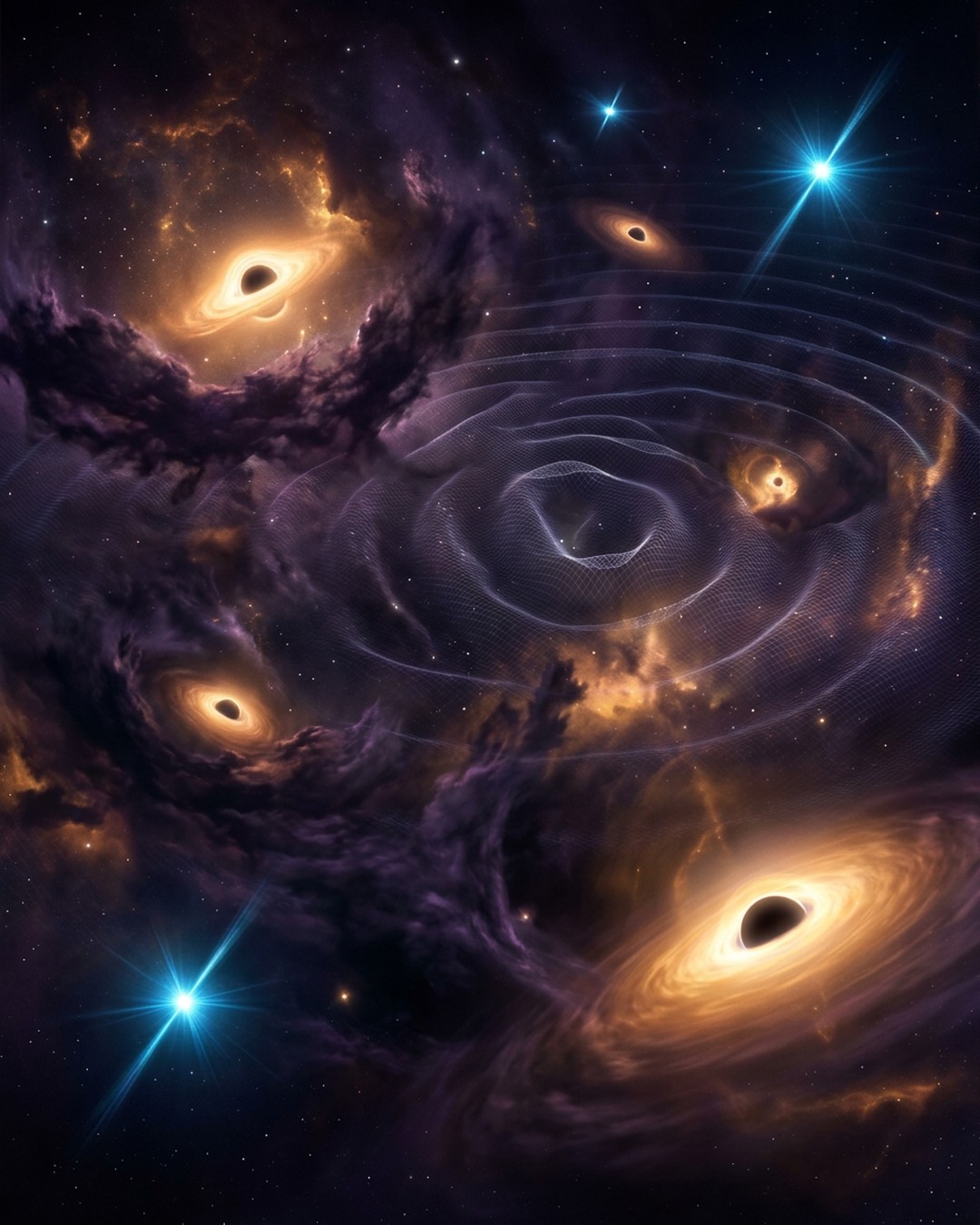
A new study published in Physical Review D by Sohan Ghodla and Cosmin Ilie of Colgate University on August 27, 2026, suggests that pulsar timing arrays (PTAs) could reveal how the universe's first supermassive black holes formed by detecting a background of extremely low-frequency gravitational waves. The researchers explored whether early black hole seeds left behind by hypothetical supermassive Dark Stars could account for a substantial share of the stochastic gravitational-wave background measured by PTAs today, connecting observations of massive early black holes with gravitational waves from merging binaries. Using models of cosmic evolution, the analysis indicates that if supermassive Dark Star remnants had a number density of approximately 10-3 Mpc-3, their descendants could contribute a major portion of the PTA signal, whereas direct-collapse black holes with densities near 10-6 Mpc-3 produce a much weaker background. These findings establish quantitative upper limits on ancient seed populations, demonstrating that seed densities between 10-2 and 10-1 Mpc-3 would overproduce the observed gravitational wave background, thereby providing a novel window into dark matter physics and cosmic dawn phenomena.

キーポイント

01

🔹 Study Overview and Publication

Published on August 27, 2026, in Physical Review D as a Letter by Sohan Ghodla and Cosmin Ilie of Colgate University, the study investigates whether supermassive black holes originating in the early universe account for the gravitational wave background detected by Pulsar Timing Arrays (PTAs).

02

🔸 Role of Supermassive Dark Stars

Hypothetical supermassive Dark Stars powered by dark matter heating rather than nuclear fusion could grow to a million solar masses or more before collapsing, leaving behind black hole seeds that potentially dominate the observed nanohertz gravitational-wave background.

03

⭐ Comparison of Formation Models

The researchers modeled two formation routes: Dark Star remnants with a number density of roughly 10-3 Mpc-3 can match PTA signals, while direct-collapse black holes with characteristic densities near 10-6 Mpc-3 produce a substantially weaker signal.

04

📊 Constraints on Ancient Seed Densities

Existing PTA observations place upper limits on ancient seed populations, showing that seed densities of roughly 10-2 to 10-1 Mpc-3 would over-produce the gravitational-wave background, thus constraining phenomena occurring at redshifts greater than 10.

05

💡 Implications for Gravitational-Wave Astronomy

The findings bridge dark matter physics, cosmic dawn observations, and gravitational wave astronomy by showing that descendant mergers of ancient objects like Dark Stars leave a detectable present-day imprint across the universe.

自分のマインドマップを作成したいですか?

Neumap AIにログインして、あなた専用のマインドマップの作成を始めましょう!

今すぐ始める