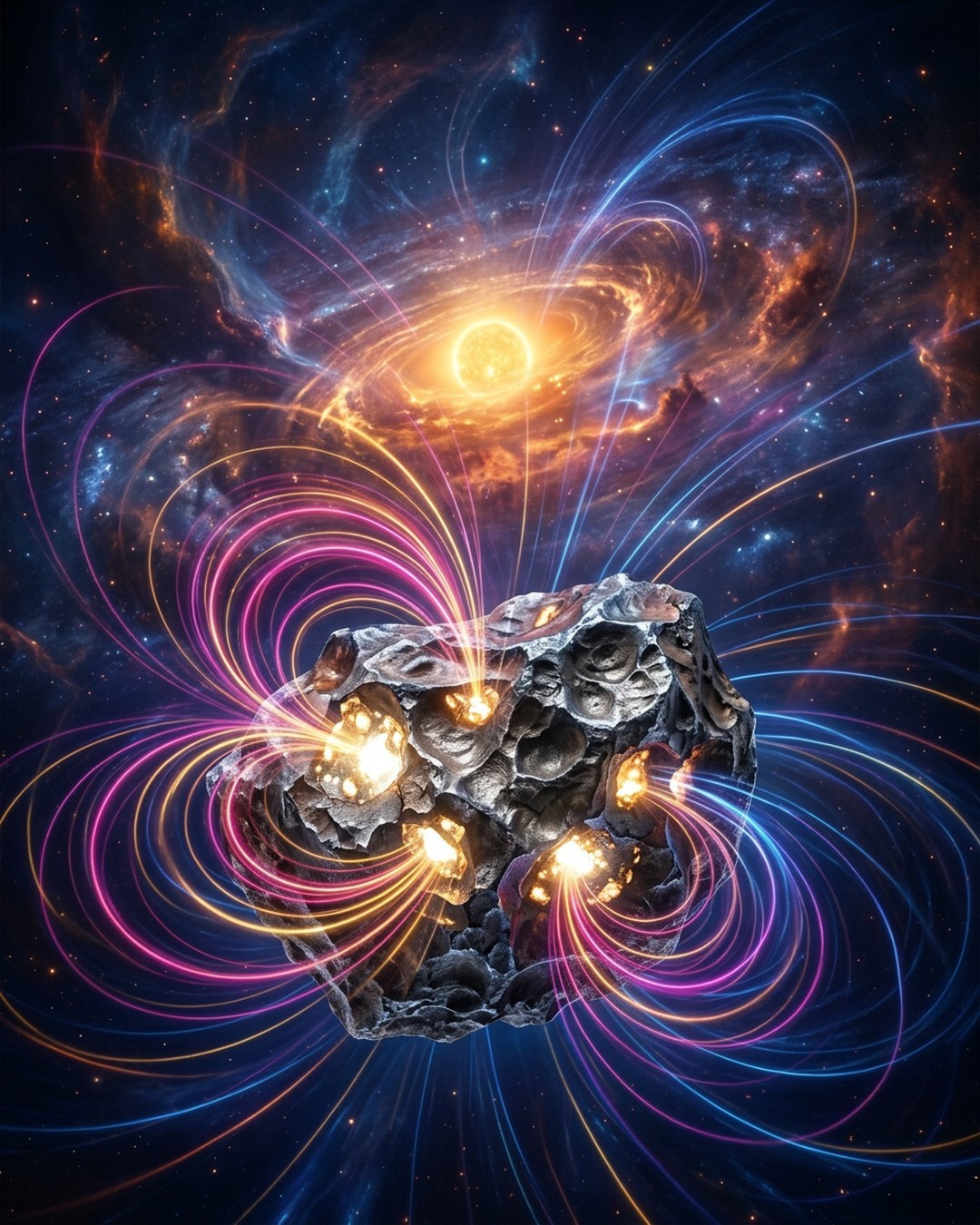
4.6-Billion-Year-Old Meteorite Reveals Primordial Magnetic Field

scitechdaily astronomy planetary-science meteorite magnetism mit

要約

マインドマップカバー画像
AI生成カバー画像

Researchers from the Massachusetts Institute of Technology analyzed microscopic mineral grains called calcium-aluminum-rich inclusions, or CAIs, preserved inside the pristine meteorite DOM 08006 found in Antarctica in 2008. The findings reveal that the infant solar system possessed an unexpectedly strong primordial magnetic field measuring between 150 and 600 microteslas during its first 200,000 years. The study led by Cauê S. Borlina and Benjamin P. Weiss challenges long-held scientific assumptions that gravity alone drove the collapse and flattening of the solar nebula into a protoplanetary disk, demonstrating that magnetic fields played a crucial role in shaping early solar system dynamics and moving matter inward toward the forming Sun. Published on August 24, 2026, in the Proceedings of the National Academy of Sciences, this research bridges critical knowledge gaps regarding the pre-planetary stage of stellar and planetary system evolution, establishing magnetism as a core fundamental ingredient alongside gravity in early solar system formation. Scientists and educators can utilize these insights to update planetary formation models, incorporating ancient magnetic forces into simulations of protoplanetary disk evolution and matter accretion around young stellar objects.

キーポイント

01

🔹 Discovery of Primordial Magnetic Fields in Ancient Meteorite

MIT researchers detected traces of ancient magnetic fields preserved inside microscopic mineral grains known as calcium-aluminum-rich inclusions, or CAIs, within the meteorite DOM 08006, which was discovered in Antarctica in 2008 and dates back 4.6 billion years to the solar system's first 200,000 years.

02

🔸 Unprecedented Strength of the Ancient Solar Magnetic Field

Measurements of the pristine mineral grains indicate that the early solar nebula contained a magnetic field measuring approximately 150 to 600 microteslas, which is roughly three to 12 times stronger than Earth's current magnetic field.

03

⭐ Role of Magnetism in Protoplanetary Disk Evolution

While gravity has traditionally been considered the primary force behind the collapse of the spherical gas and dust cloud into a flat protoplanetary disk, the new evidence shows that strong magnetic fields actively helped drive the inward movement of primordial material toward the central forming Sun.

04

📊 Exceptional Pristine Nature of Meteorite DOM 08006

Meteorite DOM 08006 served as an ideal research subject because it experienced less alteration, water interaction, and destruction over its 4.5 billion-year history compared to almost any other known meteorite, successfully preserving its original mineral composition from the solar system infancy.

05

💡 Research Authorship and Publication Details

Led by former MIT graduate student and current Purdue University assistant professor Cauê S. Borlina alongside MIT Professor Benjamin P. Weiss, the study was published on August 24, 2026, in the Proceedings of the National Academy of Sciences with support from NASA.

自分のマインドマップを作成したいですか?

Neumap AIにログインして、あなた専用のマインドマップの作成を始めましょう!

今すぐ始める