Heavy Neutrino and Matter-Antimatter Asymmetry

scitechdaily physics cosmology neutrinos antimatter

要約

マインドマップカバー画像
AI生成カバー画像

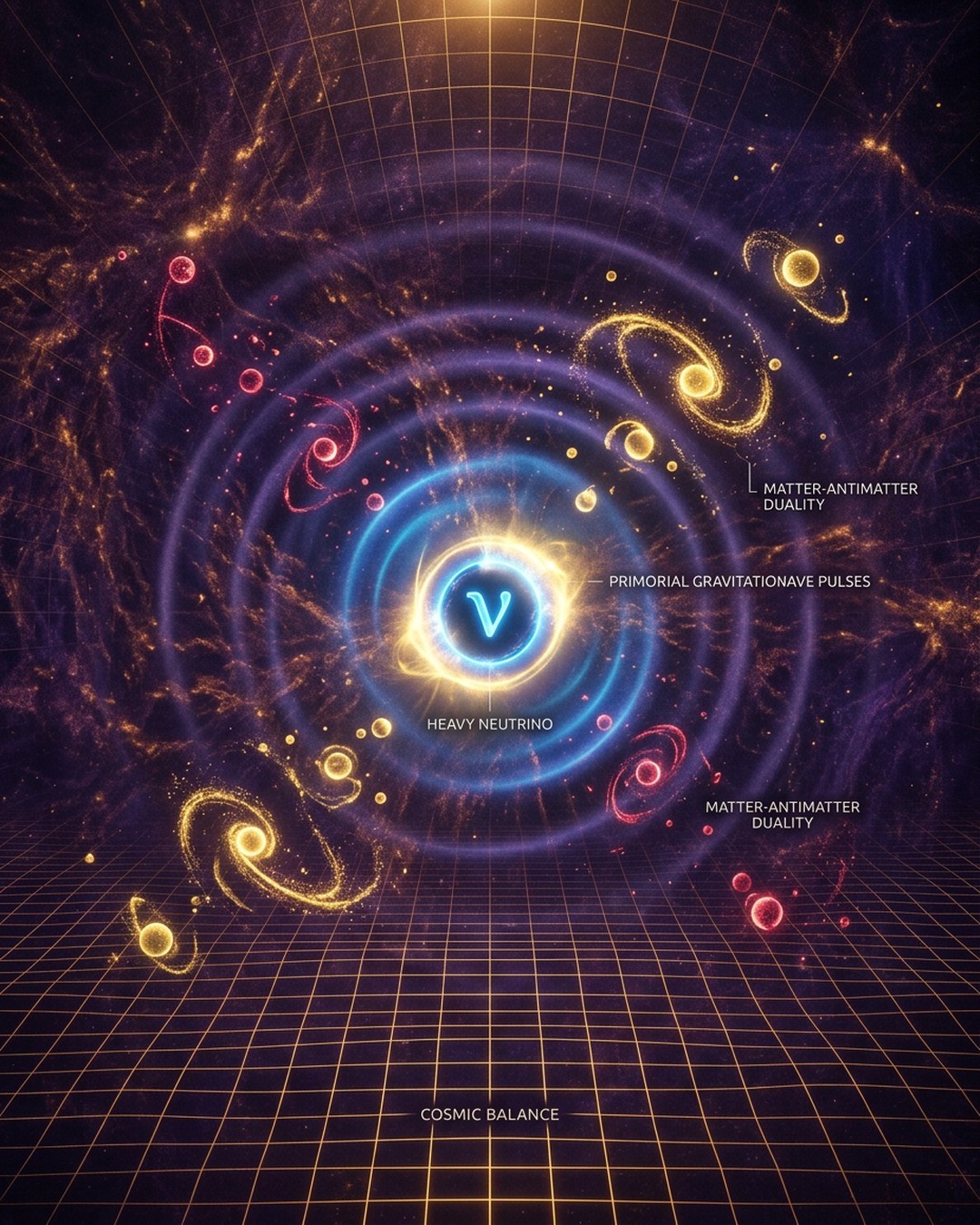
Physicists at the University of Southampton and the Indian Institute of Technology Kanpur published research on October 29, 2026, in Physical Review Letters, proposing that a decoupled heavy neutrino could explain why matter survived the Big Bang instead of completely annihilating with antimatter. The authors argue that this heavy relative of the neutrino decays incredibly slowly, taking over the energy density of the early universe as it cooled and triggering a temporary matter-dominated period that reshaped cosmic expansion. This matter-dominated period altered the temperature at which fundamental particles and their anti-particles interacted via the Standard Model Higgs boson, effectively acting as a thermal switch that determined the matter-antimatter asymmetry. The theory also predicts that this dramatic shift in early cosmic expansion leaves detectable imprints on primordial gravitational waves, offering a new avenue for testing the origin of the universe using future gravitational wave observations.

キーポイント

01

🔹 Matter-Antimatter Asymmetry Puzzle Solved by Heavy Neutrino

【📌 Core Finding】Published on October 29, 2026, in Physical Review Letters by Dr. Rishav Roshan and Dr. Sudipta Show. 【🔸 Mechanism】A long-lived decoupled heavy neutrino temporarily dominated the early universe's energy density. 【⭐ Impact】This created a matter-dominated period that altered fundamental particle interactions and tipped the balance toward surviving matter.

02

🔸 Role of Decoupled Heavy Neutrinos in Cosmic Expansion

【📌 Background】Long dismissed as an irrelevant background detail because its interactions were considered too weak. 【🔸 Slow Decay】The particle decays incredibly slowly, allowing it to survive long enough during cosmic cooling to dominate the energy budget. 【⭐ Cosmic Shift】This temporary dominance fundamentally changed how quickly the cosmos expanded after the Big Bang.

03

⭐ Thermal Switch Mechanism via Standard Model Higgs Boson

【📌 Temperature Shift】The matter-dominated period altered the temperature of the early universe. 【🔸 Particle Interaction】Fundamental particles like electrons and leptons interacted with their anti-particles with the help of the Standard Model Higgs boson. 【⭐ Asymmetry Switch】This temperature acted as a thermal switch that shaped how the matter-antimatter imbalance was successfully built up.

04

📊 Primordial Gravitational Waves as Detectable Imprints

【📌 Observational Evidence】The dramatic shift in early cosmic expansion leaves distinct imprints on primordial gravitational waves. 【🔸 New Research Avenues】These gravitational wave signatures provide a concrete method to unravel the evolution of the early universe. 【⭐ Future Testing】Astrophysicists can search for these specific wave traces to validate the minimal seesaw model mechanism.

05

💡 Institutional Collaboration and Publication Details

【📌 Research Team】Led by Dr. Rishav Roshan from the University of Southampton and Dr. Sudipta Show from the Indian Institute of Technology Kanpur. 【🔸 Publication】Research titled Delayed Charged Lepton Yukawa Equilibration in Minimal Seesaw published on September 8, 2026. 【⭐ Academic Impact】Bridges particle physics and cosmology by linking heavy neutrino dynamics directly to observable gravitational wave signatures.

自分のマインドマップを作成したいですか?

Neumap AIにログインして、あなた専用のマインドマップの作成を始めましょう!

今すぐ始める