Mathematical Patterns in Love

SciTechDaily Mathematics Psychology Relationships ArtificialIntelligence

要約

マインドマップカバー画像
AI生成カバー画像

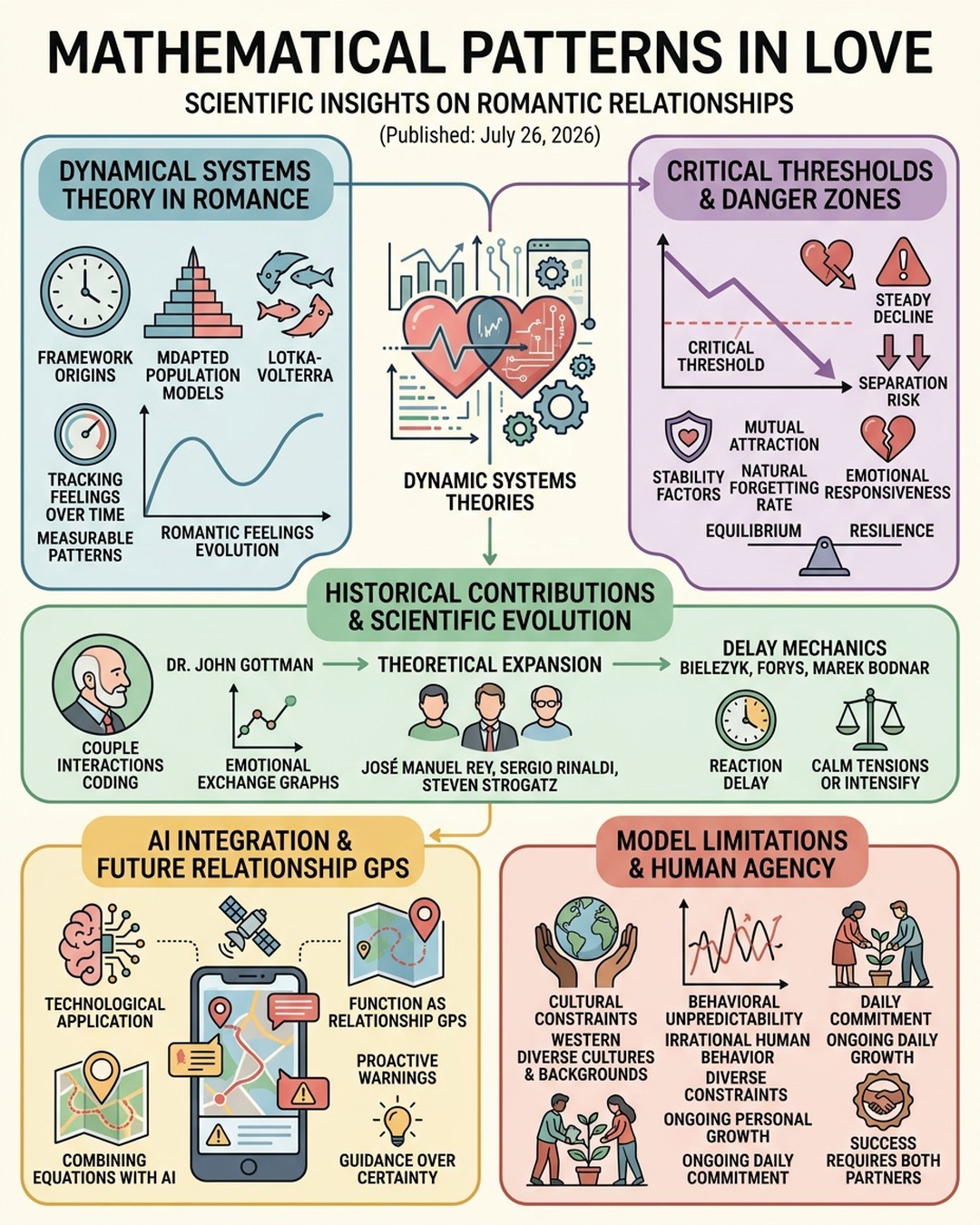
Published on July 26, 2026, scientific research reveals that romantic relationships follow measurable mathematical patterns shaped by attraction levels, emotional response dynamics, and stress resilience. Professor Laurent Pujo-Menjouet from the University of Lyon I explains that dynamical systems theories, historically used in population models like the Malthus model and Lotka-Volterra predator-prey equations, can successfully describe the evolution of human romantic feelings over time. The author's primary perspective emphasizes that love is not governed by mysterious magic, but rather by quantifiable forces that dictate whether a couple remains stable or drifts toward separation. By incorporating factors such as forgetting rates, emotional reaction delays, and critical thresholds, mathematical frameworks can effectively identify potential relationship danger zones before a breakup becomes inevitable. The article details how historical contributions from researchers like John Gottman, José Manuel Rey, Sergio Rinaldi, and Steven Strogatz have expanded dynamical systems theory into interpersonal psychology. Furthermore, future applications of artificial intelligence could combine these mathematical models to act as a relationship GPS, warning couples of risky states and suggesting proactive routes for conflict resolution. Practical application suggests that understanding these mathematical thresholds gives couples actionable tools to measure their resilience against external stressors like financial difficulties, work pressure, or illness. While human behavior remains unpredictable and influenced by cultural or psychological variables, these equations highlight the vital importance of daily commitment and proactive communication in maintaining long-term stability.

キーポイント

01

🔹 Dynamical Systems Theory in Romance

【📌 Core Concept】Published on July 26, 2026, research by Professor Laurent Pujo-Menjouet of the University of Lyon I applies dynamical systems theories to romantic relationships. 【🔸 Mathematical Origin】The framework adapts historical population models, including 18th-century Malthus population models and 1920s Lotka-Volterra predator-prey equations, to track how romantic feelings change over time. 【⭐ Key Finding】Love follows measurable patterns driven by attraction, emotional reactions, and stress resilience rather than random chance.

02

🔸 Critical Thresholds and Relationship Danger Zones

【📌 Critical Threshold】Every relationship possesses a minimum strength threshold; if feelings fall below this level and remain there, mathematical models predict a steady decline toward separation. 【🔸 Stability Factors】Long-term stability depends on three primary variables: mutual attraction levels, the natural forgetting rate or weakening of feelings over time, and how partners respond to each other's emotions. 【⭐ Resilience】The key factor is not whether couples argue, but whether they possess sufficient resilience to return to emotional equilibrium after disruptions.

03

⭐ Historical Contributions and Scientific Evolution

【📌 Pioneers】Psychologist Dr. John Gottman pioneered relationship outcome modeling by coding couple interactions and graphing emotional exchanges. 【🔸 Theoretical Expansion】Researchers like José Manuel Rey, Sergio Rinaldi, and Steven Strogatz expanded dynamical systems theory to interpersonal dynamics. 【⭐ Delay Mechanics】Polish researchers Bielezyk, Forys, and Marek Bodnar introduced reaction delays into the equations, showing how taking time to process conflict can either calm tensions or intensify them.

04

📊 AI Integration and Future Relationship GPS

【📌 Technological Application】Future models aim to combine mathematical equations with artificial intelligence to function as a relationship GPS. 【🔸 Proactive Warnings】An AI-driven system could detect warning signs when a relationship approaches a risky state, giving couples time to course-correct. 【⭐ Guidance Over Certainty】The models do not dictate fixed outcomes or predict specific romantic partners, but rather illuminate general behavioral tendencies and provide navigational guidance.

05

💡 Model Limitations and Human Agency

【📌 Cultural Constraints】Most current models are based largely on Western relationship patterns, meaning they require significantly greater complexity to account for diverse cultures, religions, and economic backgrounds. 【🔸 Behavioral Unpredictability】Human behavior is inherently irrational and unpredictable, meaning mathematical equations estimate tendencies rather than absolute certainties. 【⭐ Daily Commitment】Ultimately, mathematical models can illuminate paths and warn of danger zones, but successful relationships require ongoing daily commitment, personal growth, and therapy from both partners.

自分のマインドマップを作成したいですか?

Neumap AIにログインして、あなた専用のマインドマップの作成を始めましょう!

今すぐ始める