Master Developmental Clock in C. elegans

Biology Genetics DevelopmentalBiology ColdSpringHarborLaboratory CellularClock

要約

マインドマップカバー画像
AI生成カバー画像

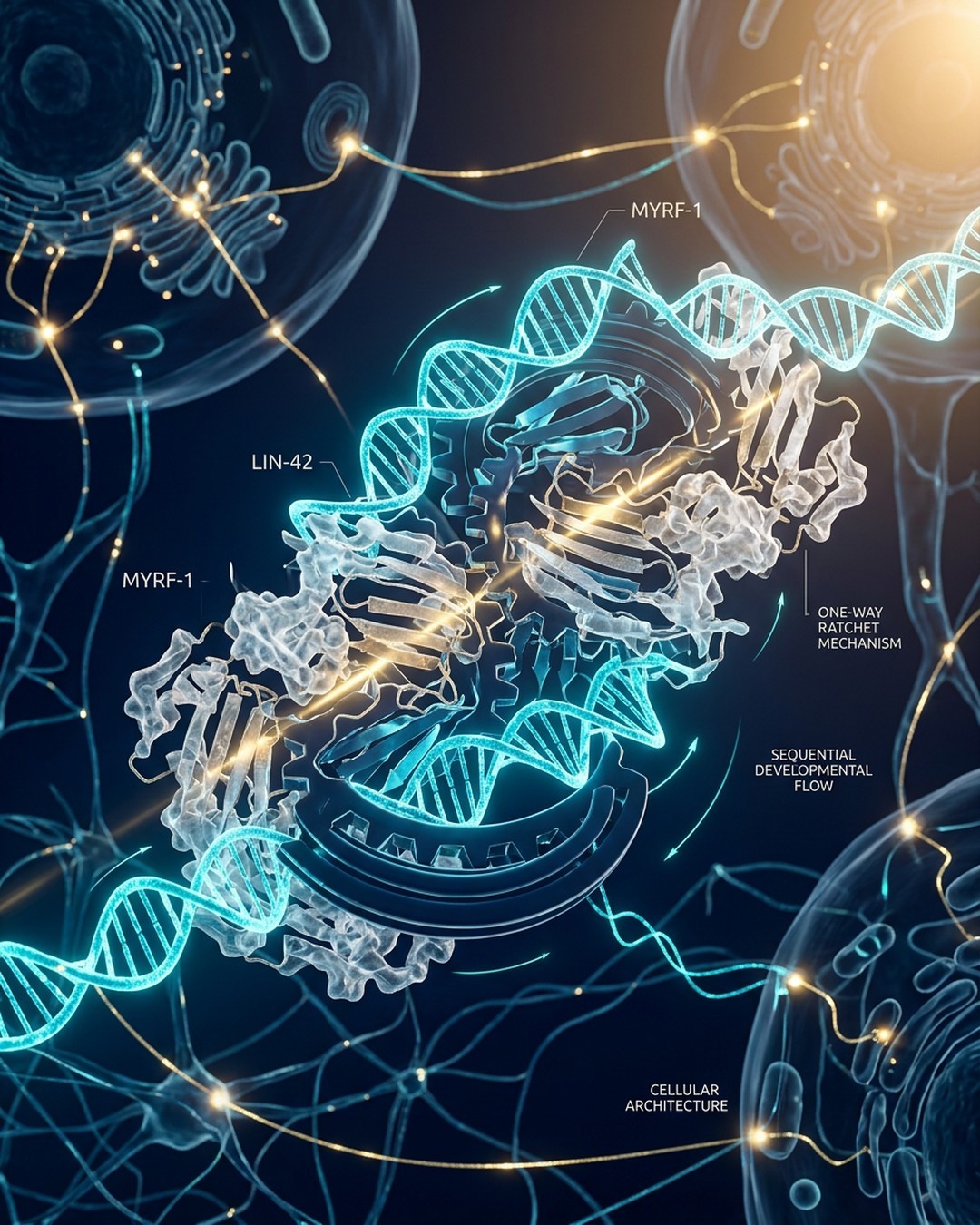
Researchers at Cold Spring Harbor Laboratory have identified a master developmental clock in the nematode C. elegans, composed of two proteins, MYRF-1 and LIN-42. This biological mechanism coordinates the precise timing and duration of gene expression pulses required for larval development, ensuring that growth stages occur sequentially and without repetition. The study, published on May 6, 2026, in the Proceedings of the National Academy of Sciences, highlights that this clock functions like a one-way ratchet, driving development forward. When the MYRF-1 protein is inhibited, the developmental process halts, underscoring its critical role as a master regulator for cellular growth and maturation. By integrating molecular biology, DNA sequencing, and AlphaFold (an AI protein structure prediction tool), the team demonstrated that MYRF-1 initiates gene pulses while LIN-42 modulates their intensity and duration. This discovery provides a new framework for understanding how cells maintain synchronization during organismal development. This research offers significant potential for understanding human developmental disorders and genetic diseases. By investigating how these cellular clocks communicate and remain synchronized, scientists hope to uncover the underlying mechanisms of developmental failure, potentially leading to new insights into cellular differentiation and growth-related pathologies.

キーポイント

01

🔹 Discovery of the Master Developmental Clock

【📌 Key Finding】Researchers identified a master clock in C. elegans driven by the proteins MYRF-1 and LIN-42. 【🔸 Mechanism】This system coordinates the timing and duration of gene expression pulses across four larval stages. 【⭐ Significance】Unlike circadian rhythms that repeat, this clock is a finite, one-way ratchet system ensuring developmental events occur in a specific, non-repeating sequence.

02

🔸 Functional Roles of MYRF-1 and LIN-42

【📌 MYRF-1】Acts as the master key for growth stages; it initiates new waves of gene activity and serves as a checkpoint marker for stage completion. 【📌 LIN-42】Regulates the intensity and duration of the gene expression pulses initiated by MYRF-1. 【⭐ Causal Relationship】MYRF-1 activates LIN-42, creating a feedback circuit that keeps the developmental process moving forward.

03

⭐ Experimental Methodology and Tools

【📌 Research Approach】The team utilized a combination of traditional molecular biology experiments and advanced computational tools. 【⭐ Technology】DNA sequencing and protein sequencing were used to map the interactions, while AlphaFold (AI-based protein structure prediction) helped characterize the structural relationship between the proteins. 【📌 Impact】These methods confirmed that blocking MYRF-1 causes a complete breakdown in developmental progression.

04

📊 Implications for Developmental Biology

【📌 Cellular Communication】The study raises new questions about whether individual cellular clocks communicate to maintain synchronization across the entire organism. 【⭐ Future Research】Scientists are now investigating the physical interaction between MYRF-1 and LIN-42 to determine if this circuit is universal across all cells in the worm. 【📌 Clinical Relevance】Understanding these timing systems may provide insights into human developmental disorders and genetic diseases caused by synchronization failures.

05

💡 Core Research Conclusion

【📌 Primary Conclusion】Healthy development is dependent on precise temporal signaling. 【⭐ Analogy】The researchers compare the system to a train: if the engineer's watch (the clock) fails to signal departure, the train (development) remains at the station. 【📌 Key Takeaway】The MYRF-1/LIN-42 circuit is the essential mechanism that prevents developmental 'stalling' and ensures proper maturation.

自分のマインドマップを作成したいですか?

Neumap AIにログインして、あなた専用のマインドマップの作成を始めましょう!

今すぐ始める