237-Million-Year-Old Marine Amphibian Discovery

scitechdaily paleontology fossils amphibians triassic uc-davis

要約

マインドマップカバー画像
AI生成カバー画像

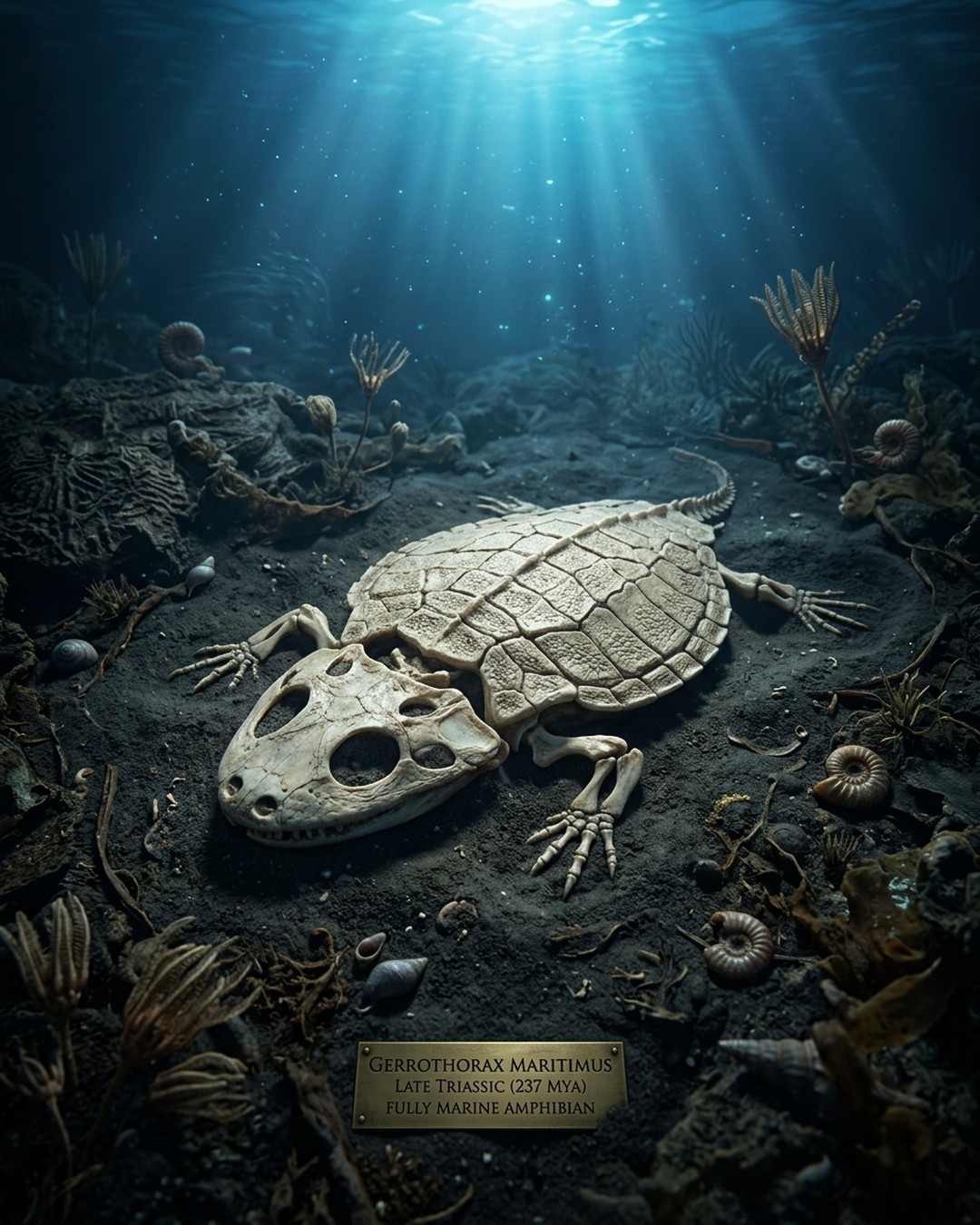
Researchers from the University of California Davis, Peking University, and the Geological Museum of Guizhou have discovered two nearly complete 237-million-year-old fossil skeletons in China's Guizhou Province, identifying them as Gerrothorax maritimus. This species represents the first fully marine amphibian on record, challenging the long-standing biological assumption that all amphibians are strictly dependent on freshwater due to their permeable skin. The findings were published in Nature Ecology & Evolution on October 26, 2026. The study's authors, including corresponding author Ryosuke Motani, emphasize that this discovery redefines our understanding of ancient marine ecosystems during the Late Triassic period. By analyzing deep-sea sediments and strontium isotope proportions that match Late Triassic seawater, the researchers confirmed the animal lived and died in a marine environment hundreds of miles from large landmasses, rather than being washed out to sea. To solve the paradox of how an amphibian could survive in salt water, the researchers propose that Gerrothorax maritimus utilized a unique combination of heavy bony armor to prevent skin absorption, combined with fish-like biology. The animal likely drank salt water through its mouth, processed it via its digestive tract, and relied on gills to filter out excess salt while hunting as a seafloor ambush predator. This groundbreaking paleontology discovery opens new avenues for exploring vertebrate adaptation and marine evolution. Scientists can apply these insights to re-evaluate other fossil records and understand how prehistoric organisms breached major physiological barriers to conquer diverse habitats during periods of severe ecological transition.

キーポイント

01

🔹 Discovery of Gerrothorax Maritimus Fossils

【📌 Key Finding】Researchers discovered two nearly complete 237-million-year-old fossil skeletons in Guizhou Province, China. 【🔸 Impact Factors】Published in Nature Ecology & Evolution on October 26, 2026, by a collaborative team from UC Davis, Peking University, and the Geological Museum of Guizhou. 【⭐ Data Support】Identified as the first known fully marine amphibian on record, living approximately 237 million years ago during the Late Triassic period.

02

🔸 Verification of Marine Habitat

【📌 Key Finding】Deep-sea sediment location and preserved fingers prove the animals lived and died where they were buried. 【🔸 Impact Factors】Carcasses at sea typically lose limbs before sinking, but preserved fingers indicate local death. 【⭐ Data Support】Geochemical analyses of strontium isotopes closely matched expected proportions for Late Triassic seawater.

03

⭐ Physiological Adaptation to Salt Water

【📌 Key Finding】Modern amphibians cannot survive in salt water due to permeable skin used for respiration and water intake. 【🔸 Impact Factors】Fewer than 2% of over 8,000 living amphibian species show salt tolerance. 【⭐ Data Support】Gerrothorax maritimus overcame this via heavy bony armor that blocked skin absorption, requiring it to drink salt water and use gills to filter salt.

04

📊 Physical Characteristics and Feeding Behavior

【📌 Key Finding】The creature featured a flattened, disc-shaped body nearly three feet long, covered in protective bony armor. 【🔸 Impact Factors】Armor provided defense against predators such as ichthyosaurs during the Late Triassic. 【⭐ Data Support】Morphology suggests it operated as a seafloor ambush hunter, using suction feeding comparable to modern wobbegong carpet sharks.

05

💡 Research Significance and Collaboration

【📌 Key Finding】Led by corresponding author Ryosuke Motani alongside Lipin Diao, Da-yong Jiang, Jiaxu Hao, and Shengyu Wang. 【🔸 Impact Factors】Funded by the National Natural Science Foundation of China. 【⭐ Data Support】Challenges the freshwater dependence paradigm of amphibians and expands our knowledge of Late Triassic marine ecosystems.

自分のマインドマップを作成したいですか?

Neumap AIにログインして、あなた専用のマインドマップの作成を始めましょう!

今すぐ始める