Evolutionary Drivers of Bird and Dinosaur Eggs

scitechdaily paleontology evolutionary-biology birds dinosaurs

要約

マインドマップカバー画像
AI生成カバー画像

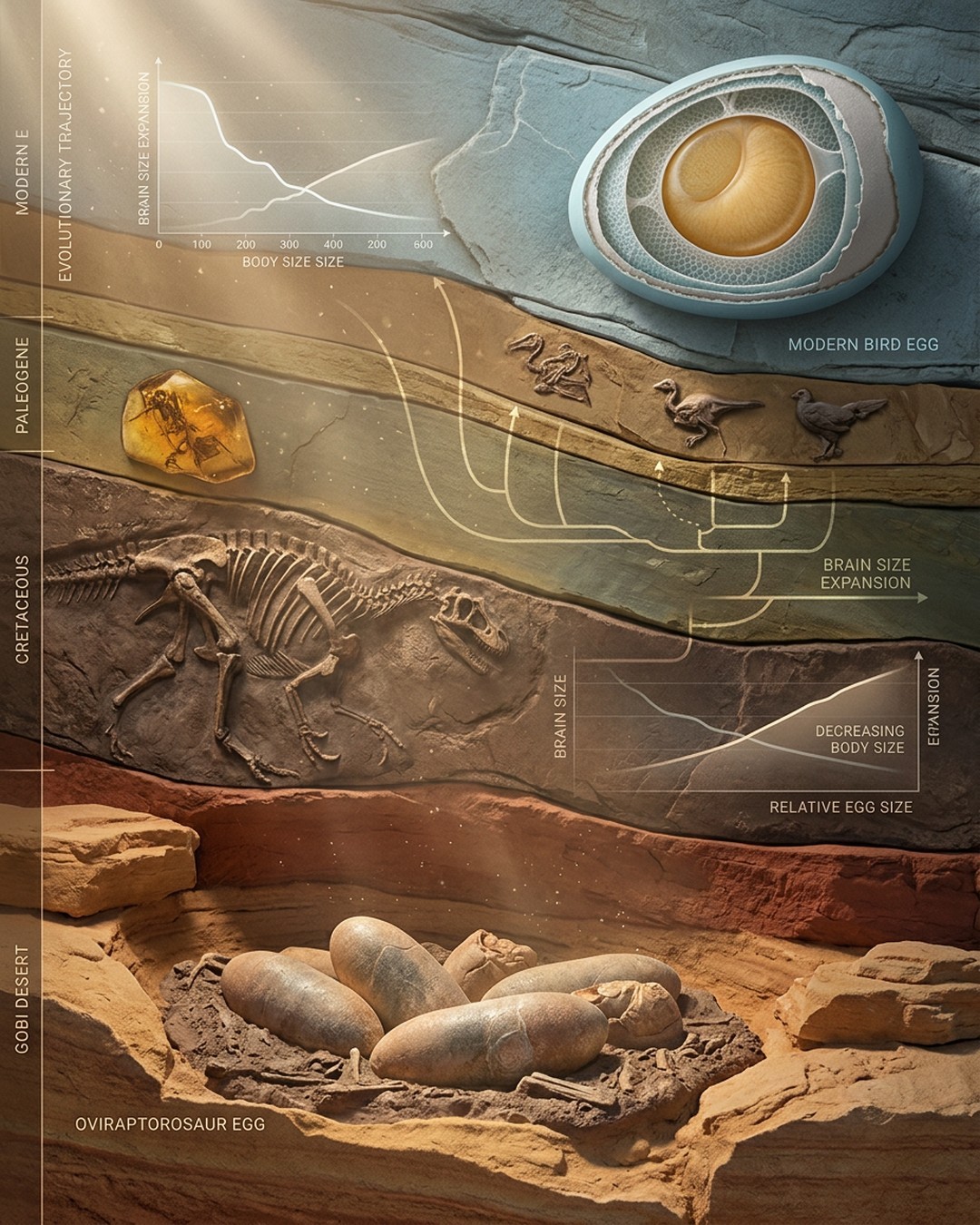
Researchers from the American Museum of Natural History and Princeton University published a study in Royal Society Open Science on June 24, 2026, solving a long-standing evolutionary mystery regarding why modern bird eggs can be larger than those of massive non-avian dinosaurs. The team analyzed reproductive and anatomical data across mammals, birds, and reptiles to establish a unified macroevolutionary framework. The study reveals a fundamental link between relative brain size and offspring size, demonstrating that species with larger brains require higher energy investments and developmental resources per offspring, leading to fewer but larger young and consequently larger eggs. As birds evolved smaller bodies compared to their dinosaur ancestors alongside larger brains, this evolutionary shift drove them toward larger reproductive outputs relative to body mass. This discovery recontextualizes key fossil evidence, such as the nesting oviraptorosaurs discovered in the Gobi Desert during the 1990s, by connecting brain evolution directly with reproductive investment strategies and anatomical transitions. The findings indicate that enlarged brains and larger eggs cascadingly influenced related physical traits, including pelvic canal width, specialized nest structures for incubation airflow, and enhanced parental care requirements. Future research will focus on examining reproductive frequency across living species that reproduce multiple times per year and investigating additional physiological drivers of amniote reproductive variation. The findings bridge significant gaps in vertebrate paleobiology and provide a comprehensive baseline for understanding the evolutionary cascade from dinosaurs to modern birds.

キーポイント

01

🔹 Core Discovery on Brain and Offspring Size

Researchers Stephanie Constance Lechki and Roger B. J. Benson published a study in Royal Society Open Science on June 24, 2026, revealing a fundamental link between relative brain size and offspring size across land vertebrates (amniotes). Species with relatively larger brains tend to invest more energy and developmental resources into each offspring, producing fewer and larger young which subsequently require larger eggs.

02

🔸 Resolving the Dinosaur-to-Bird Egg Mystery

The study solves the evolutionary paradox of why modern birds can produce eggs larger than those of massive non-avian dinosaurs despite having much smaller bodies. As birds became smaller than their dinosaur ancestors, the simultaneous evolution of larger brains pushed them toward larger relative offspring size and oversized eggs.

03

⭐ Integration of Fossil Evidence and Gobi Desert Discoveries

The research integrates critical fossil evidence, including nesting oviraptorosaurs uncovered during American Museum of Natural History expeditions to the Gobi Desert in the 1990s. These discoveries are now understood within a broader macroevolutionary picture where brain enlargement served as a primary driver of reproductive changes during the dinosaur-to-bird transition.

04

📊 Cascading Anatomical and Behavioral Impacts

Larger eggs driven by brain enlargement triggered cascading evolutionary responses across avian lineage traits, including the need for a wider pelvic canal for egg-laying, specialized nest structures allowing optimal airflow during incubation, and increased levels of parental investment and care required after hatching.

05

💡 Future Research Directions and Methodological Limitations

While fossil records present challenges in estimating annual reproductive frequency, future work led by the American Museum of Natural History and Princeton University will test these evolutionary patterns among living species reproducing multiple times per year, while examining additional physiological factors influencing amniote reproductive output.

自分のマインドマップを作成したいですか?

Neumap AIにログインして、あなた専用のマインドマップの作成を始めましょう!

今すぐ始める