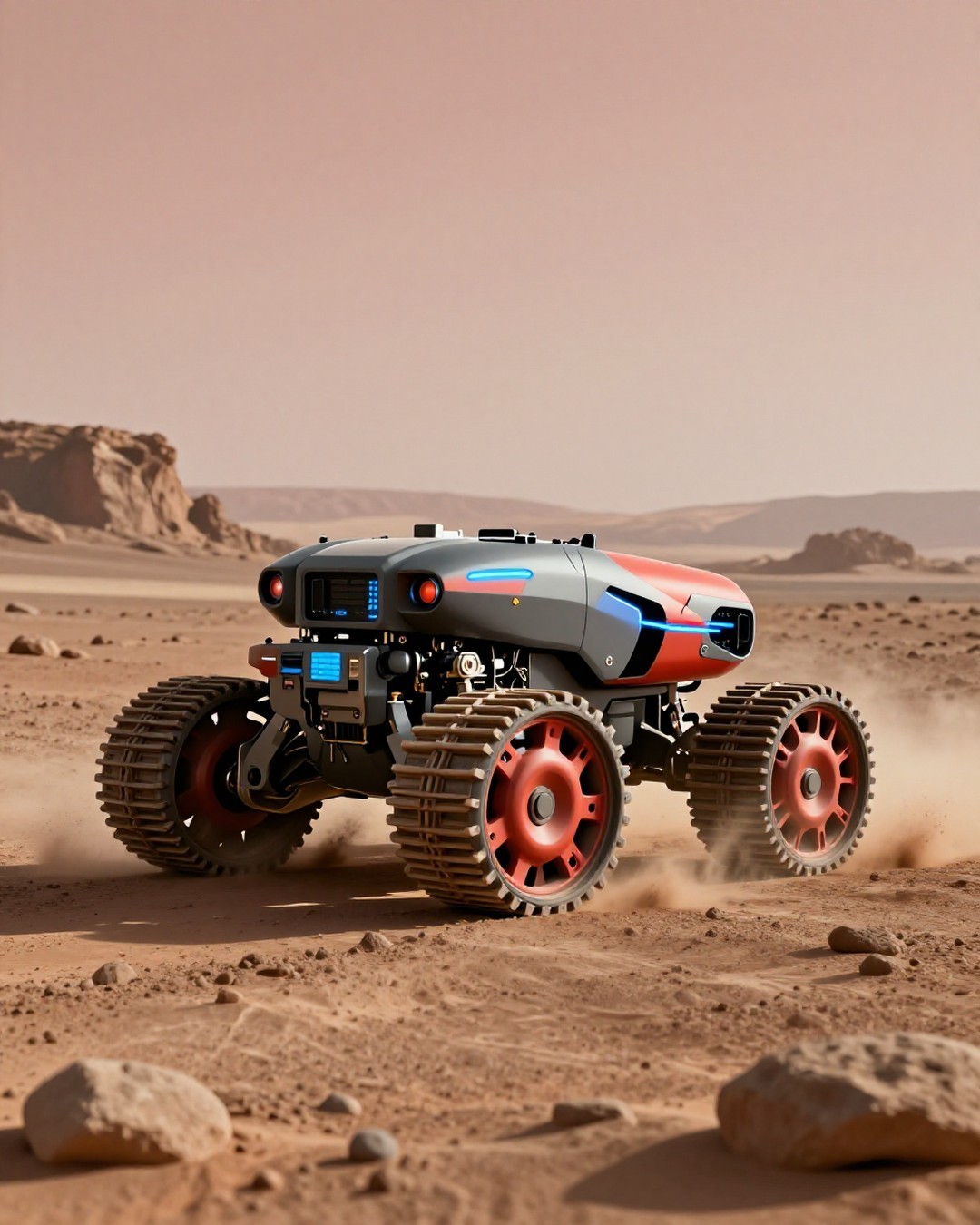
Bio-inspired Mars Rover Mobility

MarsRover Robotics Bio-inspiredDesign SpaceExploration UniversityOfWürzburg SandfishLizard

要約

マインドマップカバー画像
AI生成カバー画像

Researchers at the University of Würzburg, led by Marco Schmidt, have developed an experimental Mars rover featuring bio-inspired wheels designed to navigate loose, sandy terrain. By mimicking the locomotion of the sandfish lizard (Scincus scincus), which 'swims' through sand, the team successfully addressed the common issue of rover wheels slipping or sinking in granular environments. This project, part of the German Aerospace Center's VaMEx initiative, represents a significant advancement in planetary exploration mobility. The project team emphasizes that conventional wheel designs often fail on soft ground due to excessive ground pressure and poor traction. Through iterative testing in collaboration with the German Research Center for Artificial Intelligence (DFKI), the researchers identified that wider, lighter wheels significantly improve stability and control. The rover's ability to generate both longitudinal and lateral forces, evidenced by sinusoidal tracks, confirms the effectiveness of the bio-inspired swimming mechanism. Beyond mechanical hardware, the research team is shifting focus toward intelligent, software-guided mobility. Future developments aim to integrate control strategies that adapt to terrain interactions, allowing rovers to autonomously manage slipping and sinking in real-time. This holistic approach combines biological observation with advanced robotics to enhance the reliability of future space exploration missions. This innovation offers a practical solution for overcoming the mobility challenges faced by previous Mars missions. For engineers and researchers, the study highlights the importance of bio-mimicry in robotics and the necessity of optimizing ground pressure for soft-terrain navigation. The ongoing integration of adaptive software suggests a future where autonomous systems can navigate complex, unpredictable planetary surfaces with unprecedented efficiency.

キーポイント

01

🔹 Bio-inspired Mobility Mechanism

The rover's wheels are modeled after the sandfish lizard (Scincus scincus), a Sahara desert reptile capable of 'swimming' through sand. By mimicking the lizard's interaction with the ground, the wheels generate both longitudinal and lateral forces, allowing the rover to move through loose material rather than just rolling over it.

02

🔸 Design Iteration and Optimization

Initial prototypes were too heavy and narrow, leading to high ground pressure and sinking. The team optimized the design by increasing wheel width and reducing weight, which successfully lowered ground pressure, minimized slipping, and improved overall stability on sandy terrain.

03

⭐ Collaborative Research Framework

The project is led by Professor Marco Schmidt at the University of Würzburg as part of the German Aerospace Center's (DLR) VaMEx initiative. The team collaborated with the German Research Center for Artificial Intelligence (DFKI) in Bremen to conduct experimental validation in both sand and open-field environments.

04

📊 Performance Indicators

The success of the swimming mechanism is confirmed by the creation of sinusoidal tracks in the sand. These tracks indicate that the wheels are effectively interacting with the granular medium, providing the necessary traction that conventional pneumatic wheels often lack in similar conditions.

05

💡 Future Software Integration

The ESSEO team is expanding the project to include software-guided mobility. The goal is to develop control strategies that account for slipping and sinking, enabling the rover to adaptively navigate complex, granular environments autonomously during future planetary missions.

自分のマインドマップを作成したいですか?

Neumap AIにログインして、あなた専用のマインドマップの作成を始めましょう!

今すぐ始める