Propellantless Spacecraft Technologies

space-exploration propulsion-technology aerospace-engineering solar-sails astrophysics

要約

マインドマップカバー画像
AI生成カバー画像

Propellantless propulsion technologies represent a critical shift in space exploration, moving away from the traditional rocket equation that requires carrying heavy fuel. By leveraging external forces such as planetary gravity, solar radiation pressure, and solar wind, these methods aim to overcome the compounding weight penalties of chemical combustion, potentially enabling long-duration missions that are currently unfeasible with conventional rockets. The author highlights that while these technologies offer significant advantages in efficiency and mission duration, they are currently constrained by specific engineering and environmental limitations. The transition from theoretical potential to practical application requires overcoming hurdles related to planetary alignment, material durability, and the development of massive, complex infrastructure in space. Core propellantless strategies include gravity assists, which utilize planetary momentum; solar sails, which harness photon radiation pressure; and magnetic or electric sails, which interact with solar wind plasma. Each method presents a unique trade-off between current technological readiness and future performance capabilities, necessitating a diversified approach to deep-space travel. For researchers and engineers, the practical value lies in integrating these diverse propulsion systems to optimize mission profiles. Future advancements will likely focus on material science for large-scale structures and the refinement of electromagnetic field deployment, which are essential for achieving the speeds required for interstellar exploration.

キーポイント

01

🔹 The Rocket Equation Constraint

Since Konstantin Tsiolkovsky formulated the rocket equation in 1903, space travel has been limited by the need to carry propellant. Because fuel adds mass, more fuel is required to accelerate that mass, creating a compounding burden that restricts mission range and duration. Propellantless propulsion seeks to break this cycle by utilizing momentum from external sources.

02

🔸 Gravity Assist Mechanics

【📌 Mechanism】Spacecraft pass by planets at specific angles to gain orbital momentum. 【🔸 Impact Factors】Requires precise planetary alignment, limiting launch windows and potential routes. 【⭐ Data Support】Successfully utilized by the Voyager missions to tour all four outer planets without additional fuel consumption.

03

⭐ Solar and Magnetic Sail Technologies

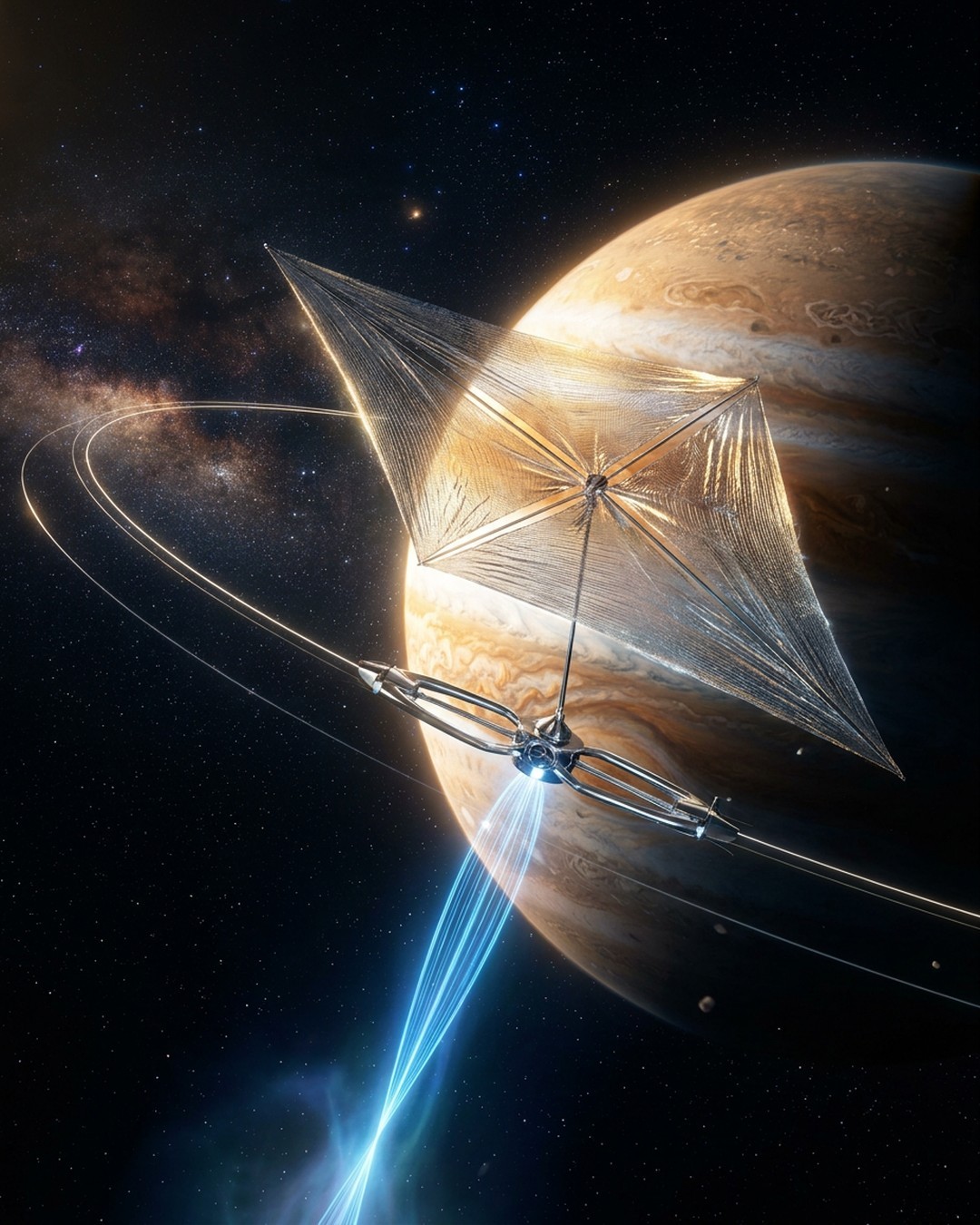
Solar sails use large membranes to reflect photons, generating continuous thrust (e.g., JAXA's IKAROS probe). Magnetic sails use superconducting coils to deflect solar wind plasma, offering higher potential acceleration but requiring massive, cryogenic infrastructure (coils up to 50km in radius) that is currently beyond existing deployment capabilities.

04

📊 Electric Sail Innovation

Electric sails utilize charged tethers to repel solar wind protons. This approach is theoretically lighter than magnetic sails, though it requires significant electrical power to maintain the charge and the deployment of extremely long, lightweight wires in the harsh space environment.

05

💡 Strategic Outlook for Interstellar Travel

No single propellantless method is a universal solution. Gravity assists are limited by planetary positions, solar sails degrade over time, and magnetic/electric sails require advanced materials. Future interstellar success depends on combining these technologies to overcome the limitations of chemical rockets.

自分のマインドマップを作成したいですか?

Neumap AIにログインして、あなた専用のマインドマップの作成を始めましょう!

今すぐ始める