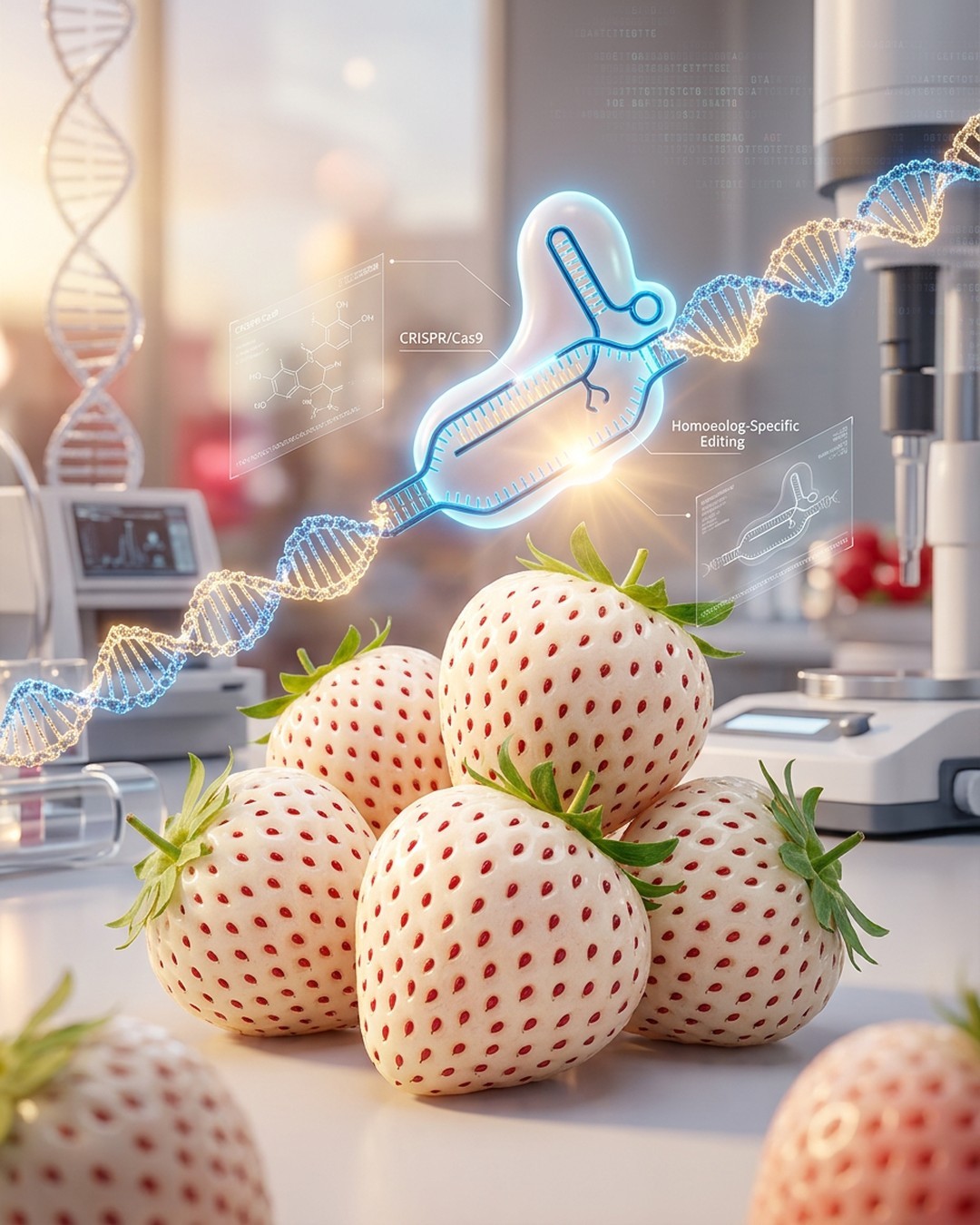
CRISPR/Cas9 Homoeolog-Specific Gene Editing in Strawberries

scitechdaily biology crispr genetics plant-science agriculture

要約

マインドマップカバー画像
AI生成カバー画像

Researchers from institutions including Kongju National University and the University of Florida successfully converted red strawberries into stable white fruit by precisely editing a single dominant gene copy using CRISPR/Cas9 technology. Cultivated octoploid strawberries contain eight sets of chromosomes, making genetic modification challenging due to gene redundancy, but the team targeted the MYB10-1B gene copy responsible for regulating anthocyanin pigment production. Published on August 25, 2026, in Horticulture Research, the study demonstrated that disrupting MYB10-1B results in white fruit while keeping seeds red, showing tissue-specific pigmentation control and minimal off-target genome changes. The study's authors emphasize that precision in polyploid crop breeding matters more than broad modifications, proving that editing a single dominantly expressed homoeolog is enough to drive a stable phenotypic change without disrupting all gene copies. Transcriptome analysis confirmed that MYB10-1B was strongly expressed in red fruit, and its inactivation sharply reduced the activity of important pigment-producing genes like CHS, DFR, and ANS, while related homoeologs failed to compensate for the loss. This targeted strategy establishes a practical roadmap for functional genomics and agricultural trait improvement, overcoming historical difficulties associated with complex polyploid genomes in crops. By selectively editing influential gene copies rather than knocking out every related variant, breeders can achieve dramatic trait modifications while preserving valuable genetic backgrounds of established crop varieties. The successful application of homoeolog-specific CRISPR editing opens new possibilities for fine-tuning complex traits in polyploid fruits and vegetables, including flavor, nutritional content, and stress tolerance. As high-quality reference genomes and precise CRISPR designs continue to improve, agricultural researchers can apply this targeted methodology to accelerate crop development and enhance resilience against environmental pressures.

キーポイント

01

🔹 Core Discovery: Single Gene Edit Turns Strawberries White

【📌 Key Finding】Researchers converted red strawberries into stable white fruit by precisely editing a single dominant gene copy. 【🔸 Target Gene】The CRISPR/Cas9 system targeted the MYB10-1B gene copy within the octoploid genome of the commercial cultivar Florida Brilliance. 【⭐ Publication Date】The research findings were published on August 25, 2026, in the journal Horticulture Research.

02

🔸 Genetic Complexity and Anthocyanin Regulation

【📌 Polyploid Challenge】Cultivated strawberries are octoploid, containing eight sets of chromosomes with multiple homologous gene copies that complicate traditional breeding. 【🔸 Pigment Control】Anthocyanin pigments responsible for the red color are regulated by the transcription factor MYB10. 【⭐ Differential Expression】Transcriptome analysis proved that MYB10-1B is strongly expressed in red fruit, whereas other homoeologs contribute relatively little to pigmentation.

03

⭐ Mechanism of CRISPR/Cas9 Homoeolog-Specific Editing

【📌 Precision Design】Researchers designed CRISPR/Cas9 to recognize small sequence differences among homoeologs to selectively alter MYB10-1B. 【🔸 Minimal Off-Target Effects】Whole-genome resequencing and high-resolution melting analysis confirmed homozygous or biallelic mutations specifically in MYB10-1B with minimal unintended genomic changes. 【⭐ Downstream Pathway Suppression】Disabling MYB10-1B sharply reduced the activity of key anthocyanin production genes, including CHS, DFR, and ANS.

04

📊 Phenotypic Results and Tissue-Specific Pigmentation

【📌 Fruit Appearance】The modified strawberry fruit remained pale white, cream, or light pink throughout its development. 【🔸 Seed Pigmentation】Interestingly, the seeds of the edited fruit stayed red, indicating tissue-specific differences in how pigmentation pathways are regulated. 【⭐ Stability】The white fruit phenotype remained stable across generations, proving the reliability of targeted homoeolog editing.

05

💡 Implications for Future Polyploid Crop Breeding

【📌 Paradigm Shift】The research demonstrates that in polyploid crops, precision matters more than power, proving that editing a single dominant homoeolog is sufficient for phenotypic change. 【🔸 Broader Applications】The same strategy can potentially be used to fine-tune flavor, nutritional content, and stress tolerance in other polyploid fruits and vegetables. 【⭐ Preserving Backgrounds】Homoeolog-specific editing allows breeders to achieve desired traits while preserving the valuable genetic backgrounds of established crop varieties.

自分のマインドマップを作成したいですか?

Neumap AIにログインして、あなた専用のマインドマップの作成を始めましょう!

今すぐ始める