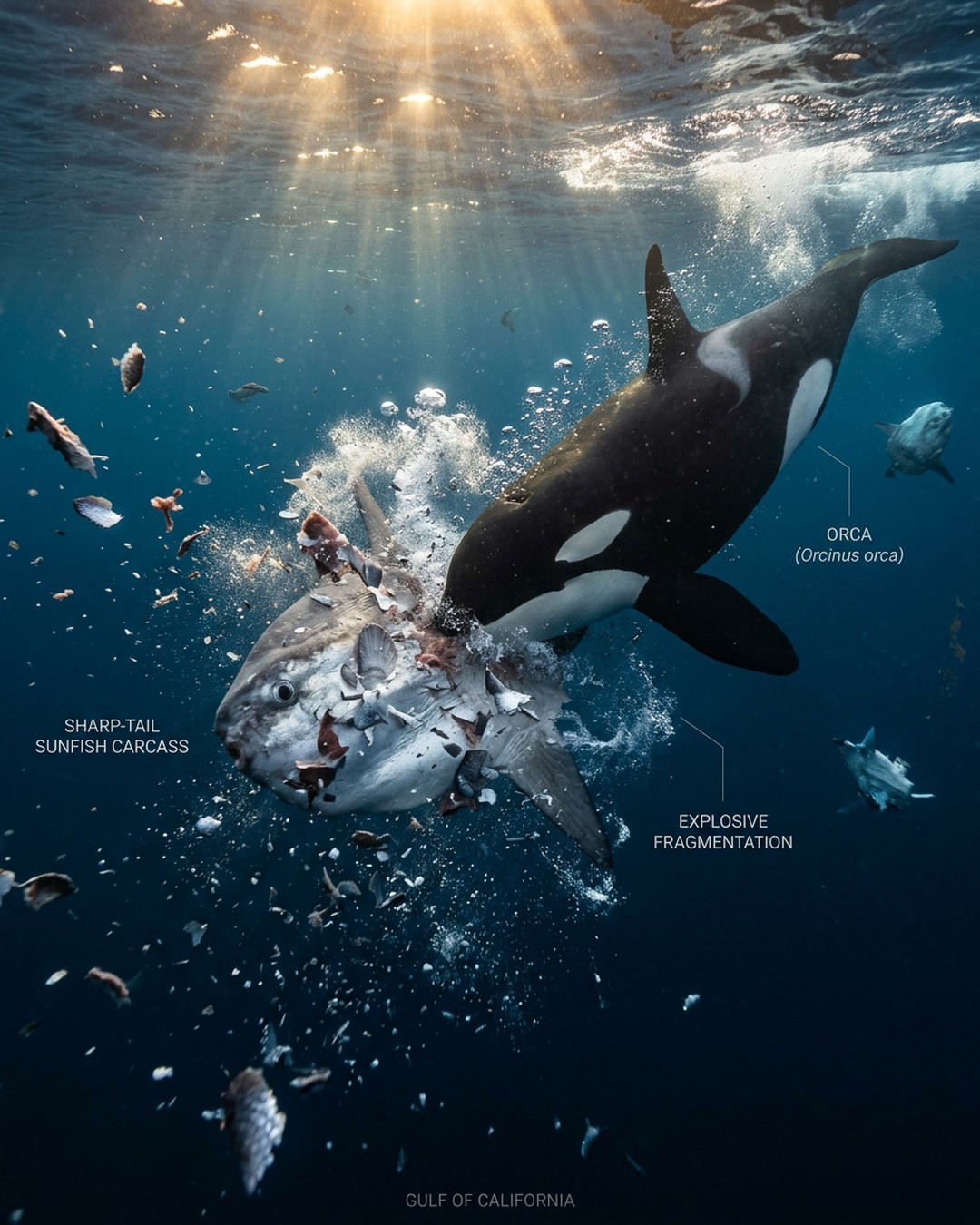
Orcas Exploding Sunfish Carcasses

sciencenews marinebiology orcas animalbehavior ethology

요약

마인드맵 커버 이미지
AI 생성 커버 이미지

Scientists have documented a novel and brutal behavior among killer whales in the Gulf of California during 2024 and 2025, where adult orcas cooperate to smash dead sharp-tail sunfish into smithereens. Published on July 23, 2026, in Frontiers in Ethology, the research reveals that one adult orca holds the carcass steady while another rams into it at high speed, completely exploding the fish. Researchers hypothesize that this aggressive practice may serve multiple purposes, including breaking down large prey into manageable pieces for young orcas to feed on, reinforcing social bonds among highly cooperative pod members, and providing a dynamic learning opportunity for younger individuals to practice complex hunting techniques. The author highlights the remarkable intelligence and creative adaptability of killer whales (Orcinus orca) when handling diverse and unconventional prey types, such as the sharp-tail sunfish (Masturus lanceolatus) which can grow up to several meters long. Rather than viewing this solely as destructive play, marine biologists emphasize that such coordinated actions reflect the sophisticated social structure and shared cultural learning embedded within killer whale pods. This phenomenon bridges nutritional necessity with social development, showcasing how apex marine predators innovate new strategies to thrive in their marine environments. The essence of this study lies in expanding our scientific understanding of cetacean behavioral complexity, demonstrating that orca interactions with carcasses go far beyond simple scavenging or casual play. By analyzing cooperative carcass destruction, researchers gain deeper insights into how marine mammal traditions are passed down across generations. The strategic breakdown of prey highlights an evolutionary optimization for feeding inexperienced calves while simultaneously strengthening the cooperative bonds essential for complex pod survival. Readers and marine researchers can apply these insights to broader studies of animal cognition, marine conservation, and behavioral ecology. Recognizing the multifaceted nature of wildlife behaviors—where play, feeding, and education intersect—allows conservationists to better appreciate the complex cultural transmission present in cetacean societies. Observers are encouraged to document similar novel behaviors using ethical wildlife observation standards to further untangle the intricate social frameworks governing killer whale populations worldwide.

핵심 포인트

01

🔹 Discovery of Orca Sunfish Carcass Destruction

【📌 Key Finding】Scientists documented killer whales (Orcinus orca) in the Gulf of California during 2024 and 2025 engaging in a brutal behavior where they smash dead sharp-tail sunfish (Masturus lanceolatus) into pieces. 【🔸 Impact Factors】Published on July 23, 2026, in Frontiers in Ethology, the observations show one adult orca holding the fish steady while another rams into it at high speed, completely exploding the prey. 【⭐ Data Support】Sharp-tail sunfish targeted by the orcas can grow up to a few meters long, presenting a substantial physical mass that requires cooperative effort to dismantle.

02

🔸 Cooperative Roles and Execution Mechanics

【📌 Key Finding】The behavior requires precise coordination between adult killer whales to achieve the explosive impact on the sunfish carcass. 【🔸 Impact Factors】An adult female orca typically holds the backside of the sunfish steady in her mouth, letting go at the exact split second before an adult male orca speeds toward the target and smashes into it. 【⭐ Data Support】Video documentation captured by study coauthor Kathryn Ayres off the coast of San Jose del Cabo on July 29, 2024, verified this synchronized hunting and carcass manipulation strategy.

03

⭐ Nutritional and Feeding Benefits for Young Orcas

【📌 Key Finding】One primary motivation for pulverizing sunfish is to process large, difficult-to-eat prey into smaller, accessible morsels for juvenile killer whales. 【🔸 Impact Factors】Marine biologist Francesca Pancaldi noted that immediately following one of the documented sunfish explosions, a young orca began feeding directly on the resulting small bits of carnage. 【⭐ Data Support】This mechanism ensures that weaning or inexperienced calves can safely consume high-energy marine biomass without choking or struggling with tough skin and massive body structures.

04

📊 Social Bonding and Cultural Learning Functions

【📌 Key Finding】Carcass destruction serves a dual purpose beyond mere feeding, acting as a crucial vehicle for social cohesion and youth education. 【🔸 Impact Factors】According to marine biologists like Francesca Pancaldi and Marianne Nyegaard, killer whales are highly social animals whose actions simultaneously provide nutritional benefits, reinforce social bonds, and serve as training grounds. 【⭐ Data Support】Younger individuals observe and participate in these high-impact exercises, acquiring essential predatory skills and cultural traditions passed down through pod generations.

05

💡 Unmatched Adaptability and Cognitive Complexity of Orcas

【📌 Key Finding】Killer whales demonstrate extraordinary ingenuity in inventing customized strategies to dispatch and consume a wide variety of unconventional prey types. 【🔸 Impact Factors】Marianne Nyegaard of Auckland Museum expressed astonishment at the behavior, noting that orcas consistently exhibit remarkable cleverness when figuring out how to hunt and manage diverse marine species. 【⭐ Data Support】This behavior aligns with other known cooperative team sports among orcas, such as ambushing blue whales or creating coordinated waves to wash penguins off floating ice floes.

자신만의 마인드맵을 만들고 싶으신가요?

Neumap AI에 로그인하고 나만의 마인드맵 만들기를 시작하세요!

지금 시작하기