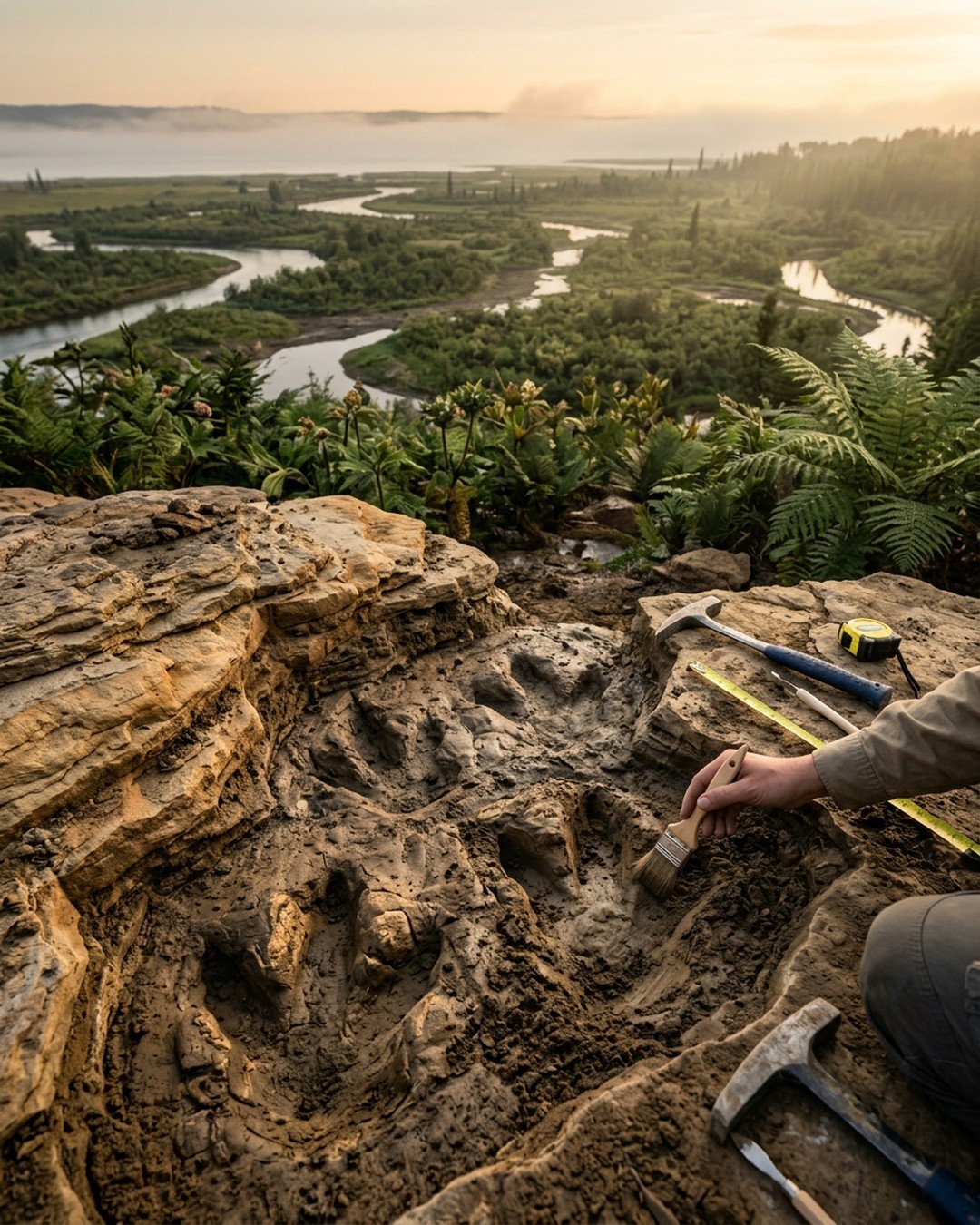
Canada's First Cretaceous Coniacian Dinosaur Tracks Discovery

scitechdaily paleontology dinosaurs cretaceous research

요약

마인드맵 커버 이미지
AI 생성 커버 이미지

Scientists A. Guy Plint and Charles W. Helm discovered Canada's first dinosaur tracks from the Coniacian age, a rarely documented sub-stage of the Cretaceous period spanning 89.75 to 86.5 million years ago. Located in the Tumbler Ridge area of northeastern British Columbia, the site preserves footprints within the Marshybank Formation delta plain sediments. The authors emphasize that these tracks provide crucial empirical evidence of terrestrial dinosaur communities during an era when much of western North America was submerged beneath an inland seaway. The findings highlight an ecosystem dominated by duck-billed ornithopods alongside carnivorous theropods and rare armored dinosaurs. The research reveals how river floods and crevasse splays formed natural casts of dinosaur tracks impressed in soft mud. Furthermore, the diversification of flowering plants during this period directly supported the proliferation of large herbivorous ornithopods and the predators that hunted them. These discoveries significantly enhance our understanding of high-latitude Cretaceous ecosystems and paleontological gaps in North America. The research underscores the value of remote geological formations like the Tumbler Ridge UNESCO Global Geopark in preserving vertebrate fossil tracks.

핵심 포인트

01

🔹 Discovery of Canada's First Coniacian Dinosaur Tracks

A. Guy Plint and Charles W. Helm published findings in Historical Biology detailing Canada's first dinosaur tracks from the Coniacian age of the Cretaceous period, dated between 89.75 and 86.5 million years ago, located in the Tumbler Ridge area of northeastern British Columbia.

02

🔸 Geological Context of the Marshybank Formation Delta

During the mid-Cretaceous period, global sea levels were roughly 100 meters higher than today, submerging much of western North America beneath an inland seaway. The Tumbler Ridge area features a small delta plain deposit known as the Marshybank Formation that escaped marine inundation.

03

⭐ Dominance of Ornithopod and Theropod Tracks

The most prevalent tracks found at the site belong to duck-billed ornithopods measuring 30 to 50 centimeters wide with broad blunt toes, followed by narrower carnivorous theropod tracks with claw impressions, and rare rounded tracks potentially from ankylosaurs.

04

📊 Preservation via River Floods and Crevasse Splays

Ancient river floods washed sand beyond river banks to form crevasse splays, whose bottom surfaces preserved dinosaur tracks originally impressed in soft mud as natural casts, alongside pervasively trampled sandy river channel banks.

05

💡 Impact of Flowering Plants on Dinosaur Diets

The rapid spread and diversification of angiosperms (flowering plants) across high latitudes provided a faster-growing, more nutritious, and easily digested food source than conifers and ferns, supporting the proliferation of Coniacian herbivorous dinosaurs and their predators.

자신만의 마인드맵을 만들고 싶으신가요?

Neumap AI에 로그인하고 나만의 마인드맵 만들기를 시작하세요!

지금 시작하기