1,200-Year-Old Hairless Dog Discovery in Peru

scitechdaily archaeology anthropology peru dartmouth-college

요약

마인드맵 커버 이미지
AI 생성 커버 이미지

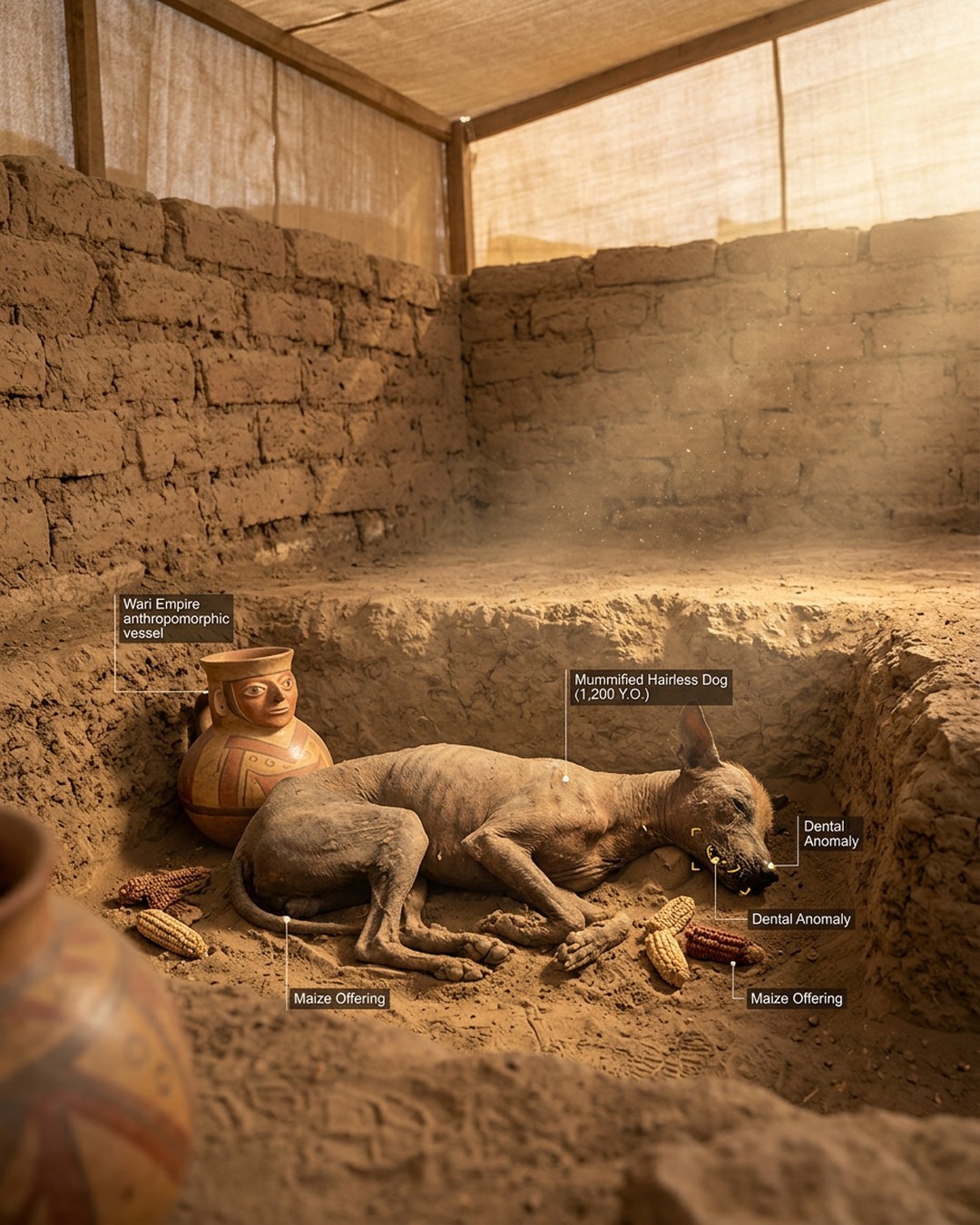
Archaeologists discovered 1,200-year-old remains of hairless dogs at Castillo de Huarmey, an ancient Wari Empire administrative and funerary complex located approximately 190 miles north of Lima, Peru. Published in the Journal of Anthropological Archaeology on March 31, 2026, the study led by Weronika Tomczyk from Dartmouth College provides the first direct physical evidence of Peruvian hairless dogs at a Wari site active between 600 and 1050 CE. The research team analyzed 341 dog bone specimens representing at least 19 individuals, alongside a naturally mummified male dog coated with cinnabar pigment and an anthropomorphic ceramic vessel shaped like a seated hairless dog. Dental anomalies, specifically the absence of first premolars and last molars linked to the gene responsible for hairlessness, confirmed the identification of the Peruvian hairless dog breed, aligning with historical depictions in ancient Andean pottery and the modern Peruvian Inca orchid breed. Isotopic analyses of carbon, nitrogen, oxygen, and strontium isotopes in bones and teeth revealed that these dogs shared dietary staples like maize with humans, while young hairless puppies exhibited distinct dietary patterns comparable to children. The findings demonstrate complex human-animal relationships where dogs received special funerary treatment, such as burial with elite figures including the Master Basketmaker, contrasting with other animal remains discarded as refuse. This discovery advances archaeological understanding of Pre-Hispanic animal husbandry, breeding practices, and cultural symbolism in the Andes. Researchers emphasize that ancient populations held nuanced, sometimes contradictory attitudes toward companion species, utilizing advanced zooarchaeological and scientific methods to reconstruct historical bonds that transcend simple categorization.

핵심 포인트

01

🔹 Archaeological Discovery at Castillo de Huarmey

Researchers uncovered 341 dog bone specimens representing at least 19 individuals, including a naturally mummified male dog and a puppy skull, at the Wari Empire site of Castillo de Huarmey in Peru. The site served as an administrative and funerary complex between 600 and 1050 CE, located 190 miles north of Lima, providing vital physical evidence of ancient Andean fauna.

02

🔸 Identification of Hairless Dogs via Dental Anomalies

Lead researcher Weronika Tomczyk identified the remains as Peruvian hairless dogs by observing missing first premolars and last molars that never erupted. This dental condition is directly linked to the specific genetic mutation responsible for canine hairlessness, matching characteristics of the modern Peruvian Inca orchid breed recognized by the American Kennel Club.

03

⭐ Isotopic Analysis and Canine Diets

Carbon, nitrogen, oxygen, and strontium isotope measurements on canine teeth and bones indicated that the dogs consumed maize, a primary Andean staple food, overlapping significantly with human diets. Hairless puppies displayed distinct dietary patterns resembling those of children, suggesting intentional breeding and specialized care during early developmental stages.

04

📊 Elite Burials and Funerary Context

Radio-carbon dating established that the mummified dog is at least 1,200 years old, providing the oldest radiocarbon date for the site. Special funerary contexts were evident, with a 6- to 8-week-old puppy buried alongside an elite craftsman known as the Master Basketmaker, an adult dog found in the palace, and other remains associated with human sacrifices.

05

💡 Complex Human-Animal Relationships

The study demonstrates that ancient Wari populations maintained diverse and contradictory relationships with animals. While most dogs received deliberate interments and elite burial honors, others were discarded as refuse or showed minimal butchery marks, reflecting a dual perspective where pets and working animals coexisted within the same society.

자신만의 마인드맵을 만들고 싶으신가요?

Neumap AI에 로그인하고 나만의 마인드맵 만들기를 시작하세요!

지금 시작하기