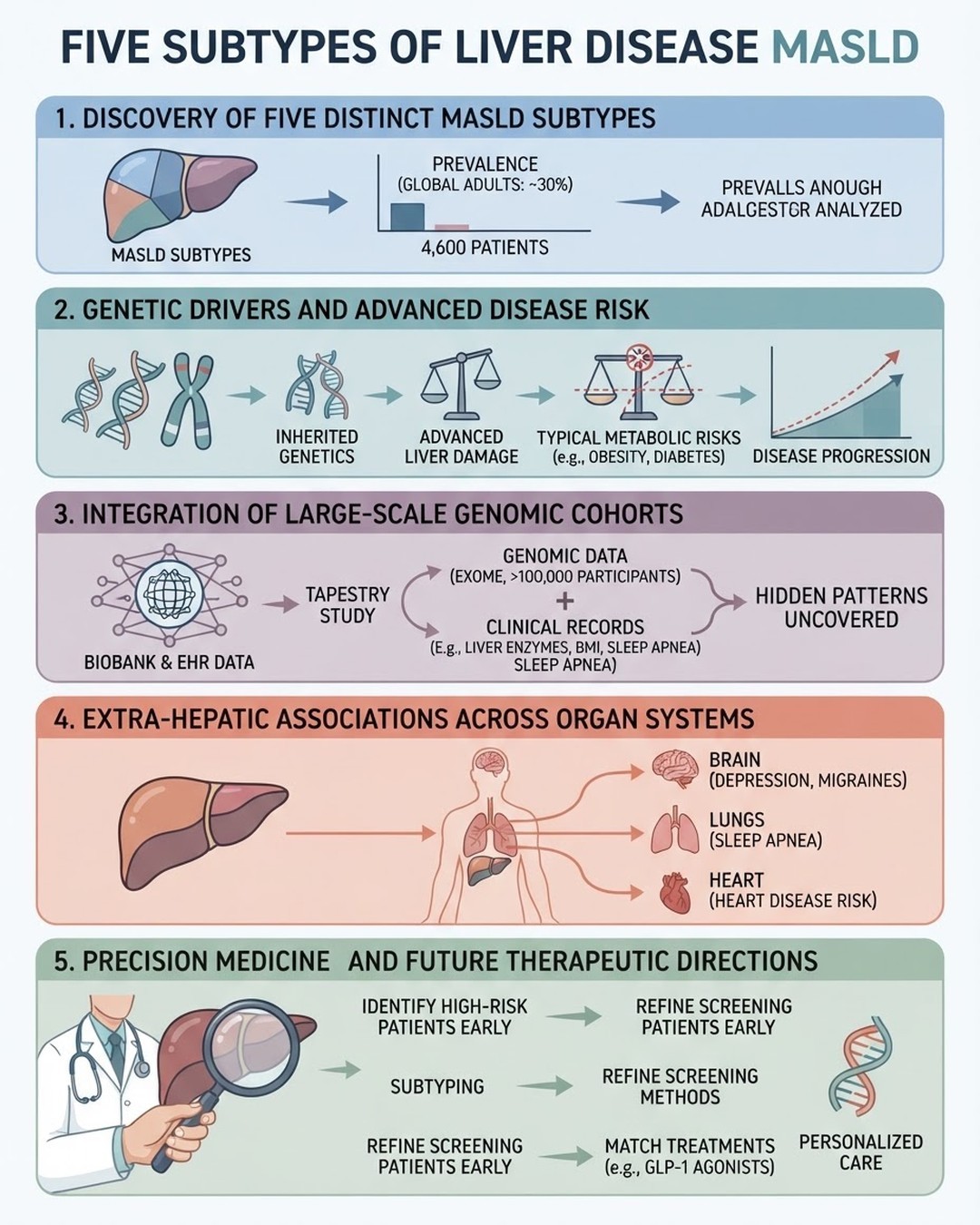
Five Subtypes of Liver Disease MASLD

MayoClinic LiverDisease Genomics MedicalResearch Bioinformatics

요약

마인드맵 커버 이미지
AI 생성 커버 이미지

Researchers at Mayo Clinic and Virginia Tech have identified five biologically distinct subtypes of metabolic dysfunction-associated steatotic liver disease, a condition affecting nearly 30 percent of adults worldwide. By combining genetic sequencing and detailed clinical information from over 4,600 patients using advanced computational modeling, the team uncovered that inherited genetic factors drive specific forms of the disease with higher risks of advanced liver damage, independent of typical metabolic risk factors like obesity and diabetes. The study emphasizes shifting from a broad diagnosis of fatty liver disease to a precision-medicine framework that maps complex biological pathways. Co-senior authors Shulan Tian and Eric Klee highlight that these genomic insights allow researchers to anticipate disease progression and match treatments to the precise biological drivers for individual patients, moving beyond generalized care approaches. The research utilized Mayo Clinic's Research Data Atlas and Tapestry Study data, which integrates exome data from over 100,000 participants with electronic health records. This large-scale infrastructure enabled scientists to uncover hidden clinical patterns and establish that specific disease subtypes are also linked to extra-hepatic conditions such as depression, sleep apnea, and migraines. These findings pave the way for refined clinical screening, earlier risk identification, and targeted interventions in broader populations. Future steps include testing how these newly defined subtypes respond to emerging therapies, including GLP-1 receptor agonists, ultimately improving individualized patient outcomes across multiple organ systems.

핵심 포인트

01

🔹 Discovery of Five Distinct MASLD Subtypes

【📌 Key Finding】Researchers identified five biologically distinct subtypes of metabolic dysfunction-associated steatotic liver disease (MASLD), which affects nearly 30% of adults worldwide. 【🔸 Impact Factors】These subtypes follow different biological pathways and carry varied risks for heart disease, liver failure, cancer, and liver transplantation. 【⭐ Data Support】The study analyzed clinical and genomic data from more than 4,600 patients utilizing advanced computational modeling.

02

🔸 Genetic Drivers and Advanced Disease Risk

【📌 Key Finding】Inherited genetic factors can drive specific forms of MASLD independently of typical metabolic risk factors like obesity and diabetes. 【🔸 Impact Factors】Genetic subtypes were associated with a significantly greater risk of progressing to advanced liver disease among patients without standard metabolic indicators. 【⭐ Data Support】Analysis led by bioinformatician Shulan Tian showed that combining clinical and genomic data reveals hidden patterns of disease progression.

03

⭐ Integration of Large-Scale Genomic Cohorts

【📌 Key Finding】The research drew on Mayo Clinic's Research Data Atlas and the Tapestry Study to connect genetic information with electronic health records. 【🔸 Impact Factors】The Tapestry Study provided exome data covering more than 100,000 participants, enabling researchers to examine how inherited differences alter disease over time. 【⭐ Data Support】Led by Konstantinos Lazaridis, the dataset paired genetic profiles with clinical records including liver enzymes, BMI, lipid levels, diabetes, depression, and sleep apnea.

04

📊 Extra-Hepatic Associations Across Organ Systems

【📌 Key Finding】Biological differences and specific MASLD subtypes extend beyond the liver to impact multiple organ systems. 【🔸 Impact Factors】For the first time, researchers reported associations between particular MASLD subtypes and conditions such as depression, sleep apnea, and migraines. 【⭐ Data Support】Published in Nature Communications on September 2, 2026, the research establishes concrete systemic connections for a condition previously viewed primarily as localized liver fat accumulation.

05

💡 Precision Medicine and Future Therapeutic Directions

【📌 Key Finding】Subtyping MASLD enables clinicians to identify high-risk patients earlier, refine screening methods, and match treatments to individual biology. 【🔸 Impact Factors】Future research plans include testing this subtyping approach in broader patient populations and evaluating responses to various treatments, including GLP-1 receptor agonists. 【⭐ Data Support】Co-senior author Eric Klee noted that mapping complex diseases with precision allows clinicians to intervene before serious damage occurs.

자신만의 마인드맵을 만들고 싶으신가요?

Neumap AI에 로그인하고 나만의 마인드맵 만들기를 시작하세요!

지금 시작하기