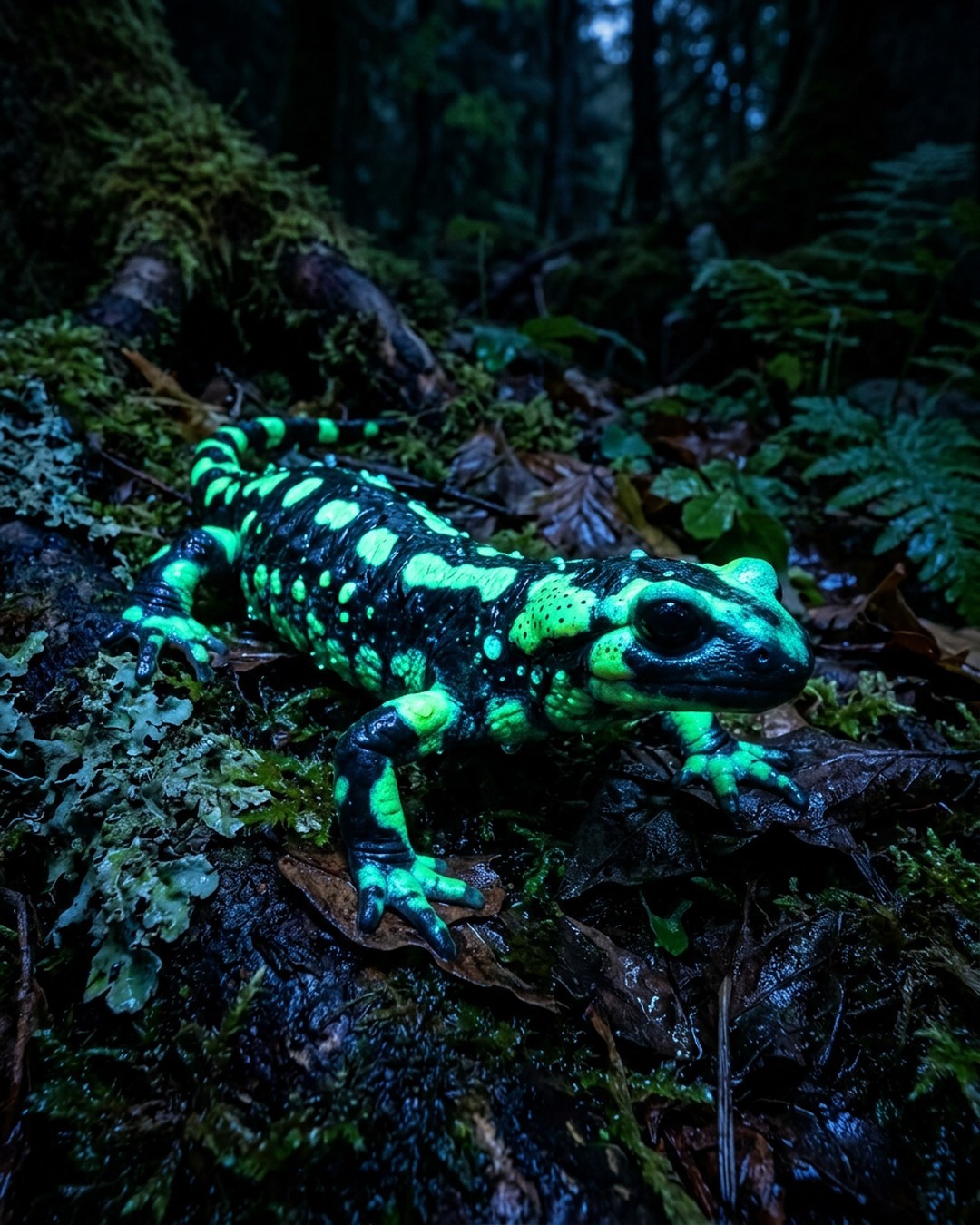
Biofluorescence Discovered in Fire Salamanders

Biofluorescence FireSalamanders MaxPlanckInstitute EvolutionaryBiology Amphibians

요약

마인드맵 커버 이미지
AI 생성 커버 이미지

Researchers have discovered biofluorescence in fire salamanders (Salamandra salamandra) for the first time, revealing that exposure to ultraviolet light causes their skin and defensive secretions to emit a striking cyan-green glow that can persist for over 24 hours. Led by a team from the Max Planck Institute for Chemical Ecology and the Museum of Natural Sciences in Barcelona, the study published in Royal Society Open Science highlights that this phenomenon originates primarily from skin glands on the yellow underside and body sides, pointing to a close connection with chemical defense mechanisms. The authors emphasize that even well-studied species can harbor hidden traits, demonstrating how new observational tools uncover biological secrets that remain invisible to human eyes under normal daylight. While bioluminescence generates light independently through chemical reactions, the fire salamander's biofluorescence absorbs invisible ultraviolet wavelengths and re-emits them as visible cyan-green light, requiring an external light source like moonlight or starlight in dim forest habitats. The exact function of this cyan-green glow remains under investigation, with scientists hypothesizing potential roles in intraspecific communication, mate recognition, and reinforcing aposematic warning signals against predators. Because the fluorescence emanates from toxic skin secretions containing samandarines, it could actively influence predator interactions under nocturnal or low-light environmental conditions where ultraviolet and violet wavelengths are prevalent. The research team is currently working to isolate and chemically characterize the specific unknown molecules responsible for the fluorescence, which will clarify its evolutionary origins and ecological functions. Given that the International Union for Conservation of Nature lists fire salamanders as vulnerable due to habitat fragmentation and degradation, understanding every aspect of their biology is critical for their conservation.

핵심 포인트

01

🔹 First Discovery of Biofluorescence in Fire Salamanders

Researchers discovered that fire salamanders (Salamandra salamandra) emit a cyan-green fluorescence when exposed to ultraviolet light. The phenomenon was documented in a study published on May 1, 2026, in Royal Society Open Science by a collaborative team including scientists from the Max Planck Institute for Chemical Ecology and the Museum of Natural Sciences in Barcelona. 【📌 Key Finding】+ 【⭐ Data Support】

02

🔸 Physical Characteristics and Glandular Origin of the Glow

The cyan-green fluorescence is most intense on the salamanders' yellow underbelly and along the sides of their body. It originates directly from skin glands and their associated secretions, with the fluorescent glow persisting for more than 24 hours after the defensive secretions are released from the animal's body. 【📌 Key Finding】+ 【🔸 Impact Factors】

03

⭐ Difference Between Biofluorescence and Bioluminescence

Biofluorescence absorbs light at one wavelength, such as ultraviolet light invisible to humans, and re-emits it as a different visible wavelength like cyan-green light. Unlike bioluminescence, which generates light independently via internal chemical reactions like those in fireflies, biofluorescence strictly requires an external light source. 【📌 Key Finding】+ 【⚖️ Key Differences】

04

📊 Ecological Hypotheses and Potential Functions

Scientists propose multiple hypotheses for the fluorescence function, including nocturnal communication, mate recognition, and enhancing aposematic warning signals. Because dim forest environments receive moonlight and starlight rich in ultraviolet wavelengths, the cyan-green glow could make salamanders more visible to conspecifics or deter predators. 【📌 Key Finding】+ 【💡 Application】

05

💡 Connection to Chemical Defenses and Future Research

The glowing secretions are tied to samandarines, which are highly toxic steroidal alkaloids derived from cholesterol precursors. The exact molecular compound causing the fluorescence remains unidentified and is currently under chemical characterization by researchers Salvador Carranza, Martin Kaltenpoth, Andrés Brunetti, and Bernat Burriel. 【📌 Key Finding】+ 【Specific Names】

자신만의 마인드맵을 만들고 싶으신가요?

Neumap AI에 로그인하고 나만의 마인드맵 만들기를 시작하세요!

지금 시작하기