New Schrödinger's Cat States from Exotic Quantum Building Blocks

QuantumPhysics UniversityOfOxford SchrodingersCat QuantumComputing TrappedIons ScientificBreakthrough

요약

마인드맵 커버 이미지
AI 생성 커버 이미지

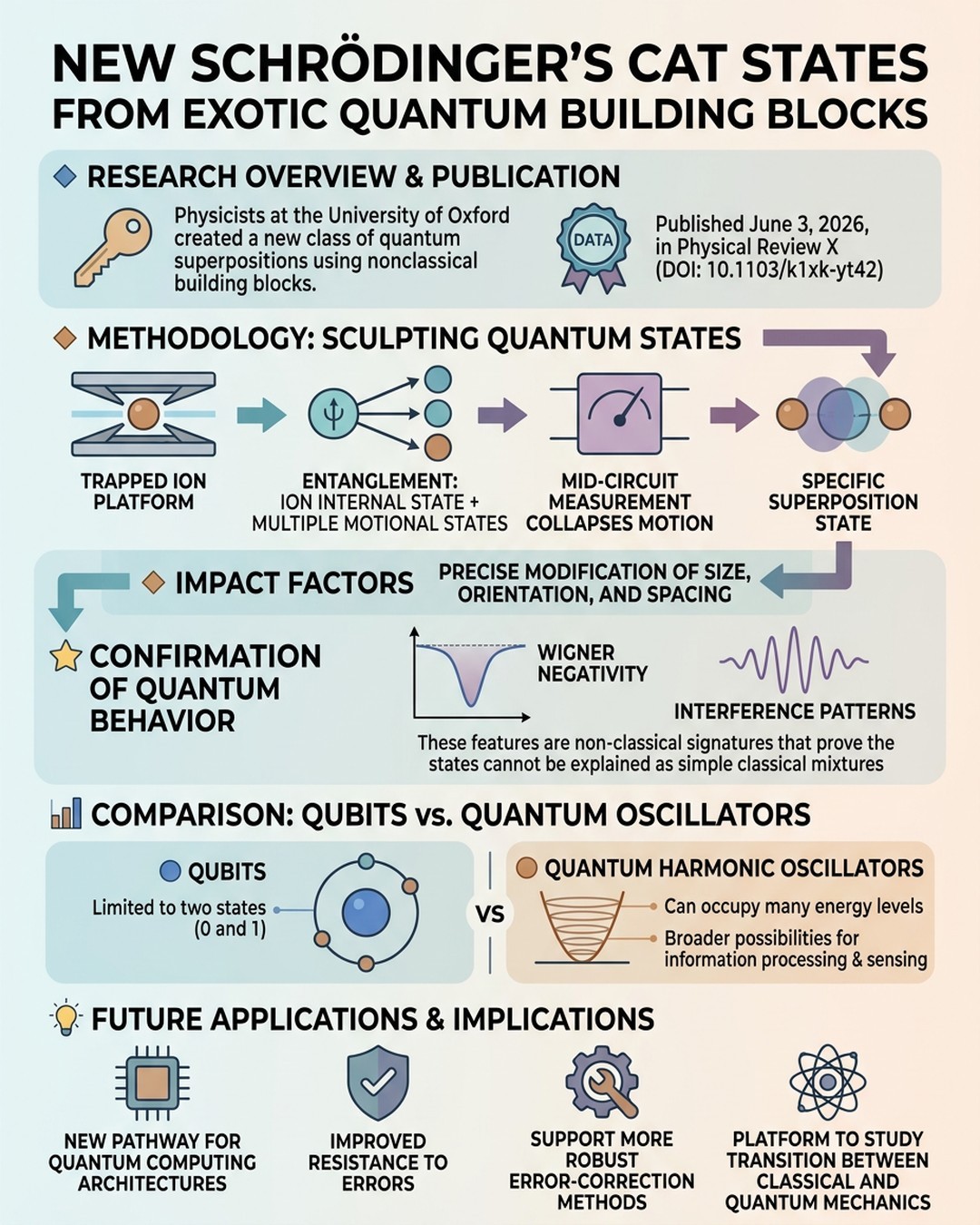
Researchers at the University of Oxford have successfully generated a new class of quantum superpositions, known as Schrödinger's cat-like states, by utilizing highly nonclassical building blocks. Published on June 3, 2026, in Physical Review X, this breakthrough demonstrates the ability to manipulate trapped ions to form complex motional states that extend beyond the limitations of standard two-state quantum bits (qubits). The team's primary objective was to move beyond traditional coherent-state wave packets by constructing superpositions from intrinsically nonclassical components, such as squeezed states. By entangling the internal state of a trapped ion with various motional states and performing mid-circuit measurements, the researchers achieved precise control over the resulting quantum state, allowing them to sculpt its properties into diverse configurations. This experimental success was confirmed through the observation of Wigner negativity and interference patterns, which serve as definitive evidence of genuine quantum behavior. These findings validate that the system operates outside the bounds of classical physics, providing a robust platform for investigating the fundamental boundary between classical and quantum realms. The practical implications of this research are significant for the future of quantum technology. By leveraging quantum harmonic oscillators rather than relying solely on conventional qubits, this approach offers a pathway toward more resilient quantum computing architectures, potentially enabling simpler and more effective error-correction methods in complex quantum systems.

핵심 포인트

01

🔹 Research Overview and Publication

【📌 Key Finding】Physicists at the University of Oxford created a new class of quantum superpositions using nonclassical building blocks. 【⭐ Data Support】The research was published on June 3, 2026, in the journal Physical Review X (DOI: 10.1103/k1xk-yt42).

02

🔸 Methodology: Sculpting Quantum States

【📌 Process】The team used a single trapped ion as the platform. They entangled the ion's internal state with multiple motional states and performed a mid-circuit measurement to collapse the motion into a specific superposition. 【🔸 Impact Factors】This technique allows for the precise modification of the size, orientation, and spacing of the quantum components.

03

⭐ Confirmation of Quantum Behavior

【📌 Evidence】The researchers reconstructed the quantum states and observed Wigner negativity and interference patterns. 【🔸 Impact Factors】These features are non-classical signatures that prove the states cannot be explained as simple classical mixtures, confirming the success of the experiment.

04

📊 Comparison: Qubits vs. Quantum Oscillators

【🔵 Qubits】Limited to two states (0 and 1). 【🟠 Quantum Harmonic Oscillators】Can occupy many energy levels, offering a broader range of possibilities for quantum information processing and sensing.

05

💡 Future Applications and Implications

【📌 Potential Use】The research provides a new pathway for quantum computing architectures. 【🔸 Impact Factors】These states offer improved resistance to errors and support more robust error-correction methods, while also serving as a platform to study the transition between classical and quantum mechanics.

자신만의 마인드맵을 만들고 싶으신가요?

Neumap AI에 로그인하고 나만의 마인드맵 만들기를 시작하세요!

지금 시작하기