380-Million-Year-Old Evolutionary Twist in Early Necks

SciTechDaily Evolution Paleontology Biomechanics Vertebrates

요약

마인드맵 커버 이미지
AI 생성 커버 이미지

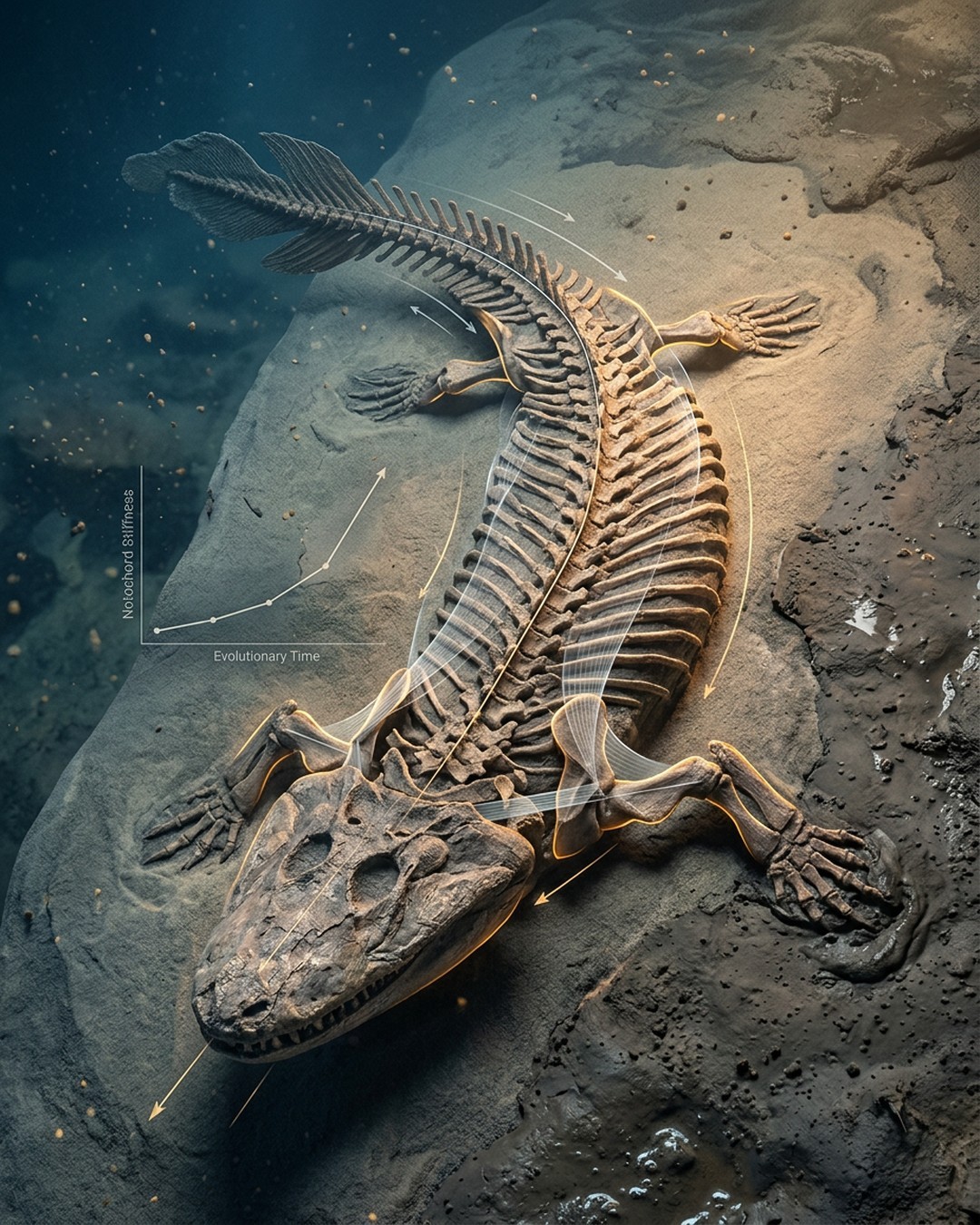
Published on October 26, 2026, recent scientific research published in Nature reveals that the first necks of early tetrapods and transitional fish such as Tiktaalik, living around 380 million years ago, were remarkably stiff rather than flexible. By combining fossil evidence with biomechanical studies of living sturgeons possessing primitive notochord backbones, researchers demonstrated that separating the shoulders from the skull did not initially provide significant head mobility or the ability to look around freely. The primary driving force behind the evolution of distinct necks in early land animals was linked to anatomical reorganization for front limb locomotion and walking rather than enhanced head movement. While flexible neck mobility became advantageous later in evolutionary history, early transitional species faced strict biomechanical limitations due to their soft-tissue backbones, muscles, skin, and dermal bones. This study challenges decades of scientific assumptions regarding the evolutionary drivers of neck development, shifting the paradigm from sensory exploration and predator avoidance to locomotor mechanics. Understanding this 380-million-year-old evolutionary twist illuminates how early vertebrates transitioned from water to land and established anatomical frameworks still reflected in modern biology. Researchers and science enthusiasts can apply these insights to evolutionary biology and biomechanics studies, recognizing that major anatomical transitions often serve different initial functions before acquiring secondary advantages. Future investigations can utilize living analogs like sturgeons to model other missing soft-tissue structures in the paleontological record.

핵심 포인트

01

🔹 Stiff Necks in Early Tetrapods (October 14, 2026 Study)

Published on October 14, 2026, in Nature, new research reveals that 380-million-year-old transitional fish and early tetrapods like Tiktaalik roseae possessed stiff necks rather than flexible ones, challenging decades of scientific assumptions about independent head movement.

02

🔸 Living Sturgeon Analogs and Notochord Modeling

Because early vertebrate backbones were built around a soft-tissue notochord that rarely fossilizes, researchers measured the stiffness of modern sturgeon notochords and applied those mechanical properties to models of early tetrapod necks.

03

⭐ Locomotion as the True Evolutionary Driver

Biomechanical modeling demonstrated that separating the shoulders from the skull did not enable significant head elevation or twisting (such as shaking the head), indicating that distinct necks initially arose to support front-limb walking rather than looking around.

04

📊 Anatomical Limitations of Transitional Species

Additional factors including muscles, skin, and embedded dermal bones further restricted movement, ensuring that living transitional animals had head mobility comparable to or even less than that of fish.

05

💡 Later Advantages of Neck Flexibility

Although greater neck flexibility eventually proved advantageous for four-limbed animals in finding food and avoiding predators, that mobility was not initially available to early tetrapods due to their primitive anatomical constraints.

자신만의 마인드맵을 만들고 싶으신가요?

Neumap AI에 로그인하고 나만의 마인드맵 만들기를 시작하세요!

지금 시작하기