The Global Shift: From Overpopulation Fears to Depopulation Crisis

demography population-decline fertility-rates socio-economics public-policy

요약

마인드맵 커버 이미지
AI 생성 커버 이미지

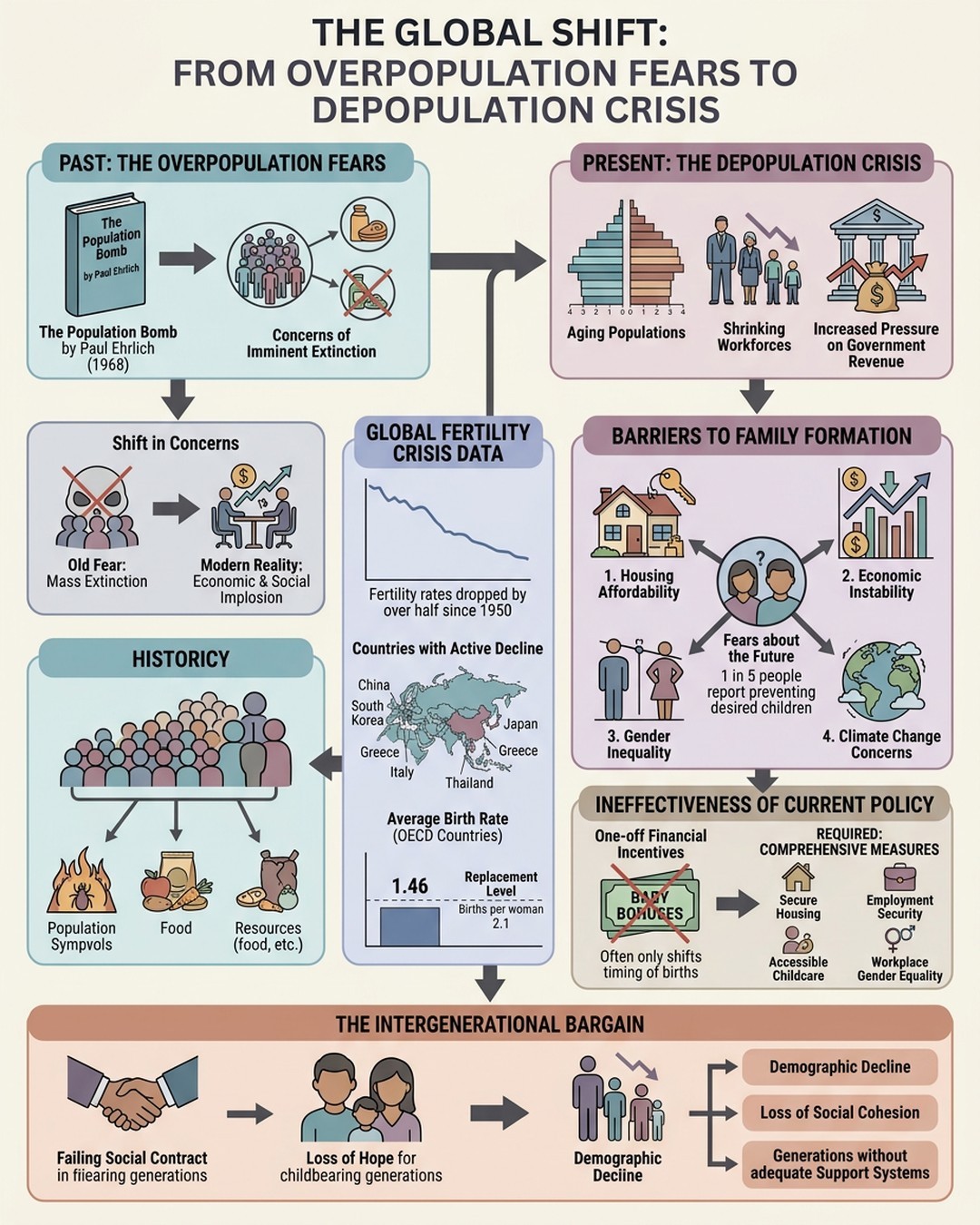
Global population concerns have shifted from the 20th-century fear of overpopulation to the contemporary crisis of depopulation and aging societies. As birth rates fall below the replacement level of 2.1 births per woman, nations face significant economic and national security challenges due to shrinking workforces and increased pressure on government revenue systems. The author argues that this demographic shift is not merely a natural evolution but a human catastrophe driven by systemic barriers. Many individuals who desire children are prevented from doing so by economic instability, housing unaffordability, gender inequality, and climate anxiety, reflecting a breakdown in the intergenerational bargain. Strategic solutions require moving beyond ineffective one-off payments like baby bonuses. Instead, governments must implement comprehensive policy suites that address structural issues, including secure housing, workplace gender equality, and accessible childcare, to restore hope and stability for prospective parents. For policymakers and society, the priority must shift from pressuring citizens to have children to actively removing the external obstacles that make family formation feel impossible. Addressing these root causes is essential to maintaining social cohesion and ensuring future economic viability.

핵심 포인트

01

🔹 Global Fertility Crisis Data

【📌 Key Finding】Global fertility rates have dropped by more than half since 1950. 【⭐ Data Support】The average birth rate across OECD countries is now 1.46 births per woman, significantly below the 2.1 replacement level required for population stability. Countries like China, South Korea, Japan, Greece, Italy, and Thailand are currently experiencing active population decline.

02

🔸 Shift from Overpopulation to Depopulation

【📌 Historical Context】The 1968 book The Population Bomb by Paul Ehrlich warned of imminent extinction due to overpopulation. 【🔸 Impact Factors】Modern reality has flipped this narrative; the primary concern is now the economic and social implosion caused by aging populations and shrinking tax bases, which threaten government service provision.

03

⭐ Barriers to Family Formation

【📌 Core Problem】Approximately one-in-five people report that fears about the future prevent them from having the number of children they desire. 【🔸 Impact Factors】Key barriers include: 1. Housing affordability / 2. Economic instability / 3. Gender inequality / 4. Climate change concerns. These factors create a hostile environment for family planning.

04

📊 Ineffectiveness of Current Policy

【📌 Analysis】One-off financial incentives like baby bonuses fail to increase total fertility rates, often only shifting the timing of births. 【🔸 Impact Factors】True change requires a comprehensive suite of measures: secure housing, employment security, accessible childcare, and genuine workplace gender equality to alleviate the burden on working-aged people.

05

💡 The Intergenerational Bargain

【📌 Conclusion】The current social contract is failing, leading to a loss of hope among childbearing-aged individuals. 【🔸 Impact Factors】If the underlying causes of insecurity are not addressed, the resulting demographic decline will undermine social cohesion and leave future generations without adequate support systems.

자신만의 마인드맵을 만들고 싶으신가요?

Neumap AI에 로그인하고 나만의 마인드맵 만들기를 시작하세요!

지금 시작하기