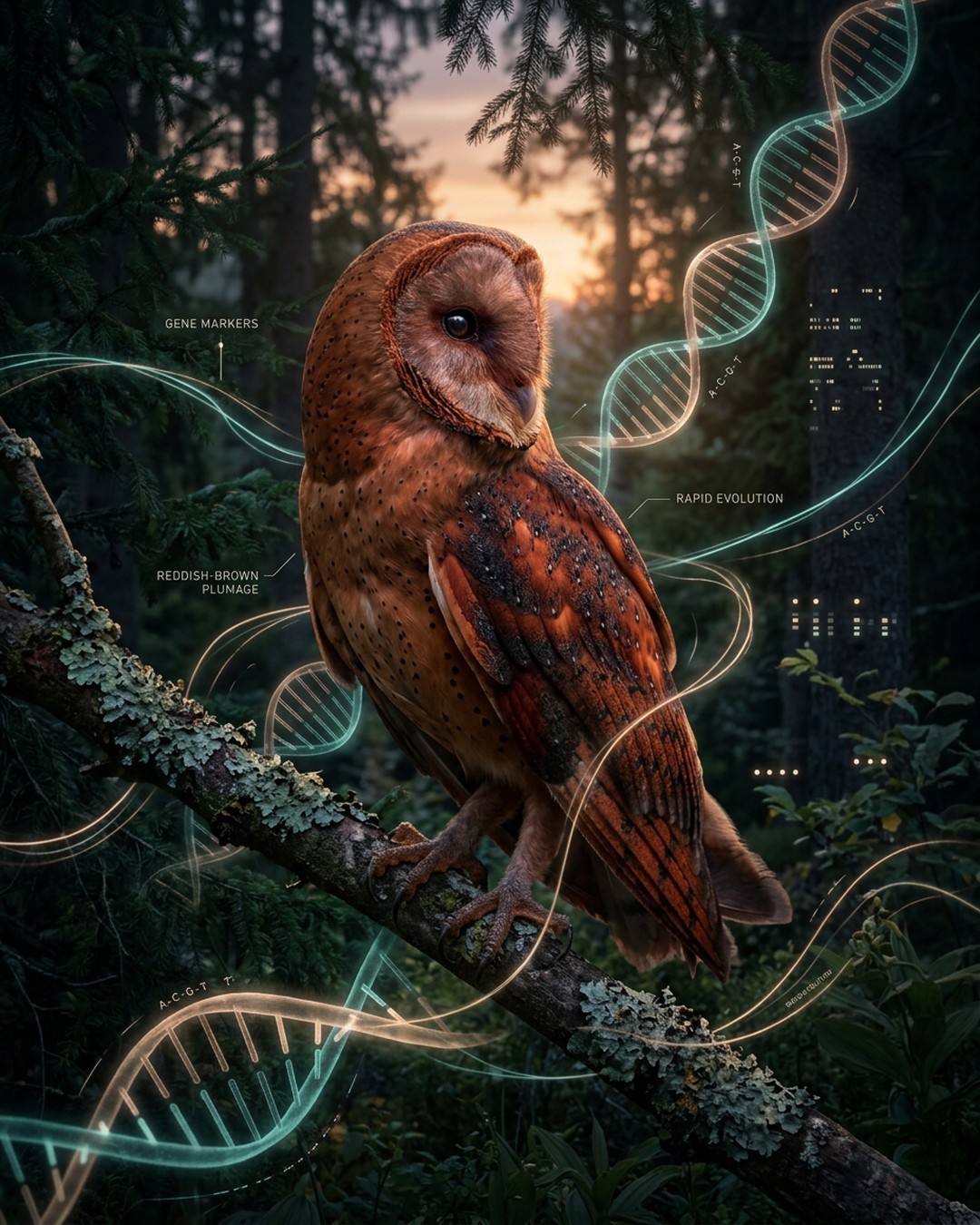
Rapid Short-Term Evolution in Wild Barn Owls

scitechdaily biology evolution genomics birds university-of-lausanne

요약

마인드맵 커버 이미지
AI 생성 커버 이미지

Over the past 30 years, Swiss barn owls have undergone rapid natural selection, becoming more reddish-brown and heavily spotted across roughly ten generations. Researchers from the University of Lausanne sequenced the complete genomes of more than 3,000 barn owls to track genetic variants linked to plumage, confirming that random chance alone could not explain the shifts. The study highlights the role of the MC1R gene and sex chromosome regions in pigmentation, though the direct driver may be linked to stress responses, aggression, or changing food availability like vole populations rather than color itself. This long-term research demonstrates that wild species can undergo detectable genetic evolution over remarkably short periods. Scientists emphasize that such rapid adaptation capacity offers an encouraging sign for wildlife coping with ongoing environmental and climate changes. The interdisciplinary research combined decades of field monitoring with high-throughput genomics to document evolution in a natural setting. Future research plans involve utilizing computer analysis of photographs to measure coloration precisely and reconstructing plumage traits of young owls to evaluate survival rates. This methodological approach sets a new benchmark for studying evolutionary biology in wild animal populations.

핵심 포인트

01

🔹 Plumage Color Shifts in Swiss Barn Owls

Over the past 30 years, Swiss barn owls have evolved to become more reddish-brown and heavily spotted. Researchers tracked DNA variants linked to plumage across approximately ten generations, revealing evolution actively unfolding in a wild population (evidenceIds: S0018).

02

🔸 Genomic Sequencing of 3,000+ Owls

Led by Dr. Tristan Cumer and Professor Jérôme Goudet at the University of Lausanne and published in Nature Communications on October 12, 2026, the study sequenced the complete genomes of more than 3,000 barn owls, representing one of the most in-depth genetic analyses ever conducted on wild animals (evidenceIds: S0019, S0021, S0022, S0035).

03

⭐ Role of Natural Selection vs Random Chance

By comparing field observations with evolutionary simulations, researchers proved that the proliferation of genetic variants associated with reddish-brown plumage far exceeded random chance, confirming natural selection as the driving mechanism (evidenceIds: S0019, S0020).

04

📊 Genetic Markers and Stress Responses

Genetic regions identified include MC1R and a sex chromosome region affecting pigmentation. Because the melanocortin system also regulates stress and aggression, selection may target stress coping mechanisms or food availability, with color changing as a byproduct (evidenceIds: S0023, S0024).

05

💡 Implications for Rapid Adaptation

The demonstrated capacity for rapid evolution over short timescales suggests wild species may possess better-than-expected potential to cope with contemporary environmental pressures and climate change (evidenceIds: S0032, S0033).

자신만의 마인드맵을 만들고 싶으신가요?

Neumap AI에 로그인하고 나만의 마인드맵 만들기를 시작하세요!

지금 시작하기