Venus Moon Demise Study

scitechdaily astrophysics planetary-science venus uc-riverside

요약

마인드맵 커버 이미지
AI 생성 커버 이미지

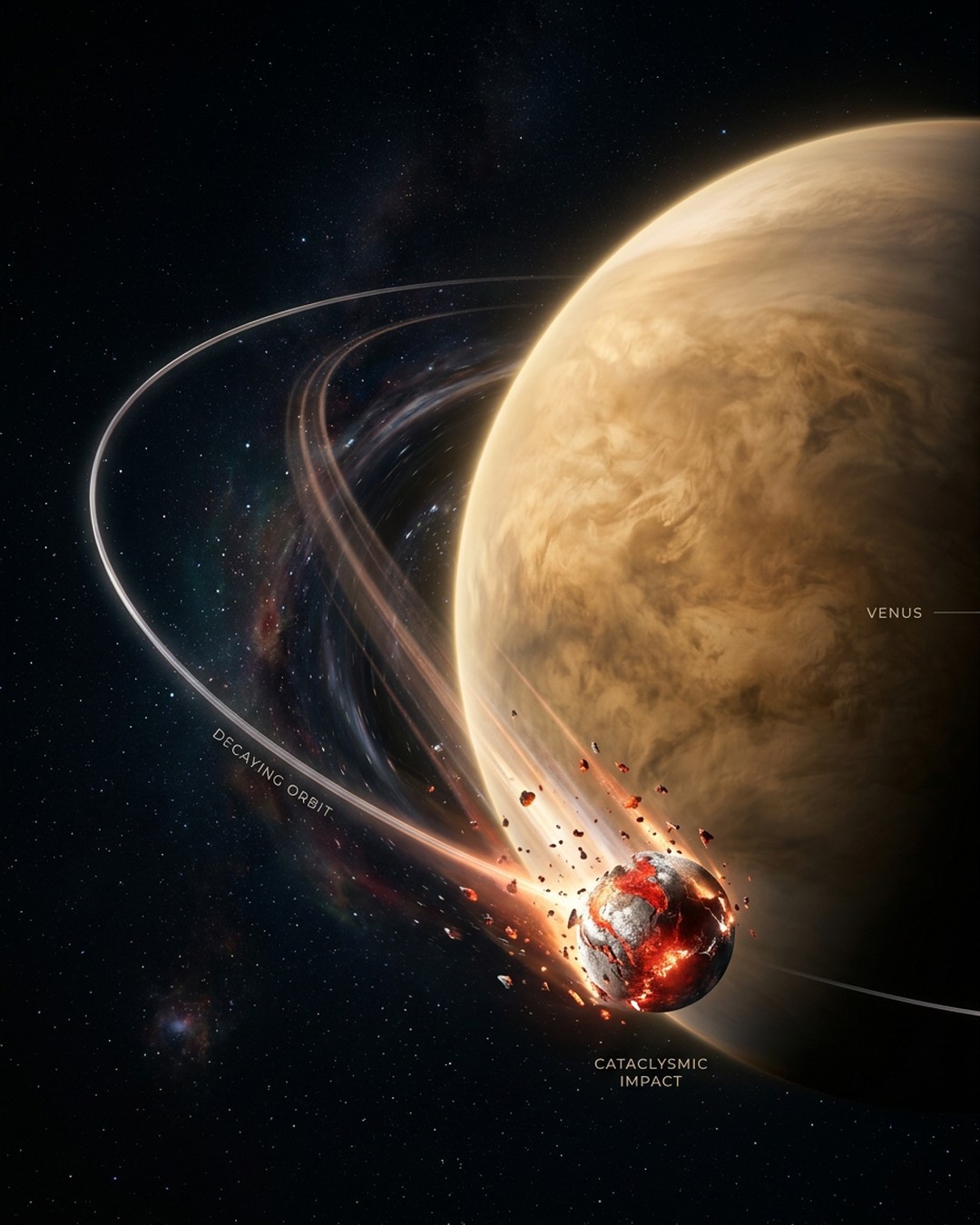
Recent computer simulations conducted by astrophysicists at the University of California, Riverside, published in The Astrophysical Journal on September 14, 2026, suggest that Venus may have swallowed its own moon due to its extraordinarily slow rotation rate. Unlike Earth, where a fast 24-hour rotation pushes the moon away at a rate of 4 centimeters per year, Venus takes 243 Earth days to complete a single rotation, causing planetary gravity to draw any companion inward until it collides with the surface. Lead author Stephen Kane and his colleagues utilized physical models of gravitational interactions to demonstrate that even if Venus once formed a moon, its sluggish spin would have made moon retention impossible, resulting in a cataclysmic collision that transferred massive amounts of energy and angular momentum to the planet. The study provides a compelling mechanism to explain the current lack of moons around Venus without requiring an external catastrophic impact, offering critical insights into planetary evolution and the unique orbital dynamics of Earth-sized worlds across the universe. These findings caution astronomers searching for potentially habitable exoplanets that slow planetary rotation can lead to the destruction of moons, fundamentally altering climate and geological history, and prompting deeper seismic investigations beneath the heavily resurfaced crust of Venus.

핵심 포인트

01

🔹 Venus Moon Demise Simulation Results

Computer simulations published in The Astrophysical Journal on September 14, 2026, by Stephen R. Kane and colleagues indicate that Venus likely swallowed its own hypothetical moon. The research demonstrates that planetary gravity combined with an extremely slow rotation rate naturally causes orbiting moons to spiral inward and crash into the planetary surface rather than maintain stable orbits.

02

🔸 Rotational Dynamics Comparison: Earth vs Venus

Earth completes a rotation every 24 hours, transferring fast spin energy to its moon and pushing it outward at a rate of 4 centimeters or 1.6 inches per year as measured by Apollo 11 mirrors. In contrast, Venus takes 243 Earth days to rotate once, creating an opposite gravitational dynamic that draws companions inward.

03

⭐ Research Methodology and Findings

Using computer models based on gravitational physics, researcher Stephen Kane first validated the simulation against Earth and its moon before testing Venus rotation rates with hypothetical moons ranging from half to ten times the mass of Earth's moon. Nearly all simulation scenarios consistently resulted in the moon crashing into Venus, with more massive moons colliding faster.

04

📊 Implications for Exoplanet Habitability

The study highlights a disturbing scenario for Earth-twin exoplanets, suggesting that planets lacking sufficient rotation speed will inevitably lose their moons to surface crashes, altering geological activity, climate stability, and the evolutionary course required for potential habitability.

05

💡 Geological Evidence and Future Exploration

Finding physical surface evidence is hindered by a major resurfacing event that erased roughly 80 percent of Venus's geological history about a billion years ago. However, future seismic measurements beneath the surface could reveal deep internal structures analogous to remnants found inside Earth from its ancient moon-forming collision.

자신만의 마인드맵을 만들고 싶으신가요?

Neumap AI에 로그인하고 나만의 마인드맵 만들기를 시작하세요!

지금 시작하기