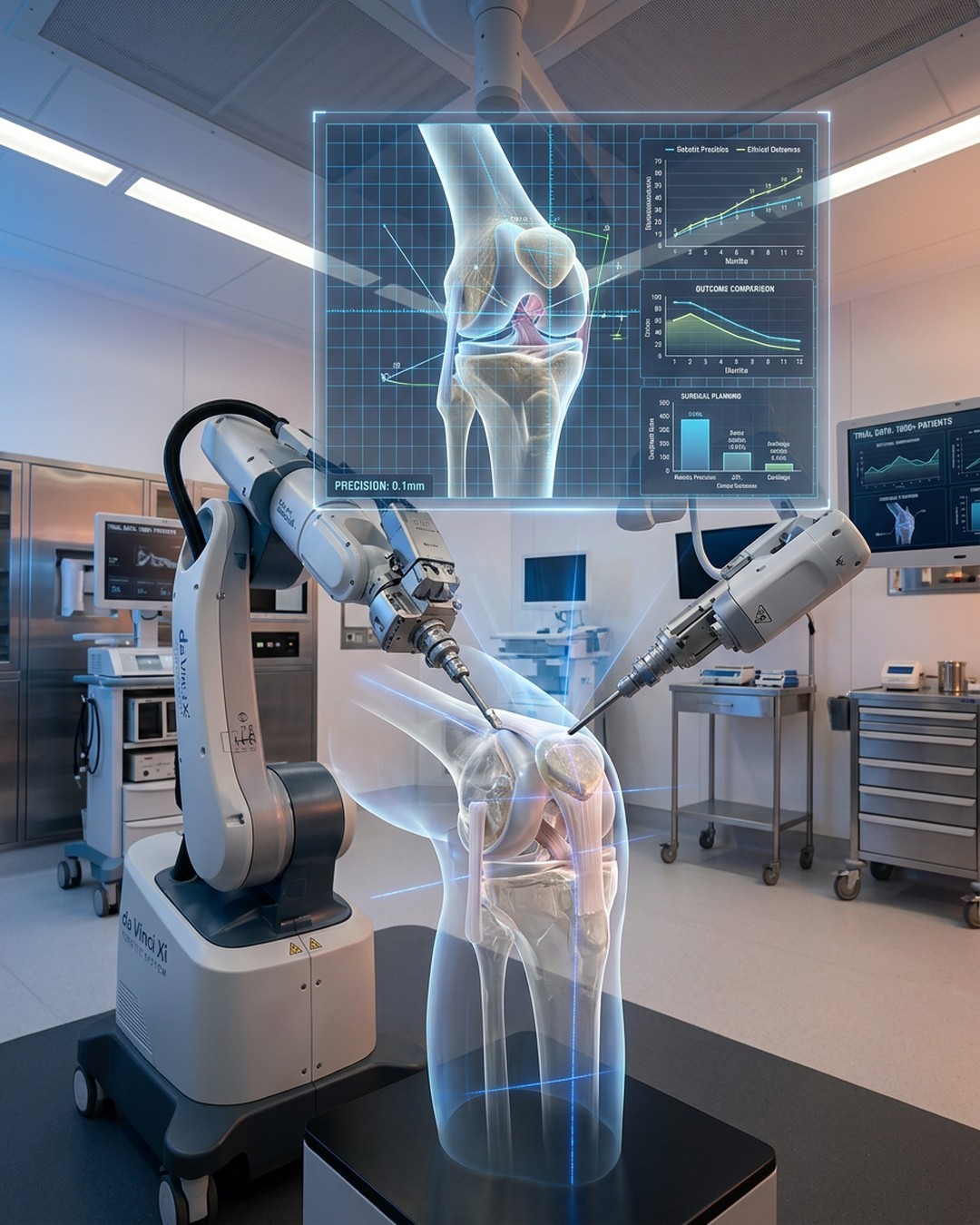
World's Largest Trial of Robotic Knee Surgery Delivers Surprising Results

scitechdaily health robotic-surgery orthopedic-research university-of-warwick clinical-trial

요약

마인드맵 커버 이미지
AI 생성 커버 이미지

The RACER-Knee clinical trial published on August 20, 2026, in The Lancet evaluated the world's largest double-blinded randomized controlled trial comparing conventional total knee replacement with robot-assisted surgery using the Stryker Mako system. The study involved 339 patients treated by 33 surgeons across 10 hospitals in the UK to determine whether increased surgical precision translates to better patient recovery. The study concluded that while robot-assisted knee surgery delivers significantly greater precision in positioning implants, it does not improve patient recovery, pain reduction, mobility, or function during the first year after surgery. Both robotic and conventional groups showed similar outcomes measured by the Forgotten Joint Score, walking ability, and pain levels, proving that current technological accuracy does not yet yield perceptible clinical benefits for patients. Economically and operationally, robotic-assisted total knee replacements required an average of 10.5 minutes longer to perform and cost about 950 British pounds more per procedure. Under current National Health Service cost limits, the system was not cost-effective during the first postoperative year, although the procedures demonstrated safety profiles comparable to conventional methods with no increase in serious adverse events. Researchers plan to monitor trial participants for ten years to evaluate long-term outcomes such as implant durability and revision rates. The findings serve as a critical benchmark for healthcare innovation, indicating that surgeons and developers must gain a deeper understanding of personalized anatomy and ideal implant positioning to successfully translate mechanical precision into meaningful patient-felt benefits.

핵심 포인트

01

🔹 RACER-Knee Trial Overview and Methodology

Published in The Lancet on August 20, 2026, the RACER-Knee trial is the world's largest double-blinded randomized controlled trial comparing conventional total knee replacement with robot-assisted surgery. Coordinated by the University of Warwick, University Hospitals Coventry and Warwickshire NHS Trust, and the Royal Orthopaedic Hospital, the study evaluated 339 patients treated by 33 surgeons across 10 UK hospitals using the Stryker Mako robotic system.

02

🔸 Precision Versus Patient Recovery Results

【📌 Key Finding】Robot-assisted surgery successfully delivered higher precision in positioning implants and adjusting to patient anatomy.【🔸 Impact Factors】Despite this mechanical advantage, the trial found no significant difference in patient recovery, mobility, or pain during the first year.【⭐ Data Support】The primary measure, the Forgotten Joint Score, along with walking ability and pain scores during the first three months and at 12 months, showed identical outcomes between the robotic and conventional groups.

03

⭐ Operational and Economic Implications

【🔵 Robotic Procedures】Required an average of 10.5 minutes longer operating time and cost approximately 950 British pounds more per surgery.【🟠 Conventional Procedures】Faster operation times and lower initial costs with equivalent clinical efficacy.【⚖️ Key Differences】Under current National Health Service cost limits, the robotic system was not cost-effective in the first year, though it maintained an equivalent safety profile with no increased risk of serious adverse events.

04

📊 Global Adoption and Context

Robotic assistance is currently utilized in about 6 percent of knee replacements in the UK, compared with 16 percent in the United States and 42 percent in Australia. Total knee replacement remains one of the most common elective operations worldwide for treating knee arthritis, highlighting the massive global scale and relevance of evaluating this surgical technology.

05

💡 Future Research and Strategic Outlook

Researchers will continue monitoring trial participants for a total of ten years to determine if long-term advantages emerge, such as reduced need for revision surgeries. Experts emphasize that surgeons need a more advanced understanding of optimal implant positioning and personalized patient anatomy to truly leverage robotic precision into tangible clinical benefits.

자신만의 마인드맵을 만들고 싶으신가요?

Neumap AI에 로그인하고 나만의 마인드맵 만들기를 시작하세요!

지금 시작하기