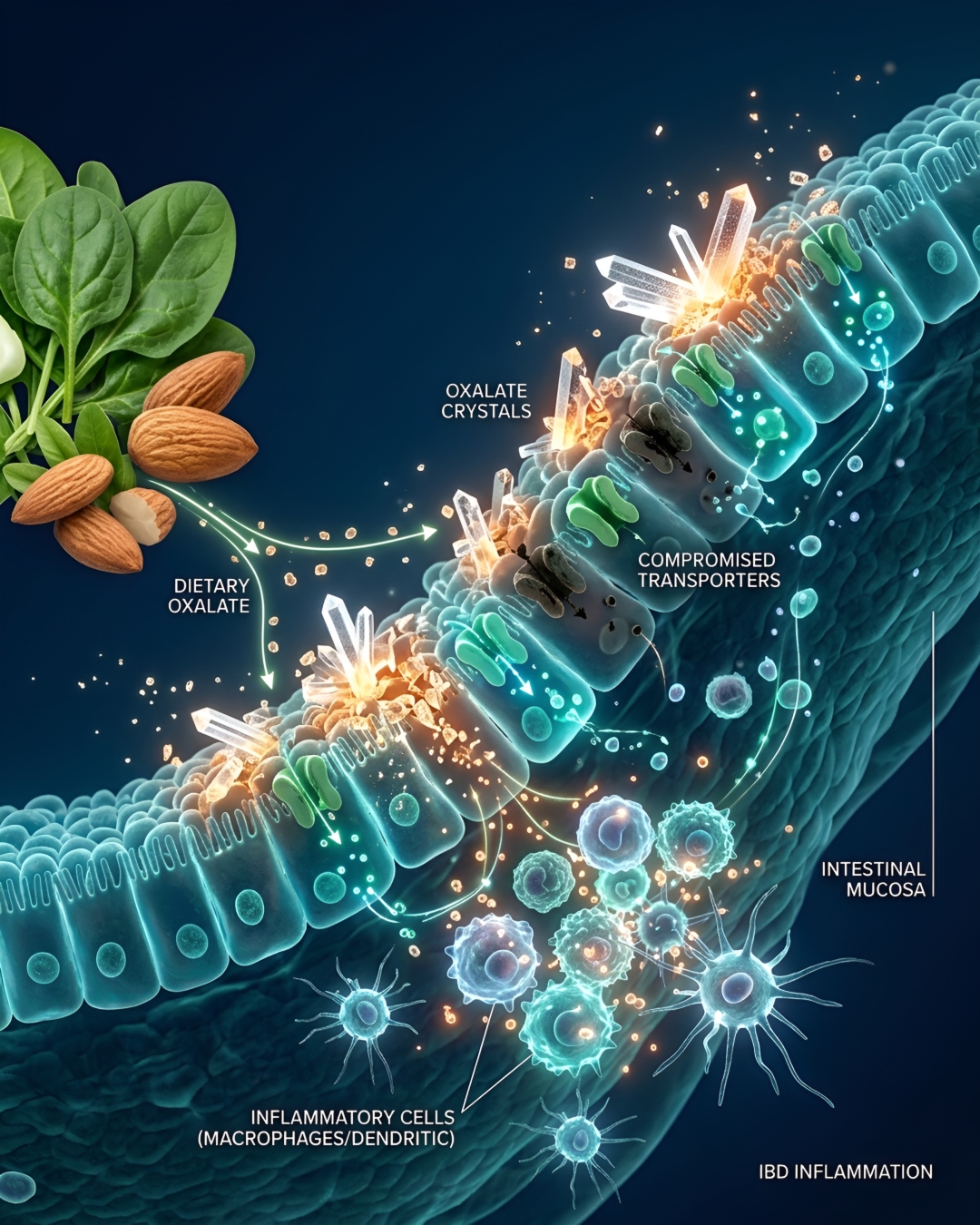
Oxalate Worsens Gut Inflammation in IBD

scitechdaily health gut-inflammation ibd nutrition

요약

마인드맵 커버 이미지
AI 생성 커버 이미지

Recent research published in Cellular and Molecular Gastroenterology and Hepatology reveals that dietary oxalate, a natural compound found in healthy foods like spinach, almonds, and sweet potatoes, may actively worsen intestinal inflammation in individuals suffering from inflammatory bowel disease (IBD) such as Crohn's disease and ulcerative colitis. Led by researchers at the University of North Carolina at Chapel Hill School of Medicine, including postdoctoral scholar Anna Salvador and professor Shehzad Z. Sheikh, the study discovered that patients with IBD exhibit a fundamental defect in intestinal handling rather than simply consuming more oxalate. Specifically, intestinal transporter proteins like SLC26A2, SLC26A3, and SLC26A6 are consistently reduced in these patients, leading to oxalate accumulation and heightened immune responses. Animal experiments demonstrated that mice on an oxalate-supplemented diet combined with a colitis-inducing agent experienced significantly lower survival rates and accelerated inflammation. Furthermore, laboratory analyses showed that oxalate directly intensifies inflammatory responses in macrophages and dendritic cells, while low expression of the SLC26A6 transporter correlates strongly with stricturing Crohn's disease. These findings provide a novel molecular framework for understanding diet-disease interactions in IBD, suggesting that future therapies could focus on modifying dietary oxalate content, targeting transporter mechanisms, or restoring beneficial gut bacteria like Oxalobacter formigenes to safely manage gut inflammation without eliminating nutritious plant foods.

핵심 포인트

01

🔹 Oxalate Accumulation in Inflammatory Bowel Disease

【📌 Key Finding】Dietary oxalate from healthy foods like spinach, almonds, and sweet potatoes may worsen intestinal inflammation in Crohn's disease and ulcerative colitis patients. 【🔸 Impact Factors】Intestinal transporter proteins SLC26A2 and SLC26A3 were consistently reduced in IBD patients, causing oxalate to remain in the digestive tract. 【⭐ Data Support】Published in Cellular and Molecular Gastroenterology and Hepatology on August 13, 2026, by researchers at the University of North Carolina at Chapel Hill School of Medicine.

02

🔸 Defective Intestinal Handling Over Diet Alone

【📌 Key Finding】Patients with Crohn's disease had significantly higher oxalate levels in their stool compared to non-IBD controls despite consuming similar amounts of plant-based foods. 【🔸 Impact Factors】Assessed using Diet History Questionnaire III and DNA metabarcoding to detect plant species in stool. 【⭐ Data Support】Demonstrates that elevated oxalate reflects a biological handling defect rather than purely a high-plant diet.

03

⭐ Experimental Evidence in Animal Models

【📌 Key Finding】Mice given an oxalate-supplemented diet with a colitis-inducing agent were 60 percent less likely to survive than control animals. 【🔸 Impact Factors】Oxalate caused inflammation to appear sooner and become more severe in genetically susceptible mouse models with spontaneously developing colitis. 【⭐ Data Support】Matches the biological transporter gene reduction patterns observed in human IBD patients.

04

📊 Immune Cell Activation and Disease Severity

【📌 Key Finding】Laboratory experiments revealed that oxalate heightens inflammatory responses in macrophages and dendritic cells. 【🔸 Impact Factors】Low expression of the SLC26A6 transporter was strongly connected with stricturing Crohn's disease, an aggressive form involving scar tissue and intestinal narrowing. 【⭐ Data Support】Nearly 75 percent of patients with low SLC26A6 expression suffered from stricturing disease.

05

💡 Therapeutic Potential and Future Directions

【📌 Key Finding】Findings do not recommend eliminating nutritious plant foods, but point toward precise dietary management or microbiome interventions. 【🔸 Impact Factors】Oxalate-degrading bacteria such as Oxalobacter formigenes are depleted in IBD patients, offering a potential alternative treatment target. 【⭐ Data Support】Research supported by the Helmsley Charitable Trust, NIDDK, and National Institutes of Health.

자신만의 마인드맵을 만들고 싶으신가요?

Neumap AI에 로그인하고 나만의 마인드맵 만들기를 시작하세요!

지금 시작하기