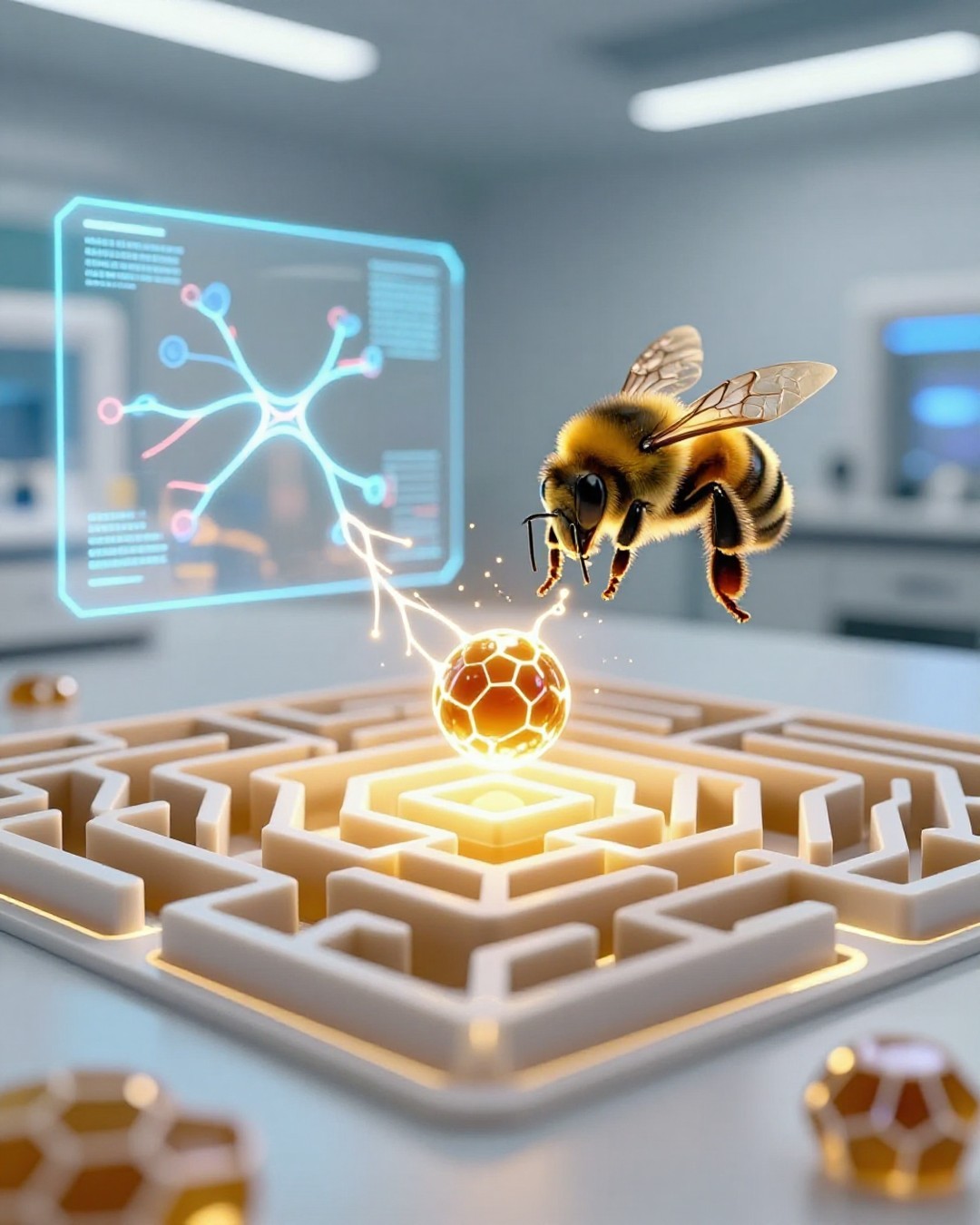
Researchers from the University of Oulu, the University of Helsinki, and the University of Turku have demonstrated that bumble bees (Bombus terrestris) possess advanced cognitive flexibility, capable of solving complex, novel object-based challenges without prior training. Published in Science on June 4, 2026, the study reveals that bees can spontaneously combine separate pieces of information to achieve a goal, a behavior previously associated primarily with large-brained vertebrates like chimpanzees.
The research team, led by Olli Loukola, designed an experiment where bees had to move a ball into a specific position to reach a reward placed on the ceiling of a transparent arena. This task, analogous to the classic 'box-and-banana' primate intelligence test, required the bees to recognize the utility of an object and manipulate it to overcome an obstacle. The findings challenge the traditional view that such insight-like problem-solving is exclusive to animals with large brains.
By utilizing stringent control experiments, the researchers ruled out simpler explanations such as trial-and-error learning, accidental success, or visual guidance. The bees demonstrated goal-directed behavior, moving the ball to the correct location even when the reward was hidden. This suggests that miniature insect brains are capable of generating flexible, adaptive solutions to novel problems in ways that were previously underestimated.
These results provide significant insights into the evolution of intelligence and cognitive abilities across species. While the researchers clarify that this does not imply human-like consciousness or reasoning, it confirms that spontaneous, goal-directed problem-solving is not limited to vertebrates, opening new avenues for understanding the cognitive landscape of insects.