A Long-Held Idea About Alzheimer Tau May Be Wrong

ScitechDaily AlzheimersDisease Neuroscience CellBiology ColumbiaUniversity

Samenvatting

Mindmap Omslagafbeelding
AI Gegenereerde Omslagafbeelding

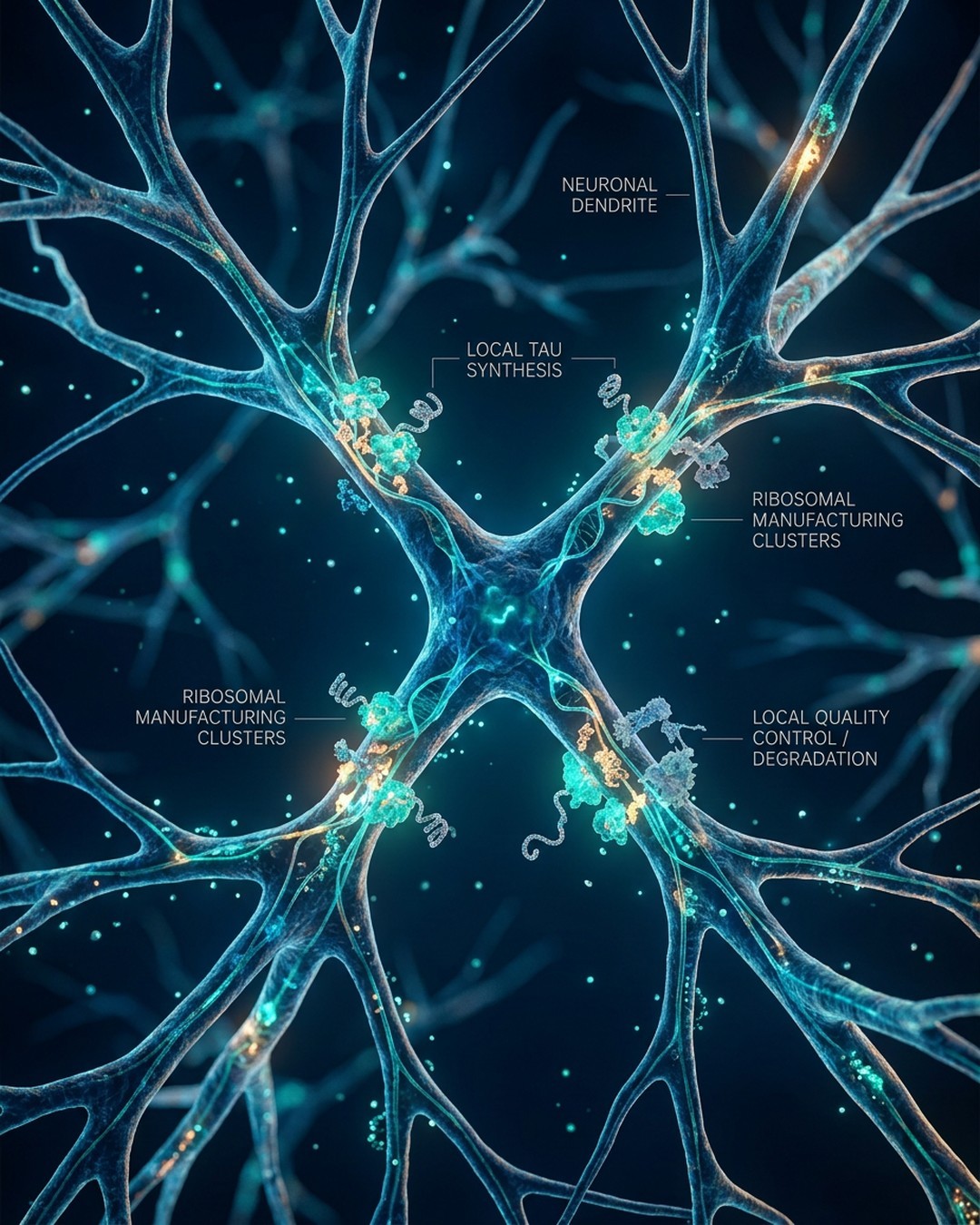
Recent research published on September 21, 2026, by a team led by Kapil Ramachandran at Columbia University Irving Medical Center challenges the long-standing belief regarding tau protein distribution in Alzheimer's disease. Scientists traditionally thought that mature tau proteins formed in axons and later migrated improperly into dendrites and cell bodies during disease progression. The new study reveals that tau is actually synthesized directly within dendrites and undergoes an intense, immediate quality-control process by nearby neuroproteasomes that destroy roughly one-third of newly made tau within minutes. This discovery shifts the scientific focus from protein migration anomalies to local dendritic protein synthesis and folding failures as potential triggers for neurofibrillary tangles. By using an innovative imaging technique named STARFISH, researchers uncovered that ribosomes producing tau and neuroproteasomes destroying misfolded tau are located side-by-side in dendrites. This localized triage system highlights a vulnerable pool of tau that is constantly present at the site of signal reception, raising questions about what keeps this pool safe and what causes protection to fail. While this model is currently a hypothesis rather than definitive proof of Alzheimer's origins, it opens novel therapeutic avenues. Understanding these local synthesis and folding pathways may allow researchers to develop interventions that ensure tau folds properly before it can take a pathological turn and form harmful filaments.

Belangrijke punten

01

🔹 Core Discovery on Tau Protein Synthesis Location

Contrary to the decades-old belief that tau proteins migrate from axons into dendrites during Alzheimer's disease progression, new research published in Nature Neuroscience on August 13, 2026, proves that tau is actually synthesized locally and solely within dendrites, the branching extensions used by neurons to receive signals.

02

🔸 Intense Local Quality Control and Degradation

Researchers discovered that newly synthesized tau proteins are subjected almost immediately to a rigorous quality-control mechanism where approximately one-third of the new tau is destroyed within minutes by neuroproteasomes located directly at the neuronal plasma membrane.

03

⭐ Side-by-Side Cellular Machinery Arrangement

Ribosomes responsible for translating genetic instructions to produce tau were found positioned side-by-side with neuroproteasomes, suggesting that neurons inspect and potentially eliminate misfolded tau proteins immediately after production before they can aggregate into harmful structures.

04

📊 Paradigm Shift in Alzheimer's Pathology Understanding

This study fundamentally changes the scientific perspective from studying how mature tau migrates to incorrect neuronal locations to investigating a previously hidden, vulnerable pool of tau created directly in dendrites and determining what happens when protective quality-control pathways fail.

05

💡 Therapeutic Implications and Future Directions

Led by senior author Kapil Ramachandran at Columbia University, the findings introduce the STARFISH methodology and suggest that targeting local tau synthesis, folding, and neuroproteasome triage systems could offer novel ways to prevent tau from adopting a pathological state.

Wilt u uw eigen mindmap maken?

Log in op Neumap AI en begin met het maken van uw eigen mindmaps!

Aan de Slag