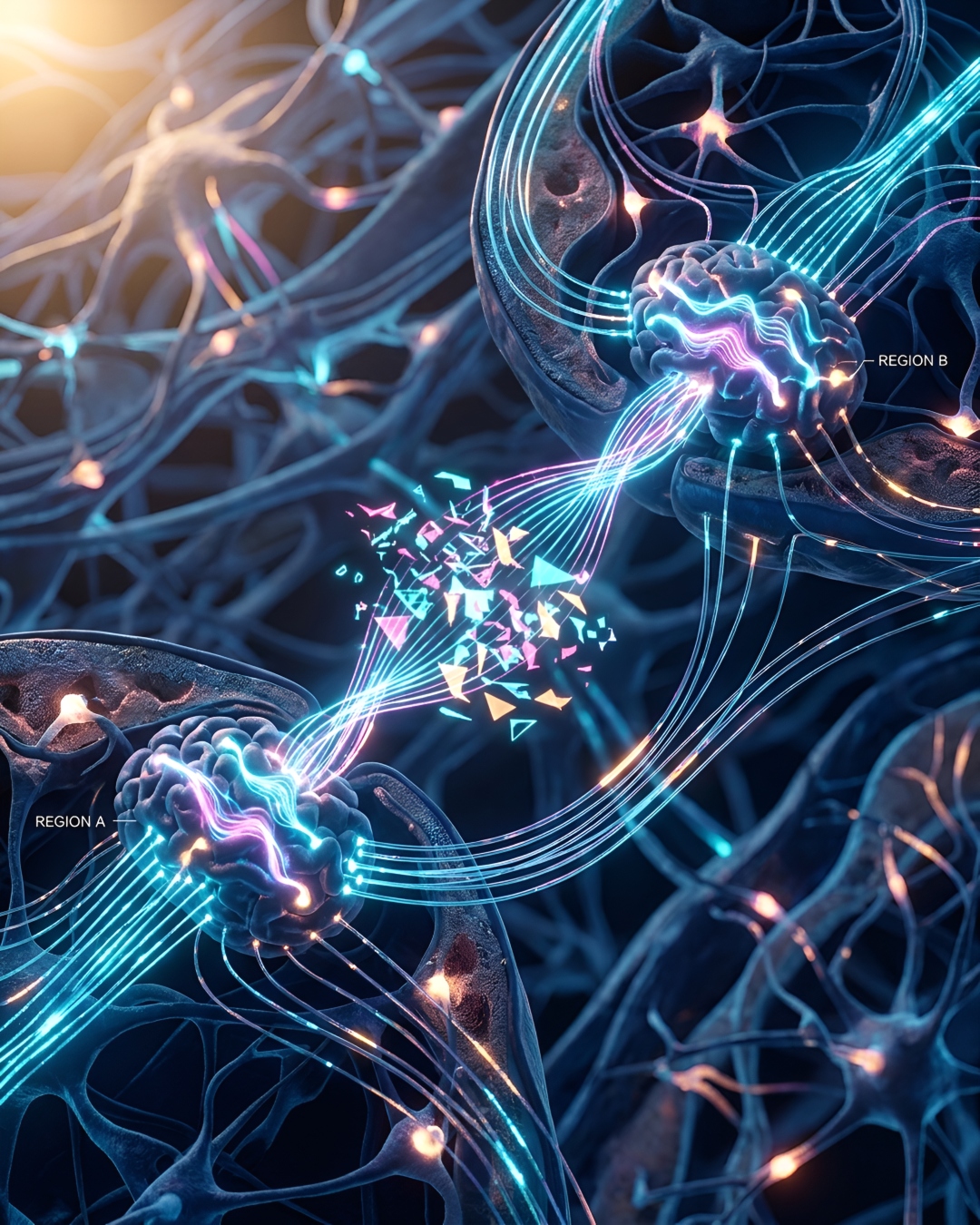
Neural Consensus Building in Visual Cortex

scitechdaily neuroscience brain-research visual-cortex artificial-intelligence

Samenvatting

Mindmap Omslagafbeelding
AI Gegenereerde Omslagafbeelding

Recent research published in Nature Neuroscience on September 30, 2026, by Mitra Javadzadeh and collaborators reveals how neighboring visual areas in the brain reach consensus when processing conflicting visual inputs. By examining the primary visual cortex V1 and the lateromedial visual area LM in mice, scientists discovered that shared activity patterns persist longer, while conflicting patterns dissipate within a fraction of a second. The authors investigate the foundational glue that combines specialized building blocks of the brain into a unified interpretation of the world. Utilizing artificial neural network models and recording data from 194 V1 neurons and 228 LM neurons across seven mice, the team demonstrated a dynamic mechanism termed consensus building driven by reciprocal connections between neocortical areas. The essence of this study lies in mapping bidirectional communication channels where specialized groups of neurons handle distinct sensory streams yet produce a consistent holistic outcome. The research successfully explains how mismatches are rapidly filtered out to maintain a coherent and stable perception despite ambiguous sensory inputs. These findings offer practical implications for understanding neurological disorders where brain regions fail to interpret the world consistently. Furthermore, the consensus-building principle inspires novel approaches in artificial intelligence systems designed to reconcile conflicting data streams and improve cross-modal sensory integration.

Belangrijke punten

01

🔹 Core Discovery on Visual Consensus Building

【📌 Key Finding】Neighboring visual areas settle on a common interpretation by reinforcing shared activity patterns while conflicting patterns fade rapidly within a fraction of a second. 【🔸 Impact Factors】This mechanism enables specialized groups of neurons to produce a consistent holistic outcome despite receiving distinct sensory streams. 【⭐ Data Support】Published on September 30, 2026, in Nature Neuroscience by Mitra Javadzadeh and collaborators from Cold Spring Harbor Laboratory, University of Cambridge, and University College London.

02

🔸 Experimental Setup and Neural Measurements

【📌 Research Method】Researchers trained mice to distinguish between two visual patterns tilted at opposite angles with a reward for one orientation while briefly silencing V1 or LM. 【🔸 Neural Data】The team measured activity from a combined 194 V1 neurons and 228 LM neurons across seven mice to build accurate artificial neural network circuit models. 【⭐ Causal Relationship】Silencing either area allowed scientists to record how the other region functioned without its partner's input to simulate circuit responses.

03

⭐ Reciprocal Connections and Artificial Neural Network Modeling

【📌 Model Construction】An artificial neural network model representing the V1-LM circuit was built to simulate how specific neuron manipulations shape activity persistence. 【🔸 Bidirectional Flow】V1 and LM communicate in both directions, allowing each area to dynamically influence its neighbor rather than acting as a simple one-way route. 【⭐ Mechanism Identification】The reciprocal connections implement consensus building over time, explaining how specialized neocortical blocks achieve coordinated perception.

04

📊 Broader Implications and Future Research Directions

【📌 Neocortex Extension】Javadzadeh is currently investigating whether similar consensus-building principles apply throughout the broader neocortex and across different senses. 【🔸 Cross-Modal Application】Future research aims to test whether conflicting audiovisual inputs, such as sight and sound disagreements, use identical reconciliation mechanisms. 【⭐ AI Inspiration】The same neural principles could inspire advanced computational approaches for reconciling conflicting information in artificial intelligence systems.

05

💡 Funding Sources and Study Metadata

【📌 Research Reference】Study titled 'Reciprocal connections dynamically build consensus between neocortical areas' published on September 18, 2026, in Nature Neuroscience. 【🔸 Grant Support】Funded by the UKRI Engineering and Physical Sciences Research Council, Gatsby Charitable Foundation, Wellcome Foundation, Cynthia R. Stebbins Fellows Program, and Pershing Square Foundation. 【⭐ Author Affiliation】Led by Mitra Javadzadeh, Cynthia R. Stebbins Fellow at Cold Spring Harbor Laboratory.

Wilt u uw eigen mindmap maken?

Log in op Neumap AI en begin met het maken van uw eigen mindmaps!

Aan de Slag