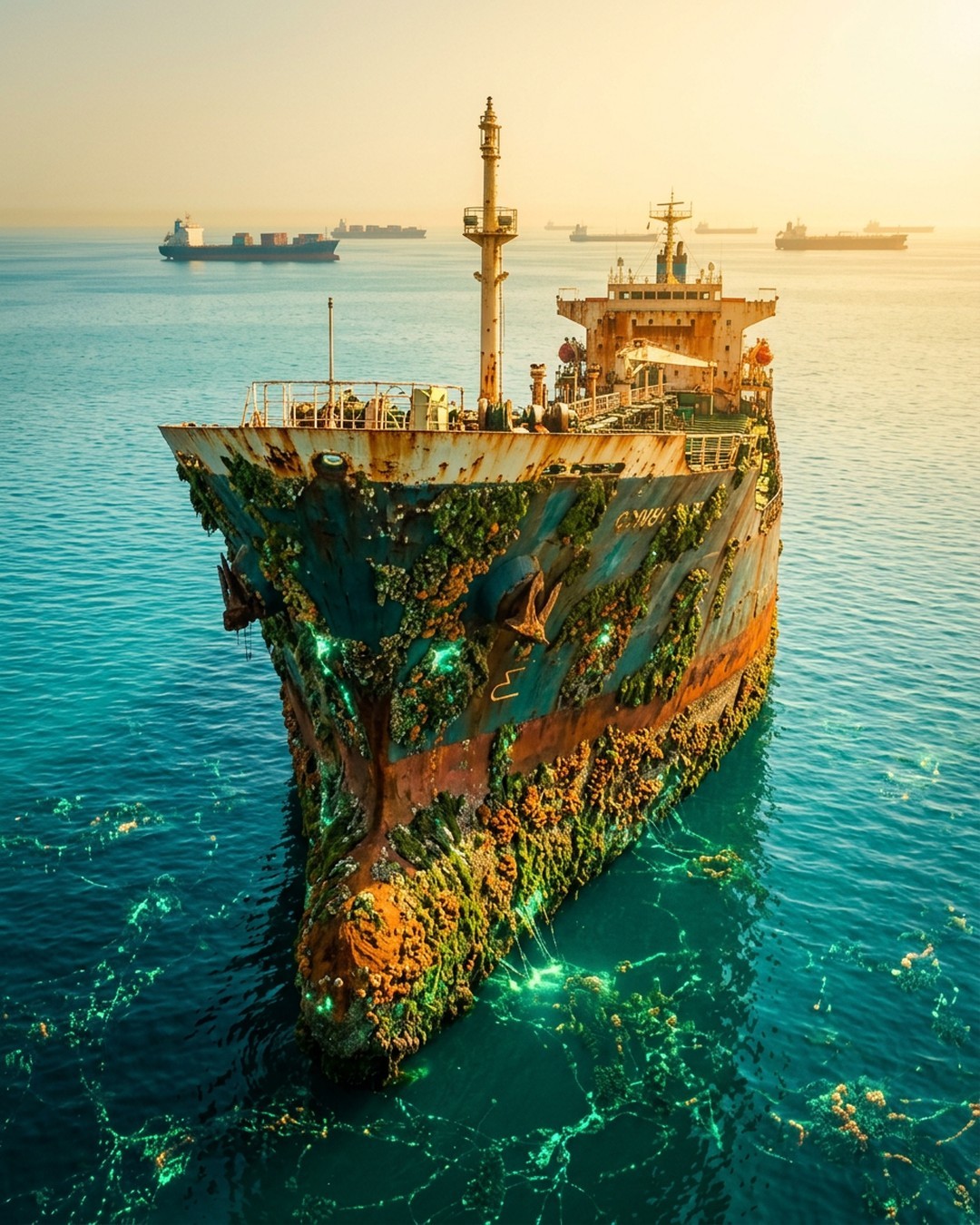
Global Marine Bioinvasion Crisis Caused by Stranded Gulf Ships

ScitechDaily MarineBiology InvasiveSpecies Ecology ShippingDisruption

Samenvatting

Mindmap Omslagafbeelding
AI Gegenereerde Omslagafbeelding

More than 1500 commercial ships stranded in the Persian or Arabian Gulf and the Gulf of Oman are transforming into floating habitats for invasive marine organisms, according to a study published on July 29, 2026, in Biological Invasions by an international team of 24 marine scientists led by the University of Maryland Center for Environmental Science and Woods Hole Oceanographic Institution researchers. The unprecedented shipping disruption has immobilized vessels for at least 40 times longer than a typical port visit, allowing dense communities of algae, barnacles, mussels, and microbes to rapidly colonize submerged hulls and internal structures. The authors emphasize that this mass lay-up during warm spring and summer months creates a global marine bioinvasion super-spreader event once normal shipping operations resume. Because the Persian Gulf features extreme heat with summer surface temperatures approaching 100 degrees Fahrenheit or 38 degrees Celsius and high salinity, the surviving organisms are exceptionally heat-tolerant and resilient, posing severe ecological and economic threats to coastlines worldwide. The study highlights that these biofouling communities do not merely transport visible invasive species but also carry hidden parasites, pathogens, and diverse genetic material that can increase target populations adaptability to warming global seas. The connected global shipping network of over 3000 vessels making nearly 250000 port calls provides an extraordinary vector to distribute these resilient organisms into coastal environments across Europe, Asia, Africa, and beyond. To mitigate this global crisis, researchers strongly recommend assessing hull fouling before vessels depart, predicting routes and first ports of call, notifying destination ports in advance, and conducting urgent cleanings where logistically feasible. Implementing these preventative measures is crucial to treating the grounded fleet like an infectious disease outbreak and stopping the widespread ecological destruction of marine ecosystems.

Belangrijke punten

01

🔹 Unprecedented Scale of Stranded Fleet

【📌 Key Finding】More than 1500 large commercial ships including oil tankers, gas tankers, and cargo vessels are stranded across the Persian or Arabian Gulf and the Gulf of Oman. 【🔸 Impact Factors】Unlike typical port visits lasting only one to three days, these vessels have remained idle for at least 40 times longer, bypassing normal antifouling mechanisms. 【⭐ Data Support】Researchers examined 3027 vessels that collectively made 248362 port calls across 3517 global locations, revealing a massive potential vector network.

02

🔸 Extreme Environmental Breeding Conditions

【📌 Key Finding】The Persian Gulf functions as an intense incubator due to its shallow, semi-enclosed geography. 【🔸 Impact Factors】Summer surface temperatures reach nearly 100 degrees Fahrenheit or 38 degrees Celsius with high salinity and limited water exchange. 【⭐ Data Support】Recent surveys identified 57 nonnative and uncertain-origin biofouling species along western Persian Gulf ports, creating resilient warm-water communities.

03

⭐ Accelerated Biofouling and Genetic Risks

【📌 Key Finding】Prolonged stationary periods extend past the critical 10-day window for rapid biofouling growth. 【🔸 Impact Factors】Algae, barnacles, mussels, and microbes mix and reproduce rapidly on sheltered hull structures, rudders, and intake pipes. 【⭐ Data Support】The biological communities carry hidden parasites, pathogens, and diverse genetic material that enhance environmental stress tolerance and adaptability.

04

📊 Global Transmission Pathways and Vulnerable Coasts

【📌 Key Finding】Reactivated vessels risk acting as a bioinvasion super-spreader event for world coastlines. 【🔸 Impact Factors】Organisms surviving the Gulf's harsh heat can increase heat tolerance in related populations globally. 【⭐ Data Support】Connected trade routes can rapidly distribute resilient organisms into coastal ports and marine environments across Europe, Asia, Africa, and beyond.

05

💡 Prevention and Mitigation Strategies

【📌 Key Finding】Immediate intervention is necessary to prevent widespread ecological and economic devastation. 【🔸 Impact Factors】Researchers recommend hull cleaning before departure, pre-voyage fouling assessments, and early warning notifications to destination ports. 【⭐ Data Support】Experts compare the strategy to managing an infectious disease outbreak by treating ships as carriers and ports as transmission hubs.

Wilt u uw eigen mindmap maken?

Log in op Neumap AI en begin met het maken van uw eigen mindmaps!

Aan de Slag