Mammal Ancestors Live Birth Evolution

sciencenews paleontology mammalevolution cynodonts viviparity

Samenvatting

Mindmap Omslagafbeelding
AI Gegenereerde Omslagafbeelding

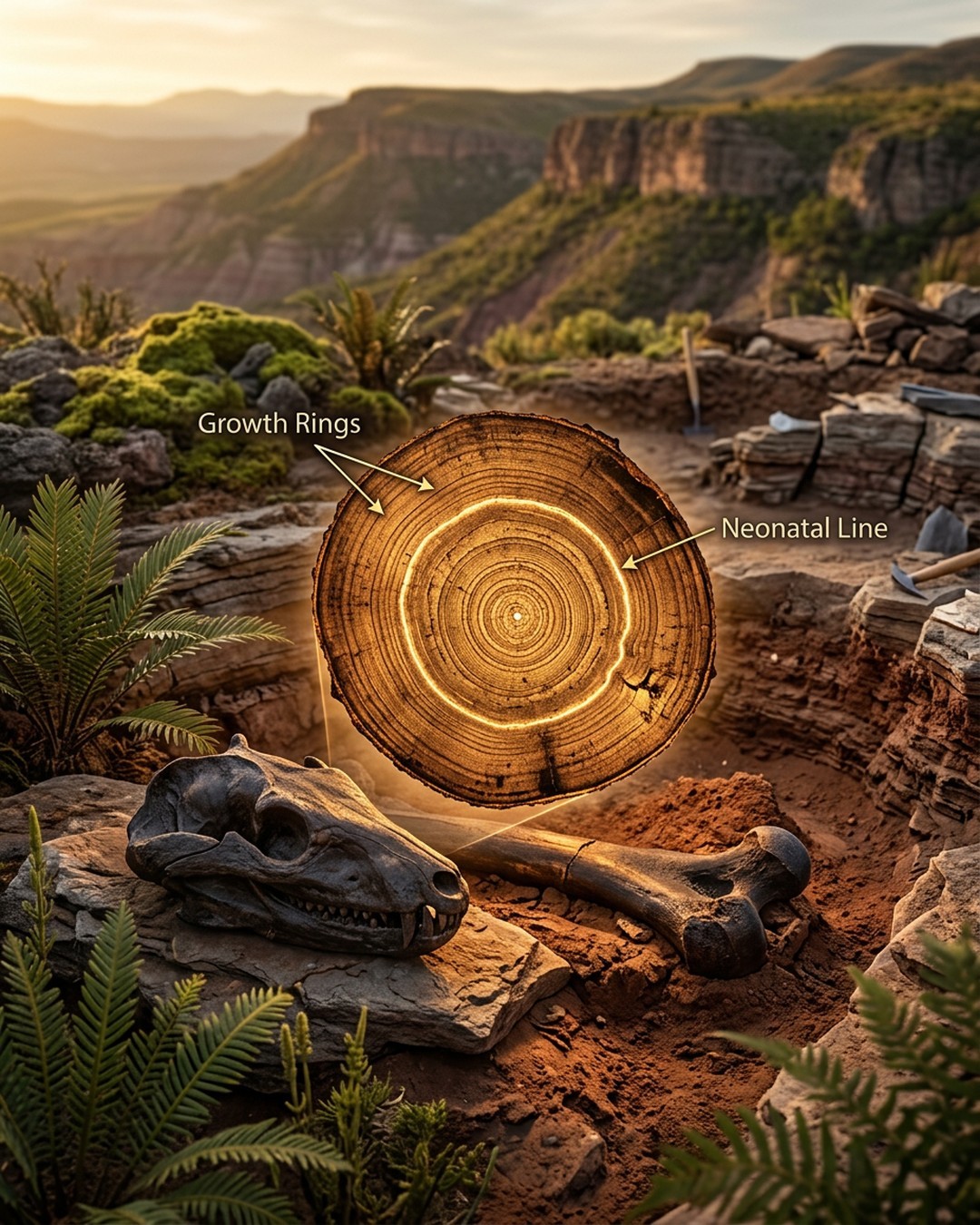
Recent research published on August 13, 2026, in Frontiers in Mammal Science reveals that mammal ancestors may have given birth to live young approximately 90 million years earlier than previously believed. Scientists analyzed growth rings in fossil bones from an adult Chiniquodon theotonicus, a cynodont species that lived around 236 million years ago in northwestern Argentina. The research team identified a microscopic dark ring known as a neonatal line, which marks the intense metabolic stress of being born and separates prenatal tissue from postnatal tissue. By examining this line alongside other bone growth rings, researchers estimated that the animal weighed about 1.7 kilograms at birth and reached about 12 kilograms as an adult, establishing a newborn-to-adult body mass ratio of roughly 14 percent. This body mass ratio closely matches modern placental mammals like the bay duiker, contrasting sharply with egg-laying monotremes, marsupials, reptiles, and birds, whose ratios are significantly lower. This significant discovery implies that viviparity may have evolved much earlier in the mammal lineage or possibly emerged multiple times independently during evolutionary history. While this finding challenges established timelines regarding the emergence of viviparity around 160 million years ago with therian mammals, other experts emphasize that more fossil evidence is necessary. Alternative discoveries, such as egg-encased Lystrosaurus embryos and multiple young fossils of Kayentatherium wellesi, indicate that certain early mammal relatives continued laying eggs, highlighting the complexity of early mammalian reproductive evolution.

Belangrijke punten

01

🔹 Earliest Evidence of Live Birth in Cynodonts

Researchers report on August 13, 2026, in Frontiers in Mammal Science that Chiniquodon theotonicus, a cynodont species living around 236 million years ago, likely gave birth to live young. This finding pushes back the estimated origin of mammalian live birth by at least 90 million years compared to the previous timeline of 160 million years ago.

02

🔸 Neonatal Line Discovery in Fossil Bones

Scientists analyzed growth rings in the femur bone of a C. theotonicus specimen from northwestern Argentina and identified a microscopic dark ring called a neonatal line. This line marks the metabolic stress of birth, separating embryonic tissue from post-birth tissue containing a denser network of blood vessels.

03

⭐ Newborn-to-Adult Body Mass Ratio Analysis

Based on bone-growth rings, researchers calculated that the animal weighed about 1.7 kilograms at birth and 12 kilograms upon death, yielding a body mass ratio of roughly 14 percent. This ratio groups C. theotonicus with modern placental mammals, such as the bay duiker, rather than egg-laying monotremes or marsupials.

04

📊 Evolutionary Implications and Hypotheses

Paleontologist Leandro Gaetano notes that this discovery opens new questions regarding whether mammalian live birth evolved once very early in ancestral lineages or if viviparity evolved multiple times independently. Confirming these hypotheses requires additional fossilized embryonic tissues from non-therian cynodonts.

05

💡 Counterevidence from Other Early Relatives

Despite the compelling C. theotonicus data, other scientists like Eva Hoffman and Randall Irmis urge caution because other early mammal relatives clearly laid eggs. Examples include Lystrosaurus with a preserved embryo inside a shell and Kayentatherium wellesi fossils showing 38 individual young, suggesting diverse reproductive strategies.

Wilt u uw eigen mindmap maken?

Log in op Neumap AI en begin met het maken van uw eigen mindmaps!

Aan de Slag