New Antibody Treatment for Neuropathic Pain

scitechdaily health neurology pharmacology pain-management

Samenvatting

Mindmap Omslagafbeelding
AI Gegenereerde Omslagafbeelding

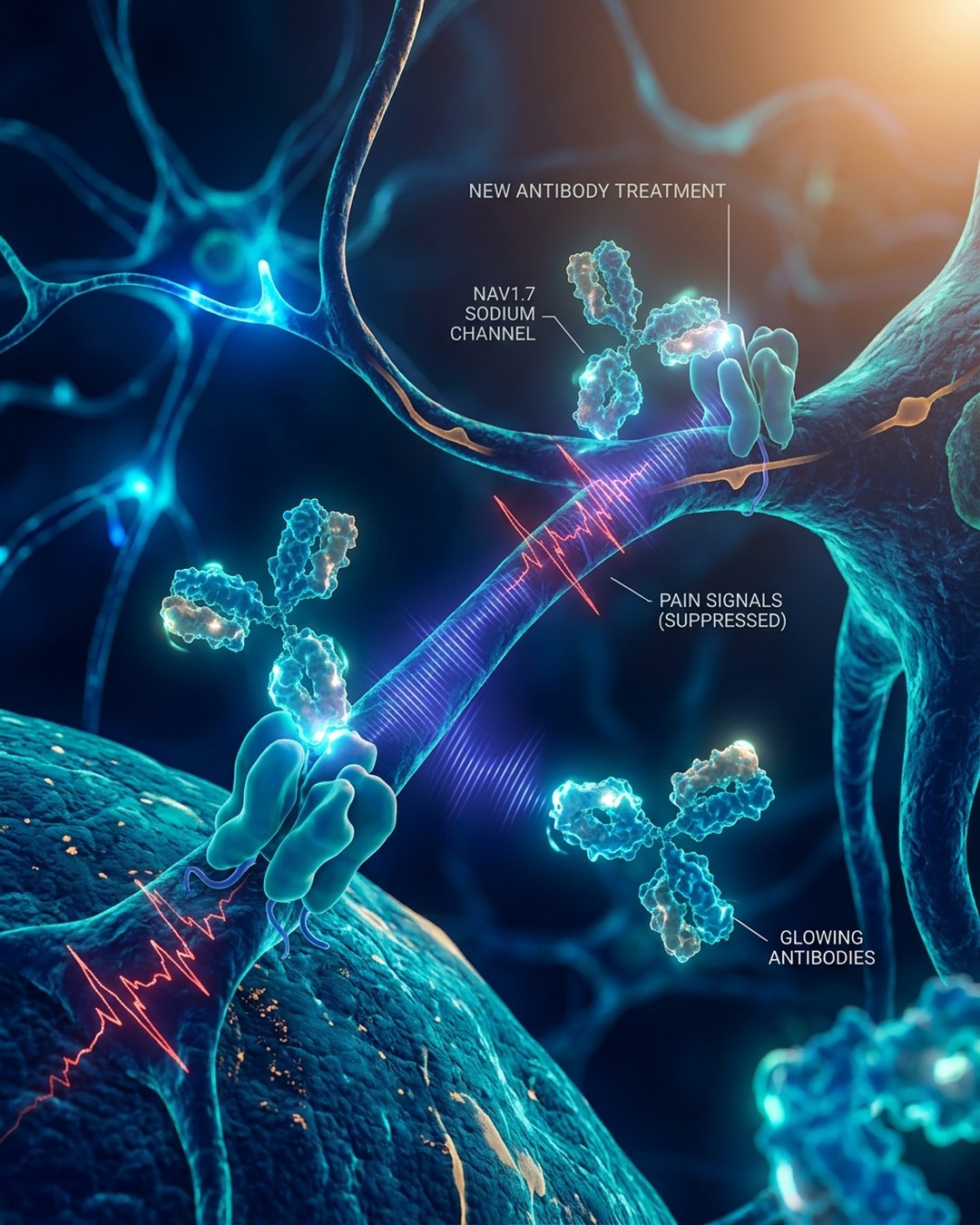
Researchers from the University of Toyama and Shionogi & Co., Ltd. published a preclinical study on June 20, 2026, in the journal Pharmaceutics, demonstrating that engineered humanized antibodies targeting the Nav1.7 sodium channel can suppress abnormal neuropathic pain signals in rats for days without impairing normal protective pain or motor function. The authors emphasize that unlike standard pain medications such as pregabalin, which can cause side effects like motor impairment, the experimental antibody candidates Clone1 and S-151128 specifically target Nav1.7 with high selectivity, showing sustained analgesic efficacy even after 96 hours following intravenous administration. The essence of this research lies in selectively neutralizing voltage-gated sodium channels responsible for pathological electrical signaling in sensory neurons while leaving physiological nociception fully intact, offering a safer therapeutic window for chronic nerve pain management. Practical application includes the progression of one of the candidate antibodies, S-151128, into active clinical trials to determine whether these promising animal model outcomes translate into a safe and effective treatment for human patients suffering from neuropathic pain.

Belangrijke punten

01

🔹 Target Selection and Antibody Development

Researchers targeted Nav1.7, a voltage-gated sodium channel in sensory neurons responsible for transmitting abnormal pain signals. Two humanized antibody candidates, Clone1 and S-151128, were developed and tested in cells, with Clone1 demonstrating at least 650-fold selectivity and S-151128 showing at least 1300-fold selectivity for Nav1.7 over other sodium channel subtypes.

02

🔸 Sustained Pain Relief in Preclinical Models

Tested in rats with partial sciatic nerve ligation (PSNL) via intravenous administration, both antibodies successfully reduced mechanical sensitivity in a dose-dependent manner. After 96 hours, the analgesic effect from the antibodies remained significantly stronger than that produced by standard neuropathic pain medication pregabalin.

03

⭐ Suppression of Abnormal Neural Activity

Nervous system measurements revealed that antibody treatment reduced elevated spontaneous activity and responses to mechanical stimulation in spinal dorsal horn neurons. Furthermore, examinations showed fewer dorsal root ganglion neurons exhibiting mechanically induced phosphorylation of extracellular signal-regulated kinase (pERK), confirming suppression of pathological signaling.

04

📊 Preservation of Normal Function and Safety

Unlike pregabalin, which impaired motor coordination on a rotating-rod task at tested doses, the antibody treatments did not significantly affect motor function. Additionally, the antibodies did not alter normal protective pain responses in uninjured animals, indicating high selectivity for pathological pain.

05

💡 Clinical Translation and Future Outlook

Although the findings remain preclinical and the exact amount of antibody reaching injured nerves could not be precisely determined, candidate S-151128 has already advanced into clinical trials. Future research must evaluate its efficacy across diverse neuropathic pain models and in human patients.

Wilt u uw eigen mindmap maken?

Log in op Neumap AI en begin met het maken van uw eigen mindmaps!

Aan de Slag