Richard Feynman's Thinking Habit and Genius Operating System

Medium RichardFeynman MentalModels FirstPrinciples LearningHabits ThomasOppong

Samenvatting

Mindmap Omslagafbeelding
AI Gegenereerde Omslagafbeelding

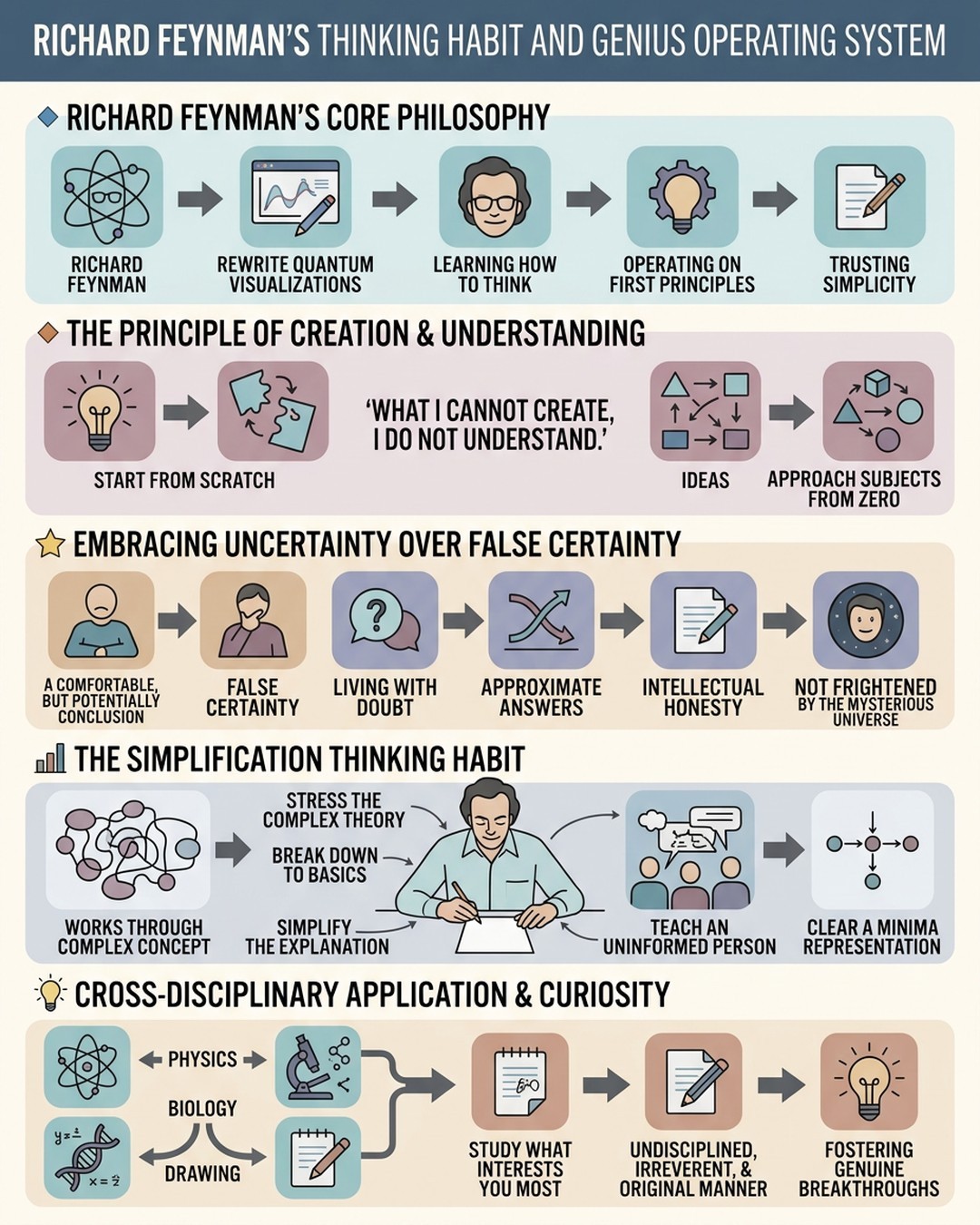
Richard Feynman, a Nobel Prize-winning physicist born in the 20th century, utilized a unique operating system for life built on first principles, absolute curiosity, and extreme simplicity. He famously stated that what he cannot create, he does not understand, demonstrating a willingness to start from scratch and look foolish rather than rely on established, complex dogma. The author Thomas Oppong highlights in this June 12, 2026 Medium article that Feynman's genius stemmed from his relentless thinking habit of explaining difficult concepts to himself in the simplest way possible, as if teaching a complete beginner on a blank sheet of paper. He embraced uncertainty and preferred living without manufactured answers over holding potentially incorrect conclusions. Feynman applied his rigorous framework across diverse disciplines including physics, biology, and drawing, always stripping away unnecessary jargon to reveal underlying truths. His core philosophy centered on studying what interests you the most in the most undisciplined, irreverent, and original manner possible. Readers can apply Feynman's mental model this week by taking complex topics they are trying to learn, grabbing a blank piece of paper, and attempting to explain the concepts using plain, jargon-free language to expose knowledge gaps.

Belangrijke punten

01

🔹 Richard Feynman's Core Philosophy

Richard Feynman was a 20th-century Nobel Prize-winning physicist known for rewriting quantum interaction visualizations. He insisted he was an ordinary person who focused intensely on learning how to think, operating on first principles and trusting simplicity as the ultimate sign of true knowledge.

02

🔸 The Principle of Creation and Understanding

Feynman famously stated, 'What I cannot create, I do not understand.' This driving belief caused him to tear ideas apart and reassemble them from scratch rather than blindly accepting established learning methods, allowing him to approach every subject from zero.

03

⭐ Embracing Uncertainty over False Certainty

Feynman preferred living with doubt and approximate answers rather than accepting potentially wrong conclusions. He noted that he did not feel frightened by being lost in a mysterious universe, choosing intellectual honesty over the comfort of false certainty.

04

📊 The Simplification Thinking Habit

For every theory, idea, or problem he did not understand, Feynman sat down with a blank piece of paper and attempted to explain it to himself in the simplest way possible, as if teaching someone who had never encountered the concept before.

05

💡 Cross-Disciplinary Application and Curiosity

Feynman applied his mental operating system across multiple fields including physics, biology, and drawing. He advised studying what interests you the most in the most undisciplined, irreverent, and original manner possible to foster genuine breakthroughs.

Wilt u uw eigen mindmap maken?

Log in op Neumap AI en begin met het maken van uw eigen mindmaps!

Aan de Slag