Scientists Turn Ordinary Plastic Into Billions of Tiny Diamonds Using Powerful Lasers

scitechdaily nanotechnology materials-science lasers diamonds

Samenvatting

Mindmap Omslagafbeelding
AI Gegenereerde Omslagafbeelding

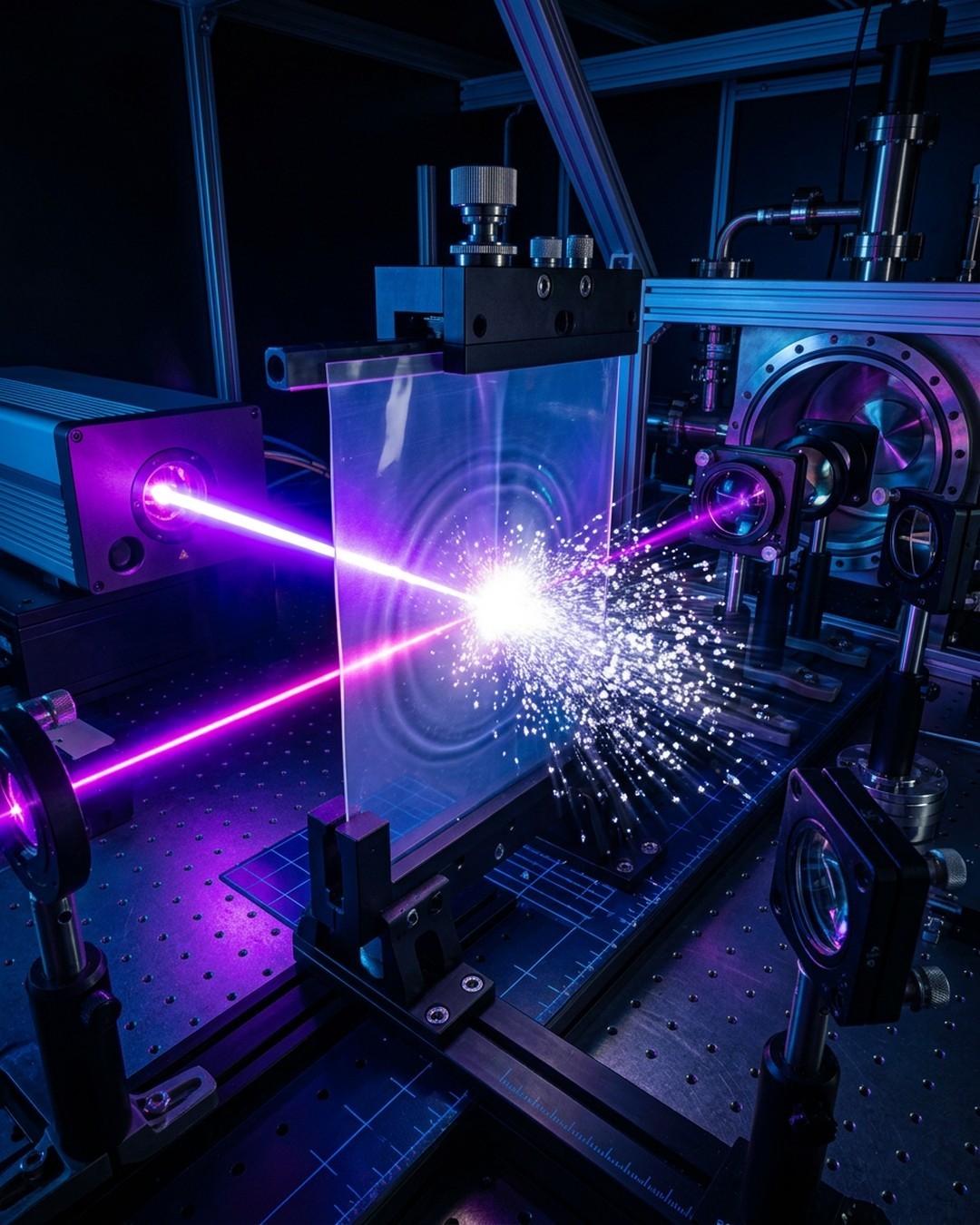
Published on October 19, 2026, researchers at the Helmholtz-Zentrum Dresden-Rossendorf (HZDR) and the University of Rostock successfully transformed ordinary PET plastic films into billions of tiny nanodiamonds using high-power lasers. The experiment, conducted at the Extreme Light Infrastructure (ELI) facility south of Prague, simulated the extreme pressures and temperatures found inside planets like Neptune and Uranus. The research team demonstrated that these nanodiamonds, averaging three nanometers across and containing roughly 3,000 carbon atoms each, survive the return from extreme conditions when captured using a water-soluble ionic gel. This soft collection medium successfully cushions the particles as they are accelerated to speeds exceeding ten kilometers per second by vacuum shock waves. The laser technique yields exceptional purity, uniformity, and ultra-small sizing that conventional explosion methods cannot achieve. By starting with plastic films, the process also facilitates doping, allowing scientists to incorporate foreign atoms into the carbon structure for tailored applications. Practical applications of these recovered nanodiamonds include advanced medical imaging contrast agents, quantum sensors, and highly efficient catalysts for chemical reactions like sunlight-driven CO2 splitting. Future work aims to scale production into the milligram range and synthesize denser carbon forms like BC8 using higher laser pressures.

Belangrijke punten

01

🔹 Laser Transformation of Plastic into Nanodiamonds

Researchers at Helmholtz-Zentrum Dresden-Rossendorf (HZDR) and the University of Rostock used high-power lasers at the Extreme Light Infrastructure (ELI) facility to convert ordinary PET plastic films into nanodiamonds, simulating conditions inside Neptune and Uranus【📌 Core Finding】+ 【🔸 Process Mechanics】(max 500 words)

02

🔸 Collection and Catcher Methodology

Laser pulses generated shock waves that compressed PET film 100 micrometers thick, accelerating the resulting nanodiamonds to over ten kilometers per second into a vacuum, where a water-soluble ionic gel safely cushioned them against meteorite-impact speeds【📌 Catcher Setup】+ 【⭐ Shock Waves】(max 500 words)

03

⭐ Characteristics and Purity of Recovered Diamonds

The recovered particles averaged three nanometers in size containing roughly 3,000 carbon atoms each, yielding a combination of high purity, exceptionally small size, and closely matched particle sizes unattainable via conventional explosions【📌 Particle Size】+ 【⭐ High Purity】(max 500 words)

04

📊 Characterization and Atomic Analysis

Producing approximately ten trillion diamonds per laser shot, the team required roughly 100 shots to collect hundreds of micrograms of material, which Ben Heuser and colleagues analyzed using the ELMI-MV electron microscope at the University of Rostock【📌 Microscopy Analysis】+ 【📊 Quantitative Yield】(max 500 words)

05

💡 Potential Applications and Future Research

Uniform nanodiamonds can improve medical MRI contrast agents, quantum sensors, and catalytic efficiency for solar CO2 splitting, with upcoming November experiments aiming to synthesize denser BC8 carbon allotropes using higher pressures【📌 Medical & Quantum Uses】+ 【💡 BC8 Synthesis】(max 500 words)

Wilt u uw eigen mindmap maken?

Log in op Neumap AI en begin met het maken van uw eigen mindmaps!

Aan de Slag