Dinosaurs May Have Eaten Seaweed Research

ScitechDaily Paleontology Dinosaurs Geochemistry Ecology

Samenvatting

Mindmap Omslagafbeelding
AI Gegenereerde Omslagafbeelding

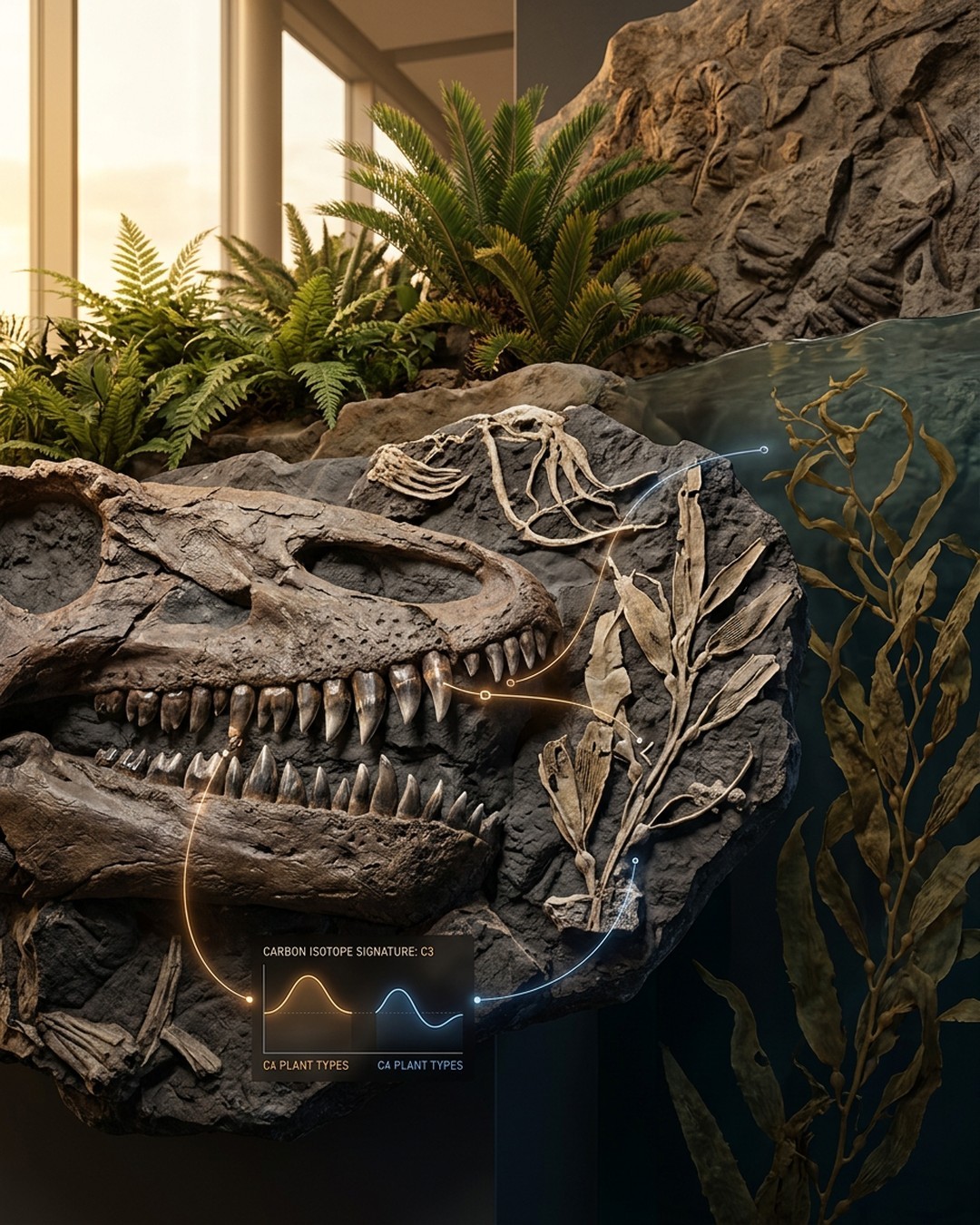
Recent research published in Frontiers in Ecology and Evolution on August 6, 2026, reveals that dinosaurs and other Cretaceous animals living near ancient coastlines consumed food derived from the sea, pointing strongly to seaweed consumption. Led by Dr. Clayton Forster at the University of Arkansas, scientists examined chemical signatures preserved in fossil teeth from North American coastlines. The researchers analyzed carbon isotope ratios, specifically measuring lighter carbon 12 and heavier carbon 13 expressed as δ13C values, in fossil specimens from sites bordering the Western Interior Seaway and the ancient Gulf of Mexico. Coastal fossils consistently exhibited higher δ13C values compared to landlocked formation fossils, indicating marine subsidization across food webs. The findings demonstrate that terrestrial organisms in Cretaceous greenhouse climates relied on marine resources to supplement their diets. Given that few organisms besides marine macroalgae or macrophytes match the criteria of remaining available over millions of years along coasts, researchers concluded that large coastal herbivores likely ate seaweed. This study bridges gaps between terrestrial and marine ecosystems, emphasizing their deep intertwinement over hundreds of millions of years. The insights highlight the importance of environmental linkages across time and space, prompting further research into polar or equatorial latitudes and different geological periods.

Belangrijke punten

01

🔹 Marine Subsidization in Cretaceous Ecosystems

Research published on August 6, 2026, in Frontiers in Ecology and Evolution shows that dinosaurs and other Cretaceous coastal animals consumed food derived from the ocean. Scientists call this transfer of ocean-derived food into terrestrial ecosystems marine subsidization, impacting food webs that included dinosaurs, crocodiles, turtles, and fish.

02

🔸 Carbon Isotope Signatures in Fossil Teeth

Scientists analyzed carbon isotope ratios, measuring lighter carbon 12 and heavier carbon 13 expressed as δ13C values in fossil tooth enamel. Living animal tooth enamel typically rises 11 to 13 parts per thousand above their food source, but dinosaur teeth consistently showed even larger shifts and higher values than expected for land-only plant diets.

03

⭐ Comparison Between Coastal and Landlocked Fossils

Fossils originating from sites bordering the Western Interior Seaway and the ancient Gulf of Mexico dating from the early Albian (113 to 107 million years ago) and early Cenomanian (100 to 96 million years ago) were compared with landlocked fossils. Coastal fossils consistently contained higher δ13C values, remaining uniform across different latitudes and time periods.

04

📊 Identification of Seaweed as the Primary Source

A carbon source capable of producing these isotopic patterns must reach the base of both aquatic and terrestrial food webs, occur along coasts, and remain available over millions of years. Researchers determined that marine macroalgae, or macrophytes (seaweeds), best fit these criteria, paralleling the behavior of modern large coastal herbivores.

05

💡 Exceptions and Future Research Directions

Not every dinosaur shared this signal; the large herbivorous dinosaur Tenontosaurus tilletti showed δ13C values typical of land-growing plants, which rules out post-mortem diagenetic alteration. Future studies will examine polar and equatorial latitudes, as well as the preceding Jurassic Period and subsequent Cenozoic Era, to broaden understanding of ancient ecosystems.

Wilt u uw eigen mindmap maken?

Log in op Neumap AI en begin met het maken van uw eigen mindmaps!

Aan de Slag