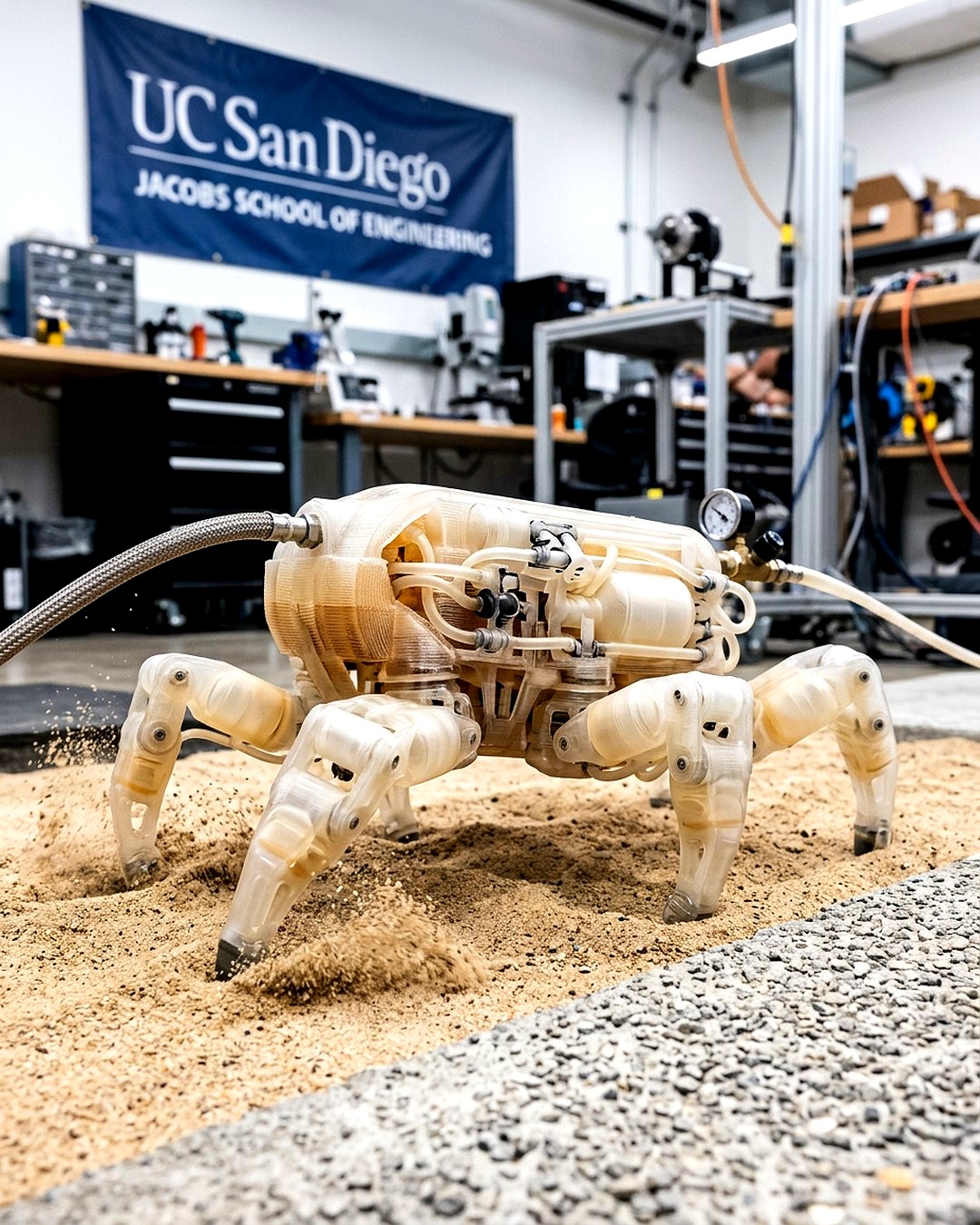
🤖 3D-Printed Electronic-Free Soft Robot

SciTechDaily SoftRobotics 3DPrinting MechanicalEngineering UCSD PneumaticRobots

Samenvatting

Mindmap Omslagafbeelding
AI Gegenereerde Omslagafbeelding

Engineers at the University of California San Diego have developed a breakthrough six-legged soft robot that can run, swim, and climb without any electronics. The machine achieves record-breaking speeds of up to 4.72 meters per second, or 10.6 miles per hour, across diverse terrains like sand and concrete. This innovation demonstrates how soft robotics can leverage pneumatic power systems to navigate challenging environments safely and effectively. The researchers argue that adapting principles from centuries-old steam engines allows modern soft robots to dramatically improve energy efficiency and speed. By implementing a two-stage expansion system, the robot extracts more useful work from compressed air without wasting valuable energy. This stance emphasizes that complex electronic controllers are not always necessary to achieve high-performance mechanical locomotion. The essential mechanism relies on a 3D-printed body made from a single piece of material containing an integrated network of chambers and valves. Compressed air first passes through high-pressure chambers to operate the internal valves before flowing into larger low-pressure chambers to drive the legs. Published in November 2026 in Science Robotics and funded by the National Science Foundation, the design successfully operates underwater and across rough surfaces. For practical application, this air-powered robotic design offers a promising new tool for exploring hazardous or extreme environments where strong magnetic fields or radiation disrupt conventional electronics. Future developments must focus on decoupling the machine from external tethers by integrating portable compressed air supplies. Engineers also aim to introduce steering capabilities and object manipulation for disaster response and space exploration.

Belangrijke punten

01

📊 Record-Breaking Speed of the Soft Robot

【📌 Maximum Velocity】The six-legged soft robot reaches top speeds of up to 4.72 meters per second, which equals roughly 10.6 miles per hour. 【📌 Terrain Versatility】The machine successfully navigates across sand, gravel, concrete, stairs, mulch, and lawns, and it can also swim and function underwater. 【📌 Core Significance】This performance makes it the fastest soft robot of its kind, outperforming earlier models by a factor of 100 without relying on traditional motors.

02

🏛️ Inspiration From the Steam Engine

【📌 Historical Adaptation】The breakthrough design takes inspiration from the compound steam engine, an invention from centuries past. 【📌 Energy Efficiency】By letting steam or air expand through multiple chambers instead of releasing it instantly, the mechanism extracts more useful energy. 【📌 Speed Multiplier】This adaptation allowed researchers to make the new soft robot more than 100 times faster than their previous 2022 prototype.

03

⚡ Two-Stage Pneumatic Power Distribution

【📌 Dual-Chamber Design】Compressed air flows through a connected network of chambers, valves, and tubes built directly into the soft body. 【📌 First Stage】Air first passes through smaller, high-pressure chambers to operate the internal valves. 【📌 Second Stage】The air then travels into larger, low-pressure chambers where it drives the legs, maximizing the utility of the compressed air.

04

📋 Single-Piece 3D Printing Construction

【📌 Manufacturing Method】The entire robot is 3D-printed in one single piece out of a single soft material. 【📌 Electronic Independence】The machine requires zero electronic components, circuit boards, or wiring to move or operate. 【📌 Future Manufacturing】The researchers view this as a significant step toward complex robots that can be printed on a desktop using inexpensive materials.

05

📌 Current Limitations and Future Goals

【📌 External Tether】The robot remains tethered to an external compressed air source, such as a conventional air compressor. 【📌 Portable Supply】Future versions aim to reduce air consumption enough to carry a portable cartridge of compressed air. 【📌 Advanced Control】Developers also plan to add steering mechanisms and object manipulation for use in disaster response and space exploration.

06

📈 Research Background and Funding

【📌 Academic Origin】The research was conducted by Yichen Zhai and Michael T. Tolley at the University of California San Diego Jacobs School of Engineering. 【📌 Publication Date】The findings were published on November 18, 2026, in the journal Science Robotics under the DOI 10.1126/scirobotics.aei1264. 【📌 Financial Support】The developmental work was funded by the National Science Foundation.

Wilt u uw eigen mindmap maken?

Log in op Neumap AI en begin met het maken van uw eigen mindmaps!

Aan de Slag