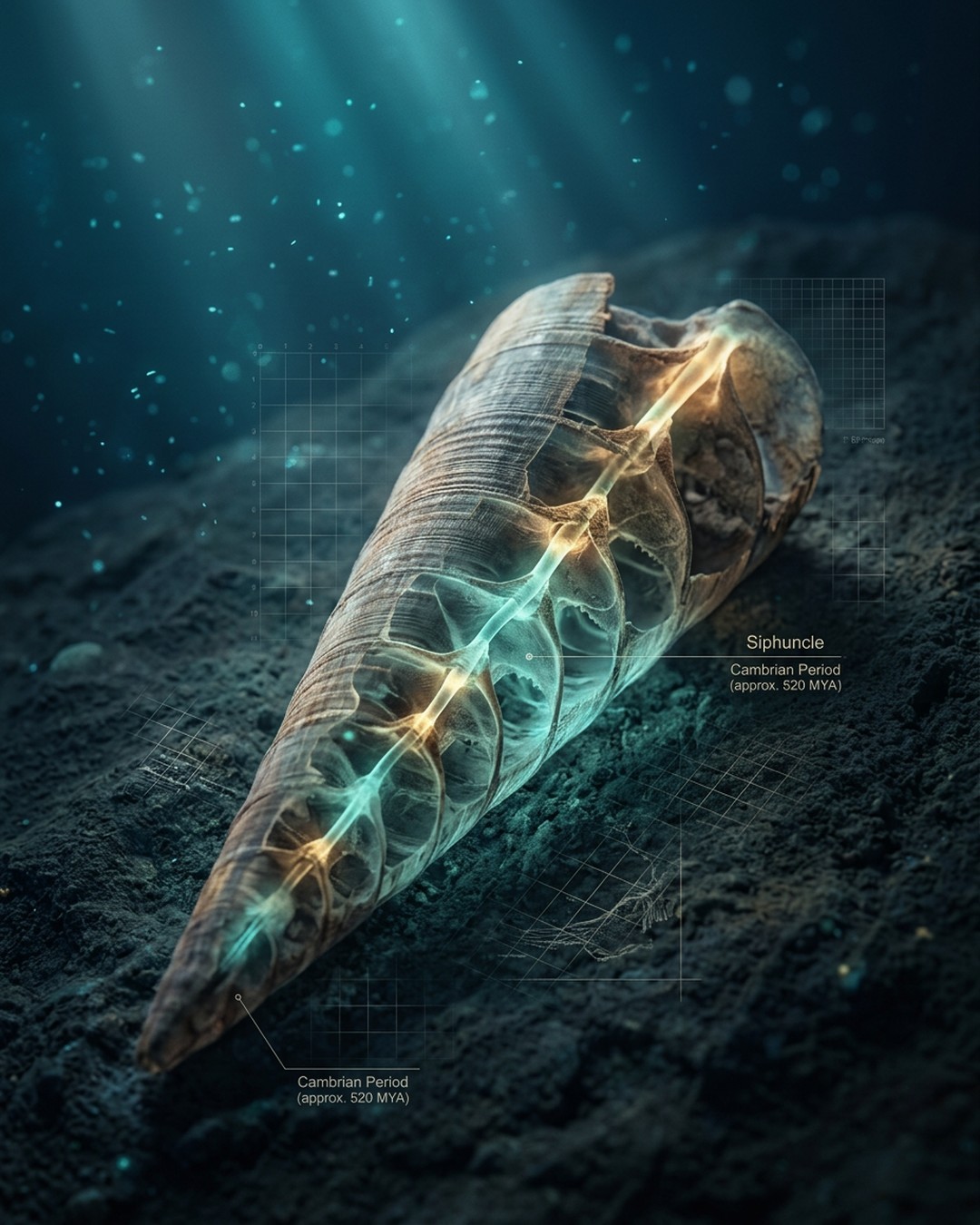
520-Million-Year-Old Fossil Reveals Cephalopod Buoyancy Evolution

scitechdaily paleontology evolution cambrian marine-biology

Resumo

Imagem de Capa do Mapa Mental
Imagem de Capa Gerada por IA

Researchers have discovered a 520-million-year-old fossil named Eoceras shaanxiense from the early Cambrian Shuijingtuo Formation in South China, revealing how early cephalopods learned to float. This newly identified species possesses the oldest-known siphuncle, a tiny segmented tube running through its shell chambers that regulated buoyancy by managing water and gas balance. Led by Junfeng Guo of Changan University and Bing Pan of the Chinese Academy of Sciences, the international research team used scanning electron microscopy and micro-computed tomography to analyze 32 small shelly fossils preserved via phosphatization. Their findings bridge a 30-million-year evolutionary gap between molecular clock estimates and the previously earliest known cephalopod Plectronoceras cambria. The anatomical features of Eoceras demonstrate that early cephalopod buoyancy evolved in distinct stages, starting with straight multi-chambered shells before developing a primitive, sealed siphuncle. Because this system was still basic and primitive, Eoceras likely spent most of its life near the seafloor rather than swimming freely in open waters. This groundbreaking discovery provides essential evidence for early animal evolution during the Cambrian Explosion, establishing Eoceras as a critical intermediate form between non-cephalopod mollusks and later sophisticated swimming cephalopods like modern squids, octopuses, and nautiluses.

Pontos-chave

01

🔹 Discovery of Eoceras shaanxiense

An international research team led by Junfeng Guo and Bing Pan identified 32 specimens of a new 520-million-year-old fossil species named Eoceras shaanxiense from the early Cambrian Shuijingtuo Formation in South China, published in Nature on July 29, 2026.

02

🔸 Earliest Known Siphuncle Structure

【📌 Key Finding】Eoceras features the oldest-known siphuncle, a segmented tube running through the underside of its straight, cone-shaped shell. 【⭐ Data Support】Measured only a few millimeters in size, preserving fine anatomical details through phosphatization and analyzed using scanning electron microscopy and micro-CT.

03

⭐ Bridging the Evolutionary Gap

This discovery bridges a 30-million-year gap in the fossil record between molecular clock estimates of the Cambrian Explosion and the previously oldest widely accepted cephalopod, Plectronoceras cambria, which lived during the late Cambrian.

04

📊 Staged Evolution of Buoyancy

【🔵 Stage 1】Animals possessed straight shells divided by multiple septa / 【🟠 Stage 2】Evolution of a sealed, segmented siphuncle inside the shell like Eoceras / 【⚖️ Evolutionary Significance】Allowed primitive control of water and gas balance, marking the transition from seafloor dwellers to advanced swimmers.

05

💡 Ecological Lifestyle of Early Cephalopods

Because its buoyancy system was still simple and primitive, Eoceras likely spent most of its life near the seafloor, providing vital clues into how modern cephalopods including octopuses, squids, ammonites, cuttlefish, and nautiluses evolved their complex floating mechanisms.

Quer criar seu próprio mapa mental?

Faça login no Neumap AI e comece a criar seus próprios mapas mentais!

Começar