Bacterial Secret for Cancer Drug Development

CancerResearch Biochemistry BacterialBiosynthesis DrugDevelopment UniversityOfWarwick NatureCommunications

Resumo

Imagem de Capa do Mapa Mental
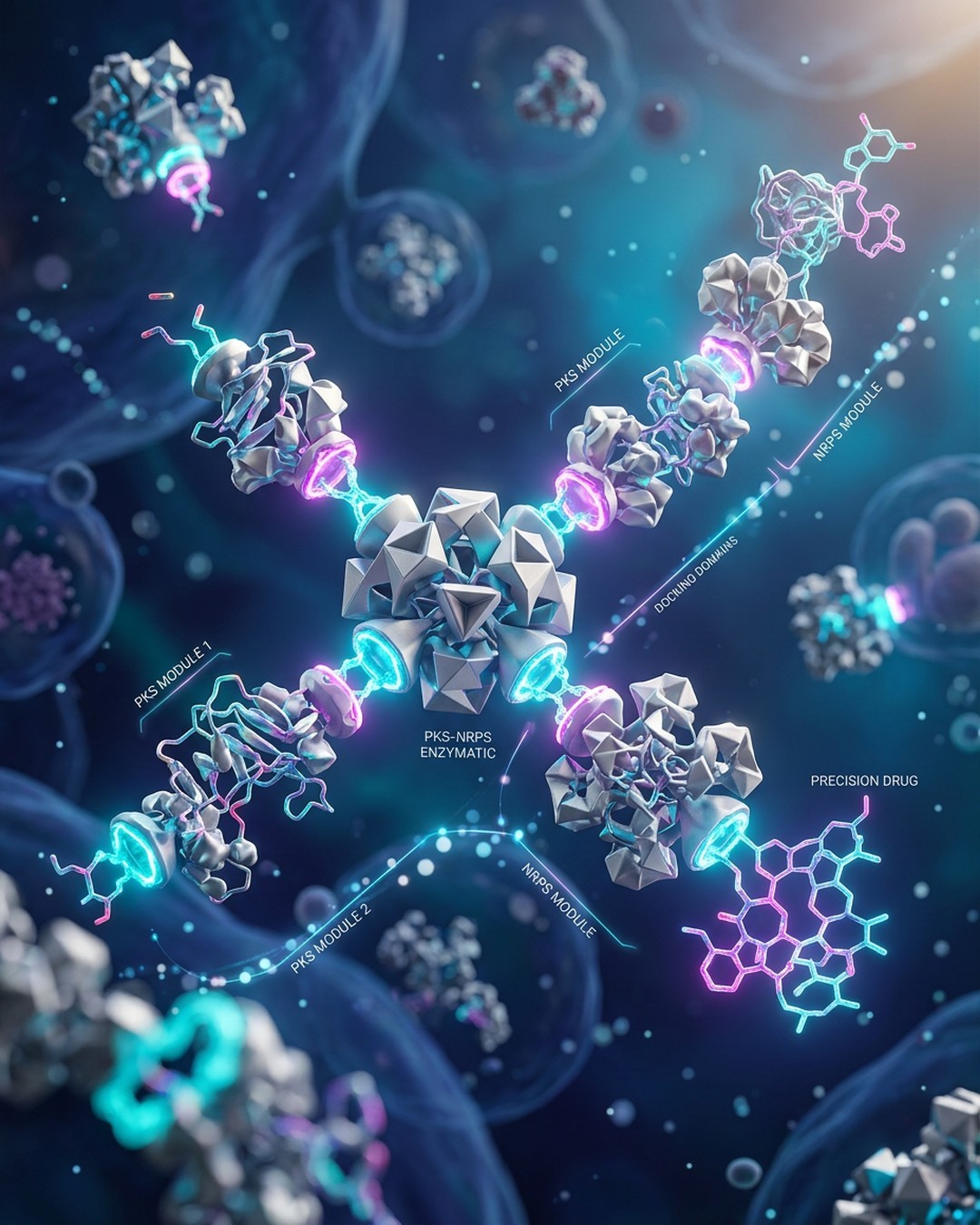
Imagem de Capa Gerada por IA

Researchers from the University of Warwick and Monash University have identified the mechanism by which bacteria naturally produce multiple variants of anti-cancer drugs. Published on July 3, 2026, in Nature Communications, the study reveals that 'docking domains' act as molecular connectors, enabling enzymes to communicate and cooperate in assembling complex depsipeptide molecules. This discovery solves a long-standing mystery regarding the biosynthesis of compounds like Romidepsin and FR-901375. The research team emphasizes that understanding this natural 'mix and match' system provides a blueprint for synthetic biology. By reverse-engineering these bacterial pathways, scientists can now design and engineer new, optimized anti-cancer drug candidates with improved potency, selectivity, and reduced side effects. This shift from observation to active engineering marks a significant advancement in pharmaceutical development. The study utilized a multi-disciplinary approach, combining structural biology, mass spectrometry, and AlphaFold computational modeling to map protein interactions. The findings confirm that these docking domains are essential for the assembly line process, where PKS-NRPS hybrid complexes combine building blocks to create diverse drug molecules. This elegant, economical system is now a target for creating libraries of new therapeutic agents. For the scientific community, this breakthrough offers a practical framework for developing next-generation HDAC inhibitors. Researchers can now leverage these identified genetic and structural principles to accelerate the discovery of treatments for difficult-to-treat cancers, moving toward a future of more precise and effective oncology therapies.

Pontos-chave

01

🔹 Discovery of Molecular Connectors

Researchers identified 'docking domains' (molecular connectors) that facilitate communication between enzyme systems. These domains allow bacteria to assemble diverse anti-cancer drug variants by acting as a bridge between core drug-building machinery and variable cap-building enzymes.

02

🔸 Mechanism of Combinatorial Biosynthesis

【📌 Key Finding】Bacteria use PKS-NRPS hybrid protein complexes to assemble complex ring-shaped molecules called depsipeptides. 【🔸 Impact Factors】The docking domains provide the necessary flexibility for enzymes to interact with multiple partners, enabling the production of a family of related compounds while maintaining high precision.

03

⭐ Clinical Significance of HDAC Inhibitors

The study focuses on HDAC inhibitors, which regulate gene expression. Romidepsin (Istodax) is a known FDA-approved treatment for T-cell lymphomas. The research successfully identified the biosynthetic pathway for FR-901375, a related compound that had previously puzzled scientists for decades.

04

📊 Research Methodology and Validation

The team employed a comprehensive approach: 1. Bioinformatic database searches to identify gene clusters. 2. Mass spectrometry to confirm metabolites. 3. AlphaFold computational modeling to predict protein structures. 4. Site-directed mutagenesis and gene deletion experiments to verify the essential role of docking domains in living cells.

05

💡 Future Therapeutic Applications

By reverse-engineering these natural evolutionary pathways, scientists can now design synthetic pathways to generate new drug candidates. The goal is to create an expanded library of anti-cancer agents with superior potency, improved selectivity, and fewer side effects compared to existing treatments.

Quer criar seu próprio mapa mental?

Faça login no Neumap AI e comece a criar seus próprios mapas mentais!

Começar