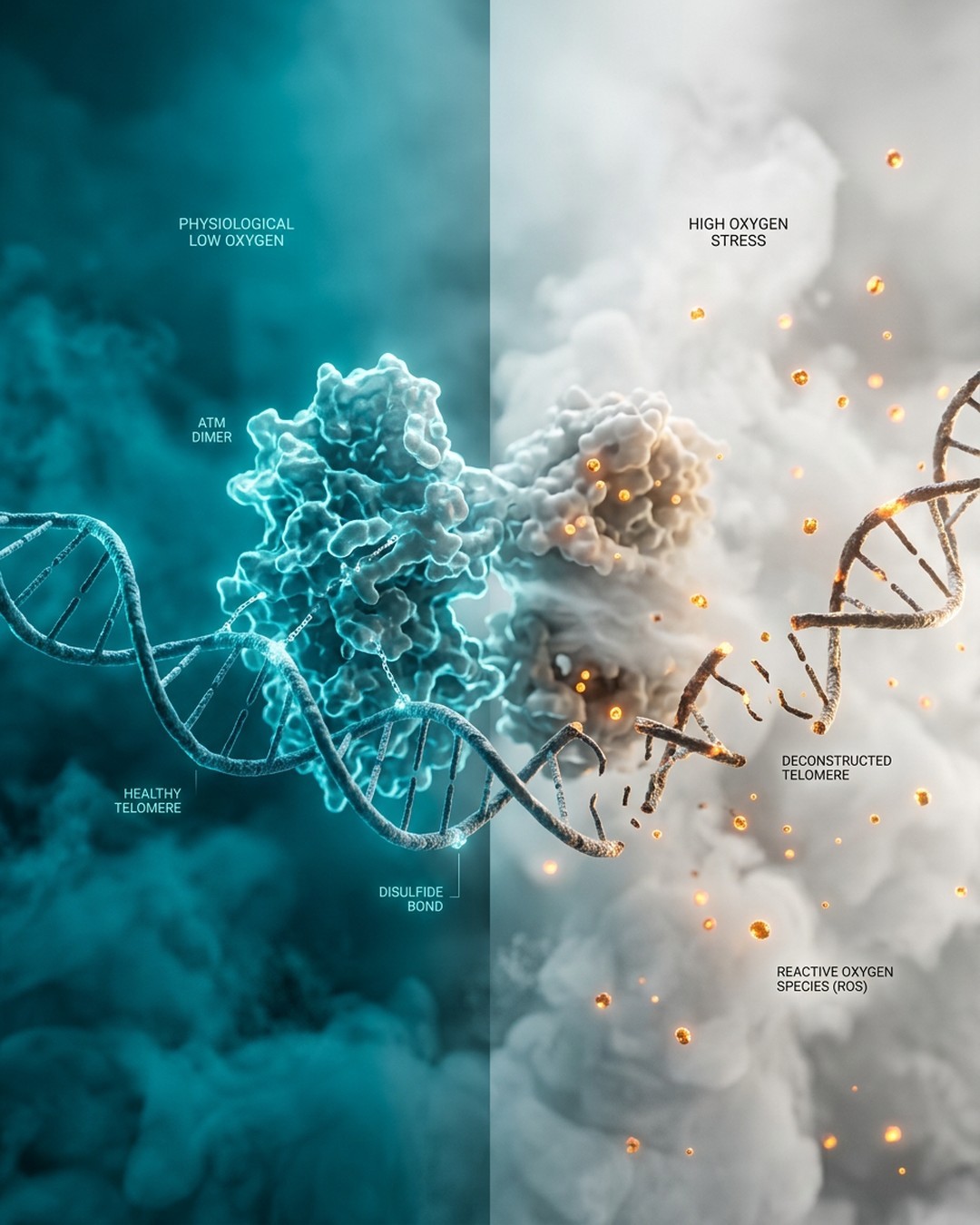
Mechanism of Cellular Aging and ATM Kinase Regulation

CellBiology AgingResearch CancerPrevention MolecularCell RockefellerUniversity

Resumo

Imagem de Capa do Mapa Mental
Imagem de Capa Gerada por IA

Researchers at Rockefeller University have identified ATM kinase as the central molecular switch governing replicative senescence, a critical tumor-suppression mechanism. The study, published in Molecular Cell on December 1, 2025, resolves a decades-old mystery regarding why cells cultured in standard laboratory oxygen (20 percent) enter senescence faster than those in physiological oxygen levels (1 to 8 percent). The authors demonstrate that high oxygen levels induce a hyperactive state in ATM kinase by altering its chemical structure through disulfide bonds. This hyperactivity causes cells to prematurely interpret short telomeres as DNA damage, triggering a permanent growth arrest. Conversely, in physiological oxygen, ATM activity is modulated, allowing cells to continue dividing until telomeres reach a truly critical threshold. This discovery clarifies the wiring of the telomere-based tumor suppressor pathway and highlights the limitations of using standard 20 percent oxygen for cellular aging research. The findings suggest that many laboratory observations regarding senescence may be artifacts of hyperactive ATM signaling rather than natural biological processes. These insights offer significant potential for cancer therapy, particularly in low-oxygen tumor environments where ATM activity is suppressed. By restoring ATM function, clinicians may be able to force malignant cells with critically short telomeres into senescence, effectively halting tumor progression.

Pontos-chave

01

🔹 The Role of ATM Kinase in Senescence

【📌 Key Finding】ATM kinase acts as the primary sensor that enforces replicative senescence. 【🔸 Mechanism】When telomeres lose the shelterin protein TRF2, they are recognized as DNA breaks by ATM, which then signals the cell to stop dividing. 【⭐ Data Support】Inhibition of ATM or overproduction of TRF2 allows cells to bypass this arrest, proving that the senescence state is fully dependent on ATM signaling.

02

🔸 The Oxygen Paradox in Cell Culture

【📌 Key Finding】Cells cultured at 20 percent oxygen (standard lab air) enter senescence significantly faster than those at 1 to 8 percent oxygen (physiological levels). 【🔸 Impact Factors】High oxygen levels cause ATM to become hyperactive, leading to an exaggerated response to telomere shortening. 【⭐ Data Support】Experiments conducted at 3 percent oxygen revealed that cells can continue dividing even with very short telomeres, a capacity lost when shifted to 20 percent oxygen.

03

⭐ Molecular Mechanism of ATM Hyperactivity

【📌 Key Finding】Reactive oxygen species (ROS) under high oxygen conditions induce disulfide bonds within ATM proteins. 【🔸 Causal Chain】These chemical bridges lock ATM into dimers, preventing effective regulation. 【⭐ Data Support】Researchers identified specific sites on the ATM protein where these disulfide bonds form, confirming that this structural change is required for oxygen-dependent regulation of the kinase.

04

📊 Implications for Cancer Biology

【📌 Key Finding】Many tumors thrive in low-oxygen environments that naturally suppress ATM activity. 【🔸 Consequence】This suppression allows cancer cells to survive with critically short telomeres that would otherwise trigger growth arrest. 【⭐ Strategic Application】Restoring ATM function in these specific tumor environments could serve as a therapeutic strategy to force malignant cells into permanent senescence.

05

💡 Research Methodology and Best Practices

【📌 Key Finding】Standard laboratory protocols using 20 percent oxygen may produce skewed results regarding cellular aging. 【🔸 Recommendation】Researchers should verify findings observed at 20 percent oxygen by replicating them at physiological levels (1 to 8 percent). 【⭐ Practical Value】The study emphasizes the difficulty of low-oxygen experiments, requiring rapid handling of reagents to prevent atmospheric exposure from altering the molecular environment.

Quer criar seu próprio mapa mental?

Faça login no Neumap AI e comece a criar seus próprios mapas mentais!

Começar