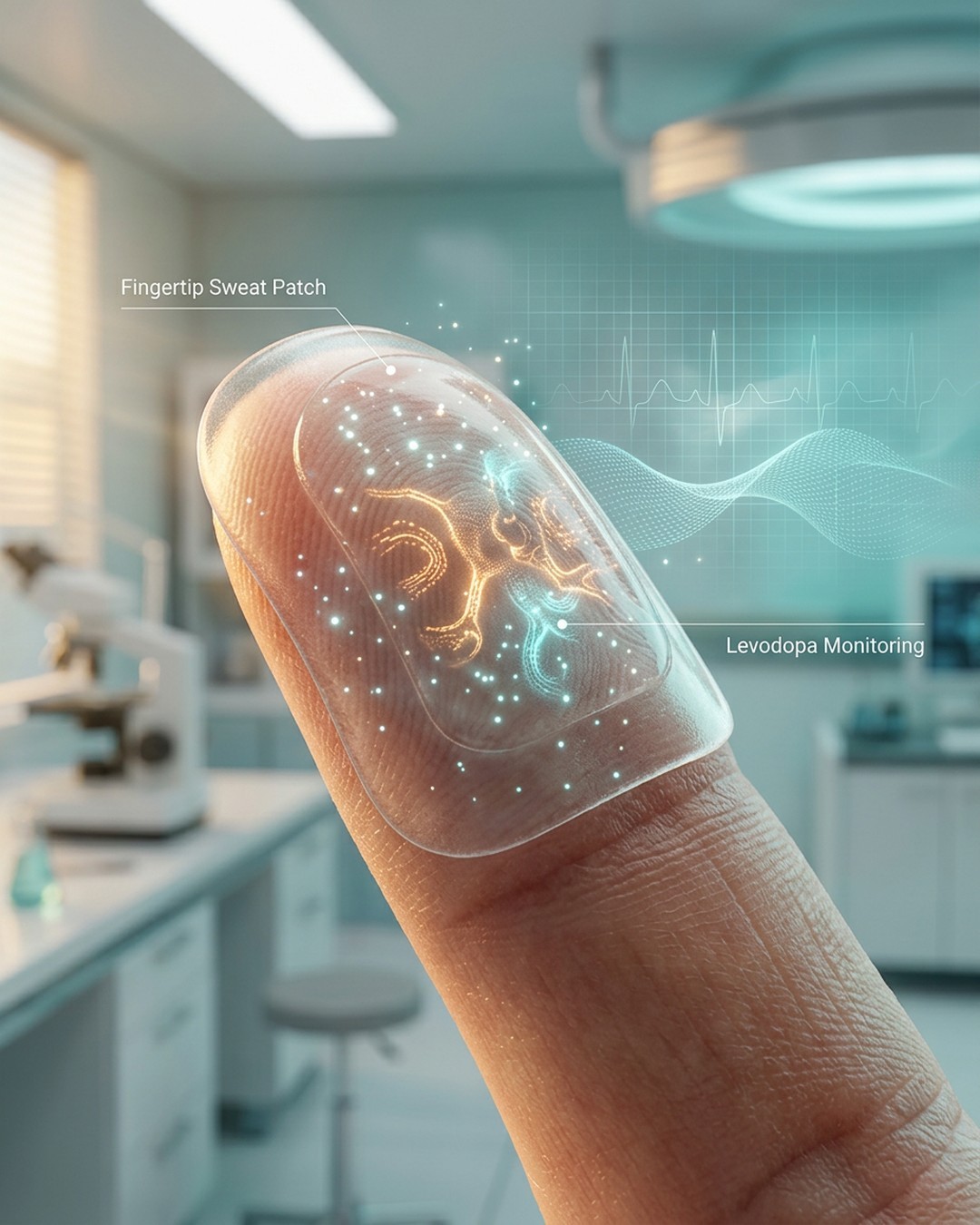
Fingertip Sweat Patch for Parkinson's Levodopa Monitoring

scitechdaily parkinsons-disease wearable-technology biomedical-engineering health-innovation

Resumo

Imagem de Capa do Mapa Mental
Imagem de Capa Gerada por IA

Researchers at the University of California San Diego developed a battery-free, soft fingertip patch that continuously measures levodopa medication levels in sweat for Parkinson's disease patients. Published on August 7, 2026, in the Proceedings of the National Academy of Sciences, the wearable device provides readings comparable to standard laboratory blood tests while allowing patients to monitor treatment at home. The author highlights how the technology addresses the challenge of a shrinking therapeutic window in advanced Parkinson's disease, where medication effects fade abruptly. By replacing subjective patient diaries with real-time continuous sweat analysis, the patch helps prevent dangerous gaps between doses and severe involuntary jerking caused by over-medication. The device operates without an external battery by utilizing an absorbent hydrogel that draws sweat from the fingertips, which contain high concentrations of sweat glands. Embedded enzymes react with levodopa to generate a small voltage that simultaneously powers the device and estimates the drug concentration based on signal strength. Clinical testing demonstrated that Parkinson's patients metabolize and eliminate levodopa significantly faster than healthy individuals, explaining rapid symptom return. Future developments aim to integrate this patch into a closed-loop system communicating with an automatic medication delivery pump.

Pontos-chave

01

🔹 Core Innovation and Purpose

【📌 Breakthrough Device】Engineers and neuroscientists at the University of California San Diego developed a battery-free, soft fingertip patch that tracks levodopa levels using sweat. 【🔸 Clinical Need】Published on August 7, 2026, in the Proceedings of the National Academy of Sciences, the technology aims to solve the problem of unpredictable medication wear-off in Parkinson's disease patients by providing real-time data instead of subjective patient diaries.

02

🔸 Mechanism of Operation and Power Generation

【📌 Sweat-Powered Sensor】The patch is placed on the fingertip due to its high concentration of sweat glands and uses an absorbent hydrogel containing concentrated salts and solvents to draw sweat via osmotic pressure. 【⭐ Self-Powered Reaction】Enzymes embedded in the patch react with levodopa in the sweat to produce a small voltage, which both powers the device and measures medication concentrations without an external battery.

03

⭐ Clinical Trial Results and Findings

【📊 Test Performance】In clinical testing involving healthy volunteers and Parkinson's disease patients, the patch produced levodopa measurements comparable to standard laboratory blood tests. 【⚖️ Metabolic Insight】Readings revealed that participants with Parkinson's remove levodopa from their bodies significantly faster than healthy participants, explaining why symptoms worsen rapidly as drug levels fall.

04

📊 Addressing the Therapeutic Window Challenge

【📌 Shrinking Window】Early in Parkinson's disease, a single levodopa dose remains effective for several hours, but as the disease progresses, the therapeutic window shrinks to approximately two hours. 【⚡ Risk Mitigation】Accurate continuous tracking prevents severe involuntary jerking from over-medication and debilitating immobility from under-medication.

05

💡 Future Applications and Closed-Loop Systems

【📌 Automated Treatment】Researchers envision integrating the fingertip patch into a closed-loop treatment system. 【🔄 Future Outlook】The patch will continuously monitor levodopa levels and communicate directly with a medical pump to automatically deliver appropriate drug doses when the patient's body requires them.

Quer criar seu próprio mapa mental?

Faça login no Neumap AI e comece a criar seus próprios mapas mentais!

Começar