
🔹 Brightest X-Rays on Earth
A nuclear fusion reaction at the National Ignition Facility produced the brightest X-rays ever recorded on Earth, rivalling the brightness of certain red dwarf stars and emitting tens of trillions of watts of power.
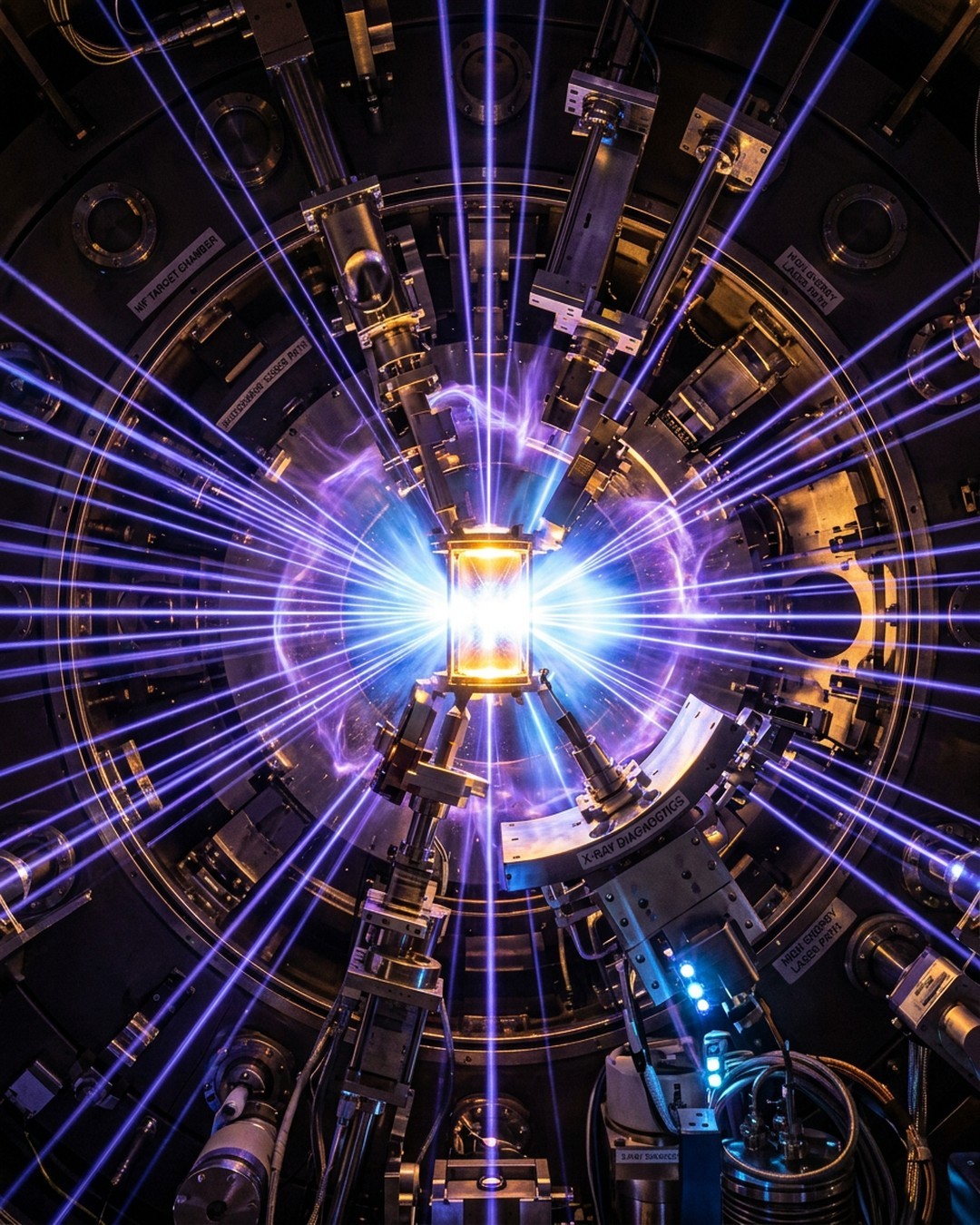
Researchers at the Lawrence Livermore National Laboratory in California have achieved a nuclear fusion reaction that produced the brightest X-rays ever created on Earth, rivalling the brightness of some red dwarf stars and generating temperatures hotter than the sun. The experiment utilized 192 energetic laser beams directed into a gold cylinder the size of a pencil eraser, compressing heavy hydrogen fuel until ignition occurred. The scientific team, including Ryan Lester at Los Alamos National Laboratory, introduced specially designed windows to the tiny cylinder. Once ignition was reached, these windows evaporated, releasing tens of trillions of watts of power and opening new avenues for extreme physics experiments. This breakthrough moves nuclear fusion beyond simple energy generation milestones by providing a direct, physical alternative to computer simulations. It allows scientists to study stellar phenomena empirically, such as measuring how the sun absorbs radiation and evaluating how low-density foams stabilize future fusion reactions. The ability to modify the fusion apparatus successfully and repeat the ignition process represents a significant generational advancement in plasma physics. Researchers anticipate that these extreme X-ray emissions will enable novel material testing and aid in the development of more efficient, sustainable fusion energy sources.
Faça login no Neumap AI e comece a criar seus próprios mapas mentais!
Começar