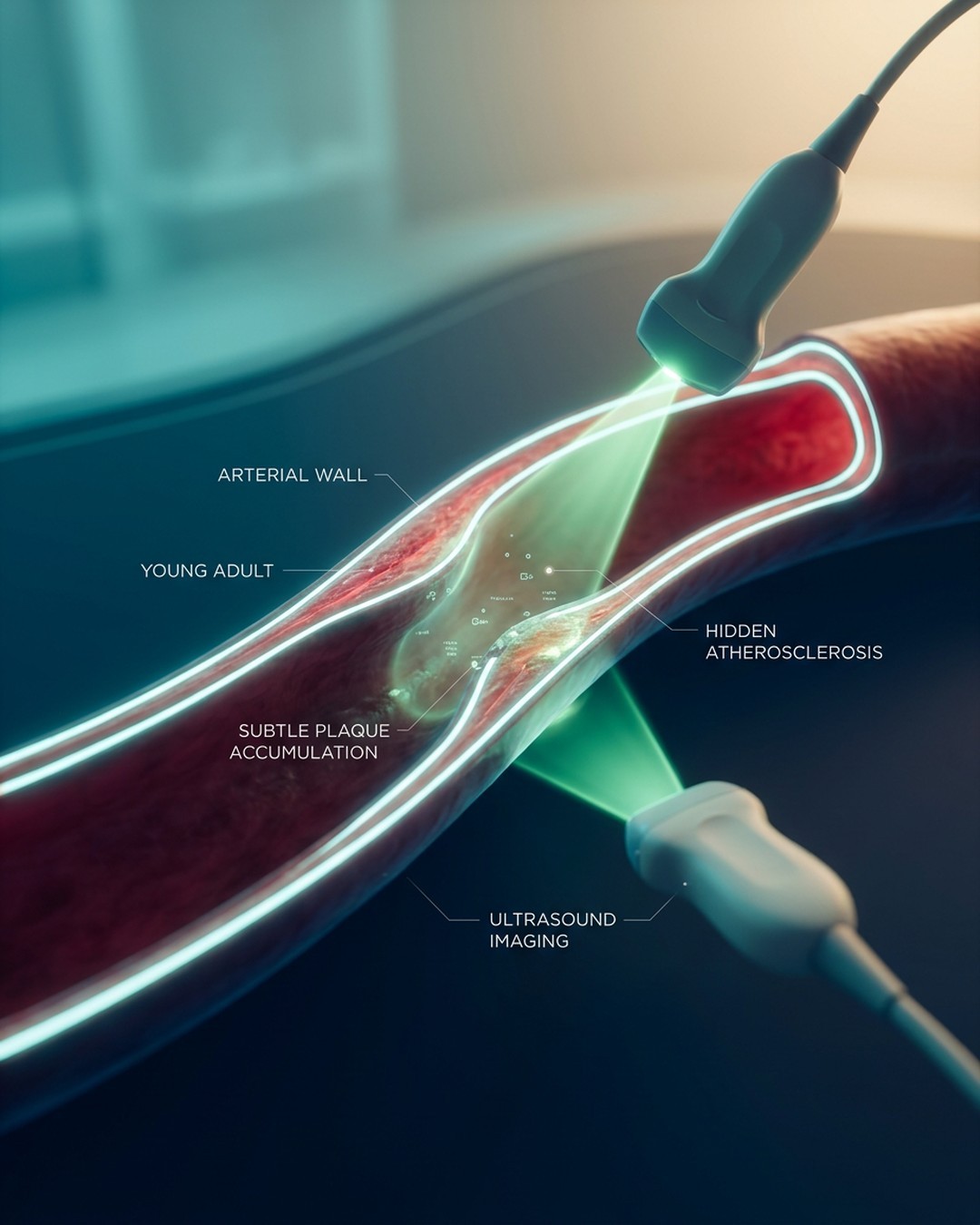
Hidden Artery Plaque in Young Adults

scitechdaily cardiology atherosclerosis medical-research public-health

Resumo

Imagem de Capa do Mapa Mental
Imagem de Capa Gerada por IA

A recent international study published in The New England Journal of Medicine reveals that silent atherosclerosis, characterized by a hidden buildup of fatty deposits in arteries, is remarkably common before age 30, affecting approximately one in 13 young adults. Led by Professor Henning Bundgaard and Dr. Borja Ibanez, the first phase of the REACT project evaluated 16,808 participants aged 18 to 70 across Denmark and Spain using advanced imaging across three major vascular regions. The researchers emphasize a paradigm shift in cardiovascular prevention, moving away from indirect risk estimations based on traditional factors like blood pressure and cholesterol toward direct disease identification via imaging technologies such as portable ultrasound. By detecting arterial plaque in its earliest asymptomatic stages, clinicians hope to intervene sooner, tailor personalized treatments, and substantially reduce the global burden of heart disease. The findings indicate that men experience an atherosclerotic progression approximately five to 10 years ahead of women, while women exhibit a steep increase in plaque accumulation between the ages of 40 and 60, corresponding with the menopausal transition. Furthermore, conventional risk calculators frequently fail to identify individuals who already possess hidden arterial plaque, exposing significant limitations in current preventive care models. Future efforts will focus on validating these results globally and conducting prospective clinical trials, such as the planned REACT-PROTECT study from 2027 to 2032, to determine whether imaging-guided interventions can successfully halt disease progression and prevent clinical events like heart attacks and strokes.

Pontos-chave

01

🔹 Prevalence of Early Silent Atherosclerosis

【📌 Key Finding】Advanced imaging detected silent atherosclerosis in 1 in 13 adults under the age of 30, and in 57.1 percent of all participants with no known cardiovascular disease. 【🔸 Impact Factors】The international study evaluated 16,808 adults aged 18 to 70 across Denmark and Spain without prior history of atherosclerotic cardiovascular disease. 【⭐ Data Support】Published in The New England Journal of Medicine, this research forms the first phase of the REACT initiative funded by a EUR 23 million grant from the Novo Nordisk Foundation.

02

🔸 Paradigm Shift in Cardiovascular Prevention

【📌 Key Finding】Researchers advocate shifting from traditional risk estimation models to direct disease detection via medical imaging. 【🔸 Impact Factors】Conventional scores utilizing age, blood pressure, cholesterol, and smoking habits frequently miss hidden plaque formation. 【⭐ Data Support】Direct identification through imaging allows healthcare professionals to guide preventive interventions based on the actual presence of silent atherosclerosis.

03

⭐ Sex-Based Differences in Disease Progression

【📌 Key Finding】Atherosclerosis develops approximately five to 10 years earlier in men compared to women across the studied age range. 【🔸 Impact Factors】Women experience their steepest rise in plaque accumulation between ages 40 and 60, coinciding with the menopausal transition. 【⭐ Data Support】Adapting assessment timing and prevention strategies to sex-specific life stages could significantly improve therapeutic effectiveness.

04

📊 Technological Approach and Future Trials

【📌 Key Finding】Portable ultrasound devices offer a noninvasive, practical screening method for carotid and femoral arteries outside of hospital settings. 【🔸 Impact Factors】The upcoming REACT-PROTECT trial scheduled for 2027 to 2032 aims to test whether imaging-guided interventions can prevent cardiovascular events. 【⭐ Data Support】Global collaborations have been established with researchers in India, Singapore, Tanzania, and Mexico to validate these findings across diverse populations.

05

💡 Continuation of Landmark PESA Research

【📌 Key Finding】The REACT project builds directly upon the PESA-CNIC-Santander study led by Dr. Valentin Fuster. 【🔸 Impact Factors】While PESA demonstrated that atherosclerosis is common in middle-aged populations and tied to lifestyle patterns, REACT investigates its emergence in younger cohorts. 【⭐ Data Support】Early identification and treatment may not only halt disease progression but potentially make it possible to cure atherosclerosis entirely.

Quer criar seu próprio mapa mental?

Faça login no Neumap AI e comece a criar seus próprios mapas mentais!

Começar