JWST Discovers Non-Round Exoplanet WASP-17b Atmosphere

scitechdaily astrophysics james-webb-space-telescope exoplanet university-of-bristol

Resumo

Imagem de Capa do Mapa Mental
Imagem de Capa Gerada por IA

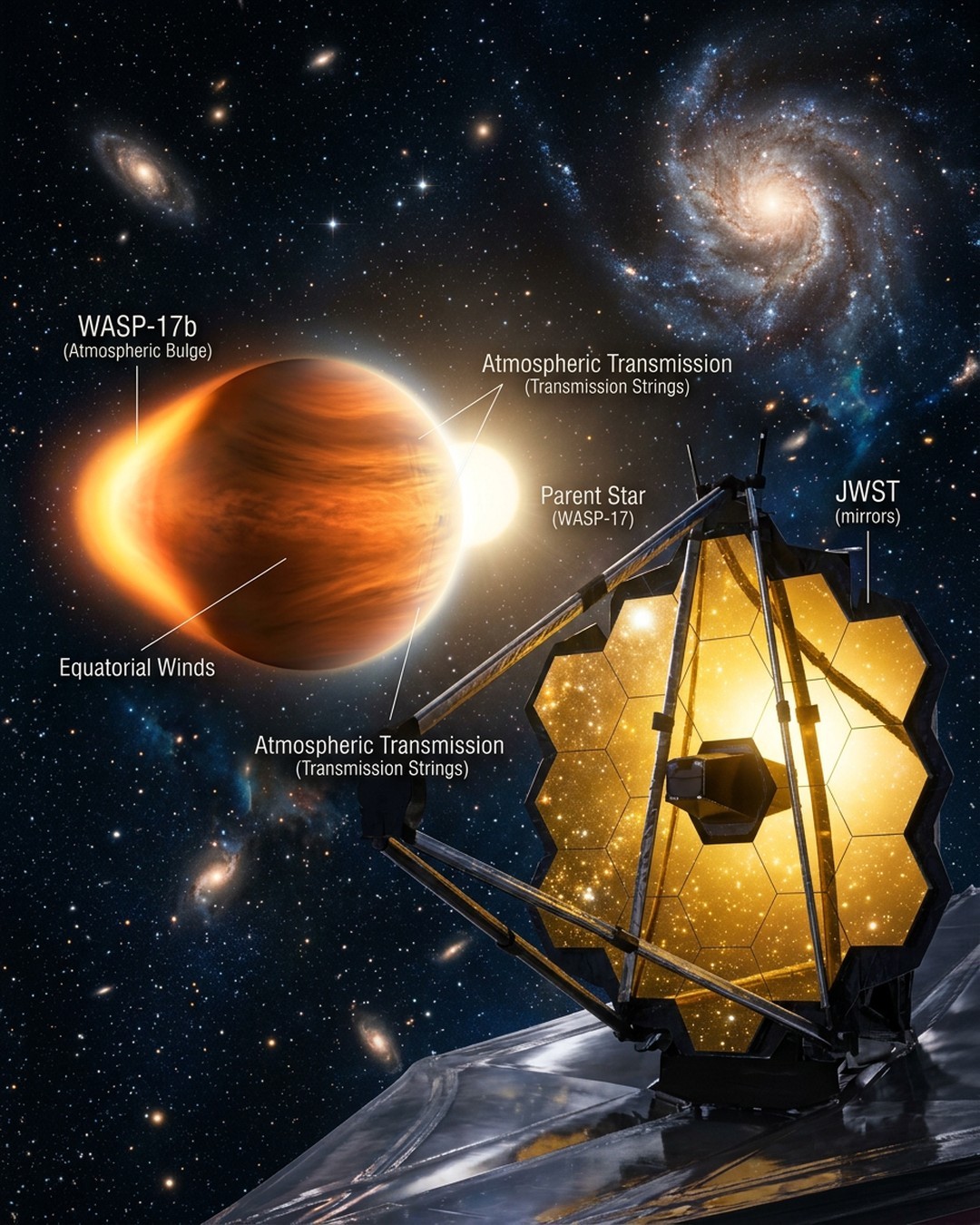
NASA's James Webb Space Telescope (JWST) has successfully mapped the uneven, non-round atmospheric shape of the hot Jupiter exoplanet WASP-17b, located approximately 1,300 light-years from Earth. Published on October 19, 2026, in Nature Astronomy, the study was co-led by researchers from Cornell University and the University of Bristol. The team utilized a novel observational method called transmission strings, or transit mapping, to analyze light passing through different parts of the planet's atmospheric limb during transit. The author highlights how this breakthrough moves astronomical research beyond traditional single-spectrum averaging to capture a multidimensional, three-dimensional view of exoplanet atmospheres. The findings reveal that powerful equatorial winds transfer heat from the permanent dayside to the nightside, causing the evening side to inflate with hot gas while the cooler morning side contracts. The strategic significance of this research lies in establishing a reliable empirical benchmark for analyzing the atmospheres of more than 6,000 confirmed exoplanets. By demonstrating that theoretical predictions of 3D atmospheric dynamics can be directly observed, the technique opens new avenues for mapping weather patterns and regional climates across distant alien worlds. Practical application of these findings includes deploying transmission strings on a broader range of exoplanets to study latitudinal temperature variations and chemical compositions. Researchers and space agencies can leverage this proven methodology to transition from basic planetary detection to detailed meteorological mapping of alien climates.

Pontos-chave

01

🔹 JWST Reveals Non-Round Exoplanet Shape

【📌 Key Finding】NASA's James Webb Space Telescope revealed that the hot Jupiter exoplanet WASP-17b possesses an uneven, non-spherical atmosphere extending further on one side. 【🔸 Impact Factors】Powerful equatorial winds transport thermal energy from the permanent dayside to the nightside, causing hot gas on the evening side to expand while cooler gas on the morning side contracts. 【⭐ Data Support】The research, published on October 19, 2026, in Nature Astronomy, studied WASP-17b situated roughly 1,300 light-years from Earth.

02

🔸 Transmission Strings Methodology

【📌 Key Finding】Astrophysicists Dr. David Grant and Dr. Hannah Wakeford from the University of Bristol developed transmission strings, also known as transit mapping, to analyze starlight filtering through specific regions of an exoplanet's atmospheric limb. 【🔸 Impact Factors】Traditional eclipse mapping or single averaged limb spectra fail to capture spatial variations, whereas this robust mathematical model tracks light changes across different distances from the planet center to edge. 【⭐ Data Support】Lead author Dr. Lili Alderson, a Klarman Postdoctoral Fellow at Cornell University, applied this technique to resolve distinct atmospheric regions for the first time.

03

⭐ Thermal Dynamics and Evening Bulge

【📌 Key Finding】Observations confirmed that the atmospheric bulge on WASP-17b is located precisely on the evening side of the equator. 【🔸 Impact Factors】Jets of wind drive heat from the permanently illuminated day side toward the shadowed night side, inflating the evening boundary relative to the cooler morning side. 【⭐ Data Support】These empirical results align bang-on with theoretical predictions regarding sharp temperature disparities between morning and evening stellar terminators.

04

📊 Three-Dimensional Exoplanet Mapping Benchmark

【📌 Key Finding】The study provides one of the most comprehensive three-dimensional views of an exoplanet atmosphere to date, serving as a vital conceptual benchmark. 【🔸 Impact Factors】This proof of concept moves exoplanet science beyond computational modeling to real-world confirmation that planets function as complex 3D objects. 【⭐ Data Support】The method establishes a foundational framework for comparing data against more than 6,000 confirmed exoplanets.

05

💡 Future Meteorological Exploration of Alien Climates

【📌 Key Finding】The successful demonstration on WASP-17b paves the way for applying transmission strings across numerous other alien worlds. 【🔸 Impact Factors】The technique is beginning to resolve conditions across diverse latitudes, extending atmospheric mapping beyond basic day-night contrasts. 【⭐ Data Support】This marks the critical first step toward mapping actual weather-scale patterns in exoplanet climates, supported by NASA grant 80NSSC20K0586 and JWST program GTO-1353.

Quer criar seu próprio mapa mental?

Faça login no Neumap AI e comece a criar seus próprios mapas mentais!

Começar